Arts In LA
Theater Reviews
Summer: The Donna Summer Musical
Pantages Theatre
Reviewed by Melinda Schupmann
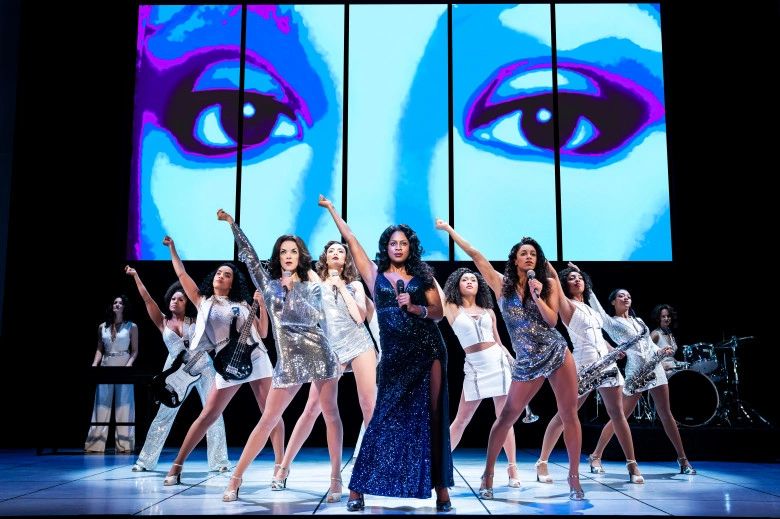
Dan’Yelle Williamson and the ensemble
Termed a “jukebox musical” by most critics when it debuted at La Jolla Playhouse in 2017 and on Broadway in 2018, Summer: The Donna Summer Musical was roundly panned by most reviewers. It played a total of 289 performances on Broadway before closing. Nonetheless, it set out immediately on a national tour in 2019 with a new cast but helmed by the original creative team. The disappointment is that despite comments by critics, the team didn’t attempt to address its weaknesses, counting on love for Summer to carry the show.
Directed by Des McAnuff with tepid results, it purports to shine a light, however superficial, on Donna Summer’s life and career and deliver 20 or so musical numbers. The problem is all the spotlights dazzling the audience (more than 20) can’t detract from the scattershot life story attempted by three authors: Colman Domingo, Robert Cary, and McAnuff.
Its conceit is to show three stages of Summer’s life: Diva Donna played by Dan’Yelle Williamson, Disco Donna by Alex Hairston, and Duckling Donna by Olivia Elease Hardy. Diva Donna is the narrator with some expository add-ins, and she offers the audience the chance to stand, sing, or join in. As the show progresses, the three are seen separately in various vignettes, but they also often perform onstage side by side as musical numbers are featured. They are strong performers, though Williamson probably gets the edge, as she dominates with her powerful stage presence.
Male influences like plural husbands, record executives, and her agent are cartoonish rather than meaningful. Locations jump from Munich to New York, to Boston’s Grant A.M.E. Church, to the West Coast, and so on. At each spot, a tantalizing glimpse of pivotal moments in Summer’s life are highlighted but not explored in any meaningful way in favor of showcasing the singers and creating a loose narrative with the songs. Summers had abusive relationships, turned a child over to her parents to raise, fought the music industry, developed cancer, and died prematurely at 63, but the message seems to be that she was the Disco Queen, and that is how she should be remembered.
Pantages Theatre
Reviewed by Melinda Schupmann

Photo by Matthew Murphy
Termed a “jukebox musical” by most critics when it debuted at La Jolla Playhouse in 2017 and on Broadway in 2018, Summer: The Donna Summer Musical was roundly panned by most reviewers. It played a total of 289 performances on Broadway before closing. Nonetheless, it set out immediately on a national tour in 2019 with a new cast but helmed by the original creative team. The disappointment is that despite comments by critics, the team didn’t attempt to address its weaknesses, counting on love for Summer to carry the show.
Directed by Des McAnuff with tepid results, it purports to shine a light, however superficial, on Donna Summer’s life and career and deliver 20 or so musical numbers. The problem is all the spotlights dazzling the audience (more than 20) can’t detract from the scattershot life story attempted by three authors: Colman Domingo, Robert Cary, and McAnuff.
Its conceit is to show three stages of Summer’s life: Diva Donna played by Dan’Yelle Williamson, Disco Donna by Alex Hairston, and Duckling Donna by Olivia Elease Hardy. Diva Donna is the narrator with some expository add-ins, and she offers the audience the chance to stand, sing, or join in. As the show progresses, the three are seen separately in various vignettes, but they also often perform onstage side by side as musical numbers are featured. They are strong performers, though Williamson probably gets the edge, as she dominates with her powerful stage presence.
Male influences like plural husbands, record executives, and her agent are cartoonish rather than meaningful. Locations jump from Munich to New York, to Boston’s Grant A.M.E. Church, to the West Coast, and so on. At each spot, a tantalizing glimpse of pivotal moments in Summer’s life are highlighted but not explored in any meaningful way in favor of showcasing the singers and creating a loose narrative with the songs. Summers had abusive relationships, turned a child over to her parents to raise, fought the music industry, developed cancer, and died prematurely at 63, but the message seems to be that she was the Disco Queen, and that is how she should be remembered.
After a spirited opener, “The Queen Is Back,” the evolution of Summer’s music is rolled out. From “Love to Love You Baby,” “On the Radio,” and a particularly poignant “MacArthur Park,” the case is made for her perseverance and drive in the music business. “Last Dance” rounds out the performance, and it is what the audience is waiting for. Enhancing the show is the band, led by conductor-keyboardist Amanda Morton, with associate conductor-keyboardist Lisa LeMay, keyboardist Makeena Lee Brick, guitarist Larry Esparza, and drummer Jesse-Ray Leich. Also attempting to dazzle is the ensemble: Jennifer Byrne, Jay Garcia, Tamrin Goldberg, Cameron Anika Hill, Brooke Lacy, Trish Lindstrom, Dequina Moore, Kyli Rae, Crystal Sha’Nae, De’ja Simone, Sir Brock Warren, Candace J. Washington, and Brittany Nicole Williams.
They execute the numbers with enthusiasm, but Sergio Trujillo’s choreography looks inserted rather than integrated. So that women could be front and center, many numbers are strangely androgynous where men might have been cast. It is not effective.
Overall, this tour will likely be successful, as Summer is beloved and represents a period in music that breeds nostalgia. It provides no insights, though, and you leave with regret at the missed opportunities for capturing the heart and soul of a woman who made an impact on the industry.
November 13, 2019
Nov 5–24. 6233 Hollywood Blvd. Tue-Fri 8pm, Sat 2pm & 8pm, Sun 1pm & 6:30pm. $39–$149, “prices may fluctuate.” (800) 982-2787.
Neil Simon’s Musical Fools
Open Fist Theatre Company at Atwater Village Theatre
Reviewed by Harker Jones
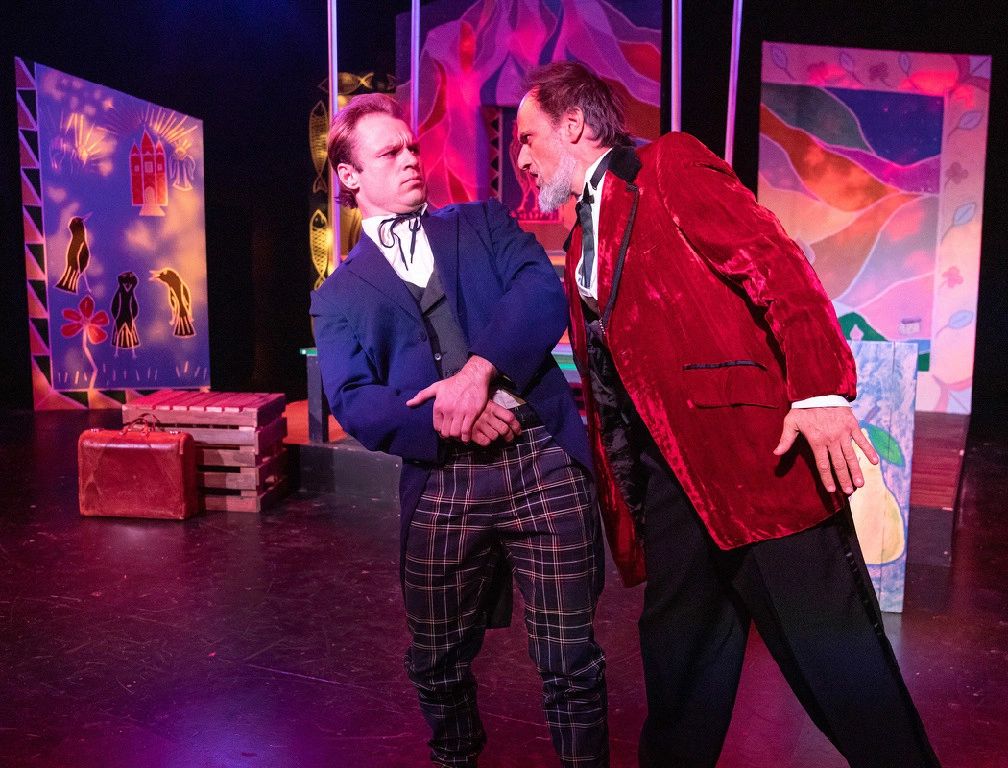
James Byous and Jason Paige
Neil Simon was a legendary playwright and screenwriter. He won a Pulitzer Prize for Lost in Yonkers, the Mark Twain Prize for American Humor, three Tonys (for The Odd Couple, Biloxi Blues, and Lost in Yonkers, in addition to a special Tony for his contribution to theater), and a Golden Globe for The Goodbye Girl. He was nominated for four Oscars (California Suite, The Goodbye Girl, The Sunshine Boys, and The Odd Couple) and for four Emmys, and was a Kennedy Center honoree. His plays were turned into hit films and television series, cementing his place in popular culture. He was a towering figure in entertainment.
Then, in 1981, there was Fools. Apparently written in the midst of a nasty divorce in which his estranged wife would receive the profits from his next show, Simon churned out a project he was sure would be a disaster. And quite a disaster he conceived. It lasted only 40 performances, even with EGOT winner Mike Nichols at the helm.
The curse can be lifted if the doctor’s daughter, Sophia (Clare Snodgrass), simply accepted the marriage proposal of the villainous, crooning Count Gregor (Ben Goldberg), who lives in the castle on the hill. Complicating matters, Leon has fallen for Sophia. Insanity ensues.
The sets, by Jan Monroe, are colorful, with murals depicting the pastoral life of the village. The four-person band — bassist, keyboardist, drummer, clarinetist/saxophonist — are game, but the score never really pops. It’s not bad, it’s just forgettable.
Perhaps if West had elevated the story from its ignominious foundation, it would play better. Then again, Simon created this specifically to fail, so perhaps there really isn’t a better story buried in its misguided sitcom’s roots.
Open Fist Theatre Company at Atwater Village Theatre
Reviewed by Harker Jones

Photo by Darrett Sanders
Neil Simon was a legendary playwright and screenwriter. He won a Pulitzer Prize for Lost in Yonkers, the Mark Twain Prize for American Humor, three Tonys (for The Odd Couple, Biloxi Blues, and Lost in Yonkers, in addition to a special Tony for his contribution to theater), and a Golden Globe for The Goodbye Girl. He was nominated for four Oscars (California Suite, The Goodbye Girl, The Sunshine Boys, and The Odd Couple) and for four Emmys, and was a Kennedy Center honoree. His plays were turned into hit films and television series, cementing his place in popular culture. He was a towering figure in entertainment.
Then, in 1981, there was Fools. Apparently written in the midst of a nasty divorce in which his estranged wife would receive the profits from his next show, Simon churned out a project he was sure would be a disaster. And quite a disaster he conceived. It lasted only 40 performances, even with EGOT winner Mike Nichols at the helm.
Oddly, the show was adapted into a musical — seemingly three times, including this production with music and lyrics by Phil Swann and Ron West, who directs, for Open Fist Theatre Company. The story follows Leon (James Byous), a young tutor, as he travels from Moscow to Ukraine in 1893 to teach in a rural village. When he gets there he finds that all of the town’s citizens live under a curse that has made them stupid. Like stupid stupid. Imagine a village where Jim Carrey and Jeff Daniels rule the roost in their Dumb and Dumber personas. The postman can’t find the right houses, the shepherd loses his sheep, and people can’t remember their own names. These people are practically drooling.
Sadly, the one-note joke is repeated ad nauseam, to diminishing returns from what is a paltry setup in the first place.The curse can be lifted if the doctor’s daughter, Sophia (Clare Snodgrass), simply accepted the marriage proposal of the villainous, crooning Count Gregor (Ben Goldberg), who lives in the castle on the hill. Complicating matters, Leon has fallen for Sophia. Insanity ensues.
The actors give it their all, but the energy just isn’t there. And while most of them are capable of singing (like most of us are), they don’t appear to be accomplished vocalists (considering they’re in a musical and so much of this story is told through song), and they don’t project enough to make up for any weakness in vocal ability. Snodgrass has a fantastic voice, but she doesn’t have the presence to be the central love interest around which almost the entire story revolves. Cat Davis (as a street vendor) brings some loopy humor to the stage, and Derek Manson and Robyn Roth as Sophia’s parents are solid comic actors.
While parallels can be drawn to the current political climate and people so simple they tenaciously guard their right to vote against their interests, the script is just so sophomoric (and that’s being generous) that it never takes off. Even Leon, our straight man, can’t help when his entire romance with Sophia is predicated solely on her beauty. He tells us explicitly and repeatedly, he only “loves” her because of her looks. It’s difficult to root for a romance based on something so shallow.The sets, by Jan Monroe, are colorful, with murals depicting the pastoral life of the village. The four-person band — bassist, keyboardist, drummer, clarinetist/saxophonist — are game, but the score never really pops. It’s not bad, it’s just forgettable.
Perhaps if West had elevated the story from its ignominious foundation, it would play better. Then again, Simon created this specifically to fail, so perhaps there really isn’t a better story buried in its misguided sitcom’s roots.
October 24, 2019
Oct 12–Dec 1. 3269 Casitas Ave. Sat 8pm, Sun 4pm, Mon 8pm. Running time 2 hours, plus intermission. $25–$35. (323) 882-6912.
Latin History for Morons
Ahmanson Theatre
Reviewed by Harker Jones

John Leguizamo
Matthew Murphy
John Leguizamo has been successful in film (the John Wick series, Romeo + Juliet, Moulin Rouge!), on television (ER, Bloodline), and on stage (Freak, which won him a Drama Desk Award; Pimps, Hos, Playa Hatas, and All the Rest of My Hollywood Friends: My Life, based on his memoir of the same name, which won him both Outer Critics Circle and Drama Desk awards).
But now the Emmy- and ALMA-nominated performer is angry and wants to teach us something in what is likely the most entertaining class you’ll ever attend. The whitewashing of Latin history is well-known, but what’s less-known is what exactly was erased, and Leguizamo is intent on filling in those blanks and setting straight the misconceptions and revealing the outright lies.
With the framing story of his eighth-grade son being bullied at his tony prep school in Manhattan and also seeking a true Latin historical hero for an assignment, Leguizamo introduces us (and his son) to 3,000 years of Latin history (from the Mayans 1,000 years ago until now), in a straightforward classroom setting with a blackboard (which he utilizes liberally) and various props (his simple transformation into Andrew Jackson is both clever and hysterical). He inhabits countless characters, driving home trenchant and sometimes sobering truths all told with pointed humor and oftentimes dance breaks.
He’s an electrifying performer who can hold an audience in thrall, eliciting loud and sometimes vociferous reactions, including cheers, laughter, and the occasional “Preach!” His characters are all distinct, and he paints them all—even the villains, such as Christopher Columbus, whom he calls a “genocidal, pedophilic rapist” and “the Donald Trump of the New World”—in broad, colorful strokes.
The only sour note is when he portrays Montezuma as a mincing, lisping pansy when Cortés is invading. Whether Montezuma was homosexual or not is irrelevant. Why play him as such an outdated stereotype? Leguizamo claims it’s okay because his brother is gay. It’s not.
Written by the Colombian–Puerto Rican star and directed by Tony Taccone, the show (nominated for the Tony for Best Play in 2018) is engaging and entertaining, not to mention educational without being preachy. At an hour and 50 minutes, it’s a bit long for a one-man show, but it breezes by fairly quickly. Leguizamo has energy that never flags.
While poking fun at Latin stereotypes and concurrently celebrating its history (almost none of which is taught in US schools), he is smart, raunchy, outrageous, and, in the end, enlightening. While there is a 90-minute iteration streaming on Netflix, that won’t give you the same electrifying feeling of being in his presence, reacting with a live audience. This is theater, best experienced in the flesh.
September 19, 2019
Sept 5–Oct 20. 135 N Grand Ave, downtown LA. See website for show dates and times. Running time 110 minutes, no intermission. $35–$145. 213-972-4400.
Into the Woods
Hollywood Bowl
Reviewed by Jonas Schwartz

Gaten Matarazzo as Jack (and Milky-White as Milky-White)
Dreams can come true. The Hollywood Bowl, under the auspices of Broadway director Robert Longbottom, has collected remarkable talent to present the classic Into the Woods. The actors invest in their roles and treat this vast arena as an intimate space, providing almost 16,000 audience members a giant thrill.
The three popular fairy tales of Jack (Gaten Matarazzo) and the Beanstalk, Cinderella (Sierra Boggess), and Little Red Riding Hood (Shanice Williams) intertwine with an original tale of a Baker (Skylar Astin) and his barren Wife (Sutton Foster), frantic to break the spell of a hideous witch (Patina Miller). The Witch demands four ingredients for a potion (hair as yellow as corn, a slipper as pure as gold, a cape as red as blood, and a cow as white as milk) in order for the Baker’s Wife to have a child. In their quest, the Baker and the Baker’s Wife muddle up everyone else’s story as they wander into the woods. Because it’s a fairy tale, all the good people live happily ever after—at least until Act 2.
The collaboration of James Lapine (book) and Stephen Sondheim (score) reflects a complex world hidden behind simplistic fairy tales. Musical motifs and familiar stories comfort the audience in Act 1 only for Act 2 to lose its sheen and become darker and more Jungian. While Sondheim’s songs in Act 1 capture a childlike innocence, Act 2 features adult themes about parenthood, community, and responsibility. With his witticisms, rhyme schemes, and wisdom, Sondheim’s words are morsels to be savored.
Hollywood Bowl
Reviewed by Jonas Schwartz

Craig T. Mathew and Greg Grudt/Mathew Imaging
Dreams can come true. The Hollywood Bowl, under the auspices of Broadway director Robert Longbottom, has collected remarkable talent to present the classic Into the Woods. The actors invest in their roles and treat this vast arena as an intimate space, providing almost 16,000 audience members a giant thrill.
The three popular fairy tales of Jack (Gaten Matarazzo) and the Beanstalk, Cinderella (Sierra Boggess), and Little Red Riding Hood (Shanice Williams) intertwine with an original tale of a Baker (Skylar Astin) and his barren Wife (Sutton Foster), frantic to break the spell of a hideous witch (Patina Miller). The Witch demands four ingredients for a potion (hair as yellow as corn, a slipper as pure as gold, a cape as red as blood, and a cow as white as milk) in order for the Baker’s Wife to have a child. In their quest, the Baker and the Baker’s Wife muddle up everyone else’s story as they wander into the woods. Because it’s a fairy tale, all the good people live happily ever after—at least until Act 2.
The collaboration of James Lapine (book) and Stephen Sondheim (score) reflects a complex world hidden behind simplistic fairy tales. Musical motifs and familiar stories comfort the audience in Act 1 only for Act 2 to lose its sheen and become darker and more Jungian. While Sondheim’s songs in Act 1 capture a childlike innocence, Act 2 features adult themes about parenthood, community, and responsibility. With his witticisms, rhyme schemes, and wisdom, Sondheim’s words are morsels to be savored.
The cast is impeccable. As the Witch, Miller is wickedly funny and sings her heart out in “Last Midnight” and “Children Will Listen.” Foster captures the Baker’s Wife’s defiance, her nurturing as well as her wayward nature. Astin evolves from an indecisive and tyrannical husband into a caregiver. His rendition of “No More” is affecting. Matarazzo and Williams are hilarious as the two delinquent youths. Boggess is luminous as the future princess Cinderella, being coy in “On the Steps of the Palace” and fostering in “No One Is Alone.” As two egocentric princes, Chris Carmack and Cheyenne Jackson are a perfect pair.
Director Longbottom uses projections to expand the forest and give the illusion of terror when the Giant strikes. Shadows of the beanstalk and Rapunzel’s tower are effective. The costumes, by Ann Hould-Ward, are elegant, particularly the Witch’s purple couture and the wolf’s furry Chippendale-dancer body suit. The orchestra sounded lush and included interesting instruments, notably a harpsicord.
The shadow of the Giant (voiced by Whoopi Goldberg) is less effective. Inconsistencies in the video images made the character stilted, and there was a lack of menace. Technical issues also caused minor consternation. The sound was out of sync with visuals, particularly when Cinderella’s mother was projected onto the moon. Her faulty synchronization called to mind the dueling cavaliers comedy sequence in the movie Singin’ in the Rain.
The Hollywood Bowl has been putting on Broadway night for many years, and though Into the Woods features one of the smallest-size casts, this show feels more epic and consistently professional. For those who consider the Sondheim musical beloved or for those who new to the show, this experience will be magical.
July 27, 2019
Falsettos
Ahmanson Theatre
Reviewed by Jonas Schwartz
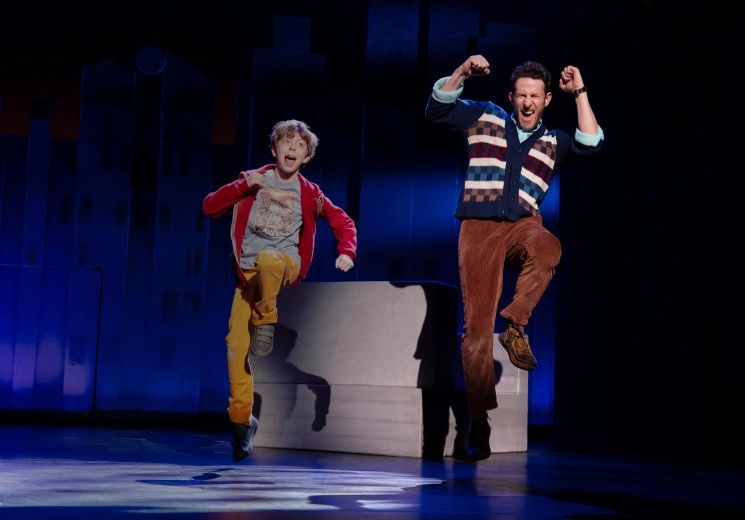
Thatcher Jacobs and Nick Blaemire
Falsettos is a master class in acting modulation. The characters are self-involved, sometimes violent, energy vampires. An actor must be true to author William Finn’s vision of Marvin and his clan, revealing warts and all, but compel the audience to accept and forgive those who need eons of therapy. A wise actor can create a Marvin who is vicious and complicated and snippy but loving and nurturing and lost. But can even the most nuanced actor, which Max Von Essen clearly is, make audiences forgive such a toxic male in these hopefully more enlightened ages?
The musical spans two years in a tumultuous time in America, when the free-loving, wild-drinking, drugging and love-making 1970s crashed into that hangover that was the Reagan-ified, yuppy greed-feeding 1980s. In 1979, Marvin (Von Essen) has just abandoned his neurotic wife Trina (Eden Espinosa) and adolescent son Jason (Thatcher Jacobs at the opening performance) for a hunky young man, Whizzer (Nick Adams). Trina turns to Marvin’s psychiatrist, Mendel (Nick Blaemire), for support and they fall in love. Despite being the catalyst for the divorce, Marvin becomes enraged when he discovers his wife and psychiatrist engaged.
In 1981, this new form of family attempts to coexist. Mendel and Trina have married, and though he ruined his relationship with Whizzer two years past (or an act ago), Marvin wins back his lover. The characters rebuild their lives while suffering with the stresses of planning an elaborate Bar Mitzvah for Jason, something that can cause consternation between even the happiest of couples.
Ahmanson Theatre
Reviewed by Jonas Schwartz

Photo by Joan Marcus
Falsettos is a master class in acting modulation. The characters are self-involved, sometimes violent, energy vampires. An actor must be true to author William Finn’s vision of Marvin and his clan, revealing warts and all, but compel the audience to accept and forgive those who need eons of therapy. A wise actor can create a Marvin who is vicious and complicated and snippy but loving and nurturing and lost. But can even the most nuanced actor, which Max Von Essen clearly is, make audiences forgive such a toxic male in these hopefully more enlightened ages?
The musical spans two years in a tumultuous time in America, when the free-loving, wild-drinking, drugging and love-making 1970s crashed into that hangover that was the Reagan-ified, yuppy greed-feeding 1980s. In 1979, Marvin (Von Essen) has just abandoned his neurotic wife Trina (Eden Espinosa) and adolescent son Jason (Thatcher Jacobs at the opening performance) for a hunky young man, Whizzer (Nick Adams). Trina turns to Marvin’s psychiatrist, Mendel (Nick Blaemire), for support and they fall in love. Despite being the catalyst for the divorce, Marvin becomes enraged when he discovers his wife and psychiatrist engaged.
In 1981, this new form of family attempts to coexist. Mendel and Trina have married, and though he ruined his relationship with Whizzer two years past (or an act ago), Marvin wins back his lover. The characters rebuild their lives while suffering with the stresses of planning an elaborate Bar Mitzvah for Jason, something that can cause consternation between even the happiest of couples.
Falsettos, a collaboration between Finn and James Lapine, began Off-Broadway as three separate programs, In Trousers (1979), March of the Falsettos (1981) and Falsettoland (1990), which were edited into Falsettos for a Broadway run in 1992, winning Tonys for Lapine and Finn’s book and Finn’s score. The musical still feels ahead of its time, even though portions of the play were written almost 40 years ago. Nakedly honest about evolving families in the late 20th-century, Falsettos can be brutally honest about its characters, none more than Marvin, who spoils everything he touches but still manages to be forgiven.
The book is a collection of song-stories woven together. Finn is one of the last of the great lyricists from the 20th-century. He conveys raw emotion in his tender songs, such as “What Would I Do,” and tongue-twisting hilarity with “I’m Breaking Down” and “A Day in Falsettoland.” The musical is distinctly gay and distinctly Jewish, as the opening number “Four Jews in a Room Bitching” and the second-act “The Baseball Game” can attest, yet, like Fiddler on the Roof, immensely universal. Finn gives Marvin his humanity through his songs. “Father to Son” and “What More Can I Say?” show a man who’s damaged but self-aware.
In the wrong hands, Marvin can be ugly, but Von Essen, while still exposing Marvin’s many faults, still exudes tenderness. Espinosa, known for her strong belt as Idina Menzel’s replacement in Rent and Wicked, is not given many opportunities to reach the ceiling with Trina’s songs, so she instead spotlights her apt comedic timing. She turns “I’m Breaking Down” into a psychotic showstopper.
Jacobs, as the confused child, displays professionalism and takes control of the evening so that Jason emerges as the central character, growing while being bounced around by crazy parents. Blaemire is hilarious as the anxious psychiatrist who has spent most of his younger life married to work, only to become an instant husband and father figure. Both Bryonha Marie Parham and Audrey Cardwell are warm as the lesbians next door.
The play’s sore spot is the performance by Nick Adams. Whizzer needs to be lovable. A woman whose marriage he helped destroy and a boy who has watched his family collapse because of this man still love Whizzer and welcome him into their extended family, despite their wish to hate him. Adams’s characterization is cold. He primps like a peacock and displays no humor nor naiveté nor vulnerability. Whizzer feels vacuous here, which it throws the production off, since everyone’s relationship to Whizzer fuels the second act.Jennifer Caprio’s costumes fit the era and demonstrate the different personalities of the characters. David Rockwell’s set, a Tetris-like stack of shapes that turn into beds, tables, and toppling doorways, is clever and functional.
A beloved musical but one that still centers on a problematic protagonist, Falsettos carries more baggage than it even did when the revival opened in ’16. After #metoo and the exposed practices of the poisonous male culture, it’s still unclear if audiences should forgive a man so unrestrained, he smacks his wife. With that question looming, this production features a wonderful score and solid performances.
April 19, 2019
April 16–May 19. 135 N Grand Ave, LA. Tue-Fri 8pm, Sat 2 & 8pm, Sun 1 & 6:30pm (added perf. 2pm May 16). Running time 2 hours and 50 minutes, including intermission. $30–$135. 213-972-4400.
Bus Stop
AmerIcon Monroe, in conjunction with Robo & Bash Productions and Cryptic Entertainment at Avery Schreiber Playhouse
Reviewed by Harker Jones
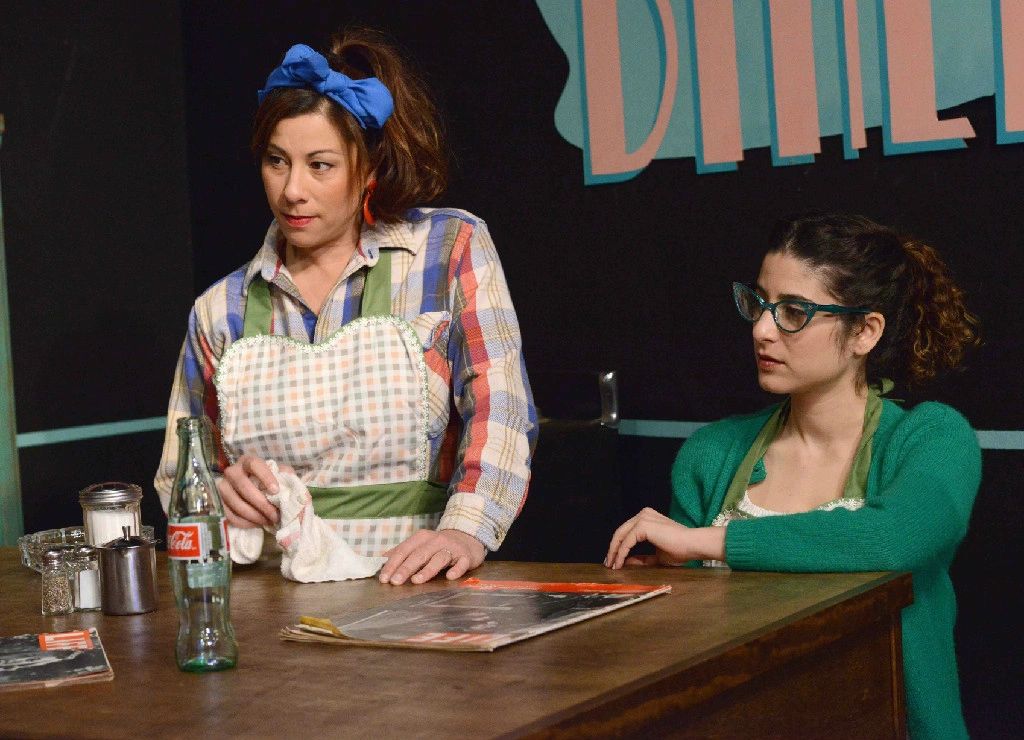
Katy Jacoby and Shelly Snellman
Pulitzer Prize winner William Inge (Picnic; Come Back, Little Sheba) specialized in writing earthy characters in the Midwest, and 1955’s Bus Stop is no exception. While not as acclaimed as the two aforementioned scripts, it garnered four Tony nominations and spawned a 1956 film version with Marilyn Monroe and Don Murray, and a 1982 performance filmed for HBO.
AmerIcon Monroe, in conjunction with Robo & Bash Productions and Cryptic Entertainment at Avery Schreiber Playhouse
Reviewed by Harker Jones

Photo by Albert Ortega
Pulitzer Prize winner William Inge (Picnic; Come Back, Little Sheba) specialized in writing earthy characters in the Midwest, and 1955’s Bus Stop is no exception. While not as acclaimed as the two aforementioned scripts, it garnered four Tony nominations and spawned a 1956 film version with Marilyn Monroe and Don Murray, and a 1982 performance filmed for HBO.
At Grace’s Diner, which is, essentially, the titular bus stop, a group of people traveling from Kansas City are stranded overnight by a March blizzard. It’s a motley crew, including Bo (Mike Bash), a hotheaded cowboy; Cherie (Jessica “Sugar” Kiper, who also did costumes), a 19-year-old aspiring singer; and Dr. Gerald Lyman (Joe Dalo), an engaging yet alcoholic philosophy professor.
There they meet Grace (Katy Jacoby), the owner of the diner; Elma (Shelly Snellman), a high-school girl working as a waitress and looking to expand her horizons; and Will (Jeff Newman), the town sheriff. Forced to spend a few hours together, their secrets are unveiled and romantic entanglements ensue.
The play is very much of its time. The sexual mores alone are quaint, at best, but within its context of 1955 Kansas, much can be forgiven, even if Lyman’s pursuit of Elma should have been considered skeazy in any period. And Bo’s dogged hounding of Cherie, with whom he hooked up in Kansas City, attempting to coerce her to moving to his Montana ranch, is caveman-like and wouldn’t even play on the broadest of sitcoms these days.
It would be difficult to tweak some of those things, but bus driver Carl was changed to Carla (Ivy Khan), who has a lesbian relationship with Grace, so director Vanessa Waters wasn’t afraid to make changes to update the story a bit. One other tweak that should have been made: Cherie’s age. She says she’s 19 when Kiper—who displays a sexy intelligence—is clearly many years older than that. All she had to do was claim to be mid-30s and it would have made perfect sense and not changed the story or her arc.
That said, the play still has its charms, and though it’s couched as a comedy, a melancholy runs through it as well, which gives it heft and heart. Snellman is that heart. She invests Elma with smarts and a kindness, and she has a true interest in learning about other people and expanding her horizons that Snellman channels with personality and poise. Dalo, however, is the standout as the erudite drunk doctor. He gives a complex, natural performance and is in character stealing the show even when he’s passed out on the floor of the diner.
Things wrap up a little neatly and quickly, but overall Bus Stop is a charming enough ensemble that’s worth getting snowed in with.
February 19, 2019
Feb 8–24. 4934 Lankershim Blvd, North Hollywood. Fri-Sat 8pm, Sun 3pm. Running time 2 hours, including intermission. $30.
The Cripple of Inishmaan
Antaeus Theatre Company
Reviewed by Jonas Schwartz
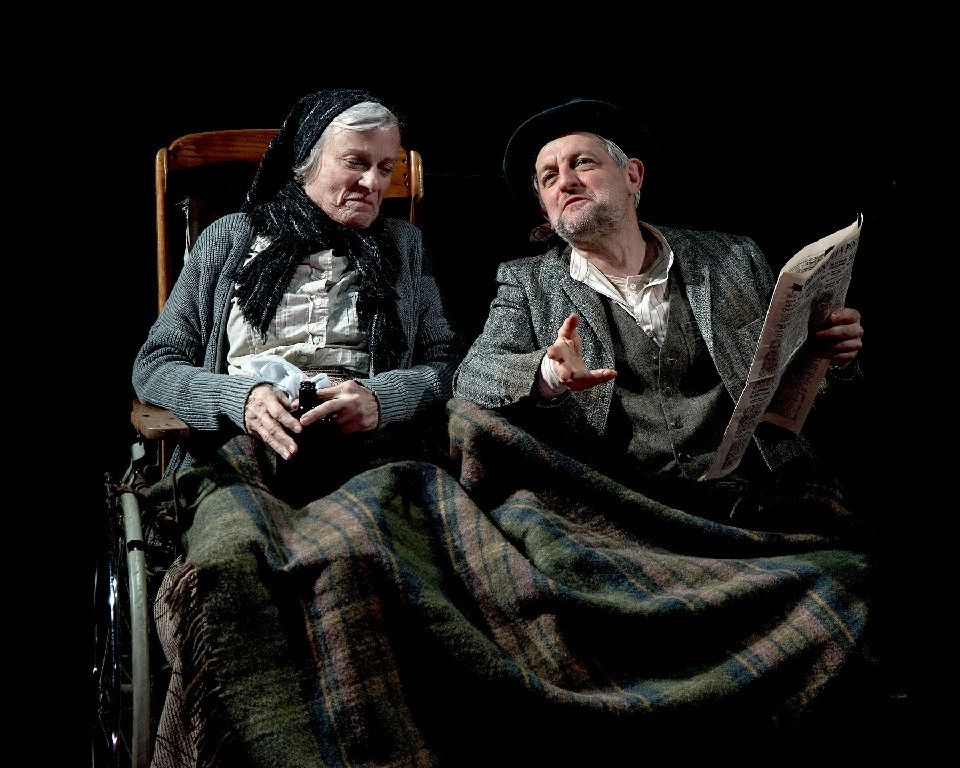
Anne Gee Byrd and JD Cullum
Playwright Martin McDonagh has mastered the art of slamming razor-sharp dark humor into sentimentality. The humor is always fierce, but he allows the audience to connect with the characters even in his works’ most perverse moments. Antaeus Theatre Company’s current production of The Cripple of Inishmaan is a perfect example, wickedly dissecting the drudgery of small-town life and portraying how escape can be futile.
In 1934 Ireland, Cripple Billy (Matthew Grondin) glumly accepts the taunts of his townmates and their misassumptions that his physical deformities translate to mental incapacity as well. An obviously wise and sensitive young man, Billy uses the filming in a nearby community by Hollywood documentarian Robert Flaherty to seek a new existence. In a community where everything is everyone’s business, Billy’s departure becomes big news.
McDonagh, a successful playwright as well as film screenwriter and director, takes a minor story and packs it with compelling characters and relatable struggles. Billy has much in common with a small girl in Kansas who needed to fly over the rainbow to learn what she had waiting for her at home. But unlike the child who clicked her ruby slippers three times to return, Billy’s troubles follow him to Hollywood, and also await his return to pummel him. Like many of McDonagh’s stories, The Cripple runs on secrets, some that deserve to be revealed and some that are better off concealed. He fills the stage with gossips, ruffians, and cold relatives who feel the need to hide their love for each other because it is the Irish way.
Director Steven Robman has assembled a remarkable cast, each actor finding nuances in their roles. Besides twisting his body into a pretzel for two acts, Grondin treats Billy with pride. His Billy knows he offers kindness and intellect, but he doesn’t broadcast it. As his two aunties, Kitty Swink and Mary-Pat Green are daffy and aloof, and a bit rough around the edges with their ward, but both women convey their characters’ adoration for him. JD Cullum is hilarious as the neighborhood snitch, who treats his chatterings as if he were a dignified journalist. For added humor, Anne Gee Byrd, as Cullum’s drunk Mammy, has a blast sparring with her meddlesome son. Abby Wilde reveals all the scars and warts of a young girl living in the sticks. With enough emotional armor to protect the Irish Navy, she picks at everyone else’s insecurities, and is downright abusive, as a defense mechanism.
Costumer Garry Lennon chooses burnt colors—browns and other muted tones—portending Billy’s existence restricted by his physicality and his situation. The stone-laid walls of John Iacovelli’s set resemble a prison, a cell where a gifted boy like Billy has served immeasurable time.
Hysterical, haunting, and challenging, Antaeus’ production of The Cripple of Inishmaan is not to be missed.
(Like most Antaeus productions, this one has been double cast. The Fripple Frapples cast is reviewed here.)
Antaeus Theatre Company
Reviewed by Jonas Schwartz

Geoffrey Wade Photography
Playwright Martin McDonagh has mastered the art of slamming razor-sharp dark humor into sentimentality. The humor is always fierce, but he allows the audience to connect with the characters even in his works’ most perverse moments. Antaeus Theatre Company’s current production of The Cripple of Inishmaan is a perfect example, wickedly dissecting the drudgery of small-town life and portraying how escape can be futile.
In 1934 Ireland, Cripple Billy (Matthew Grondin) glumly accepts the taunts of his townmates and their misassumptions that his physical deformities translate to mental incapacity as well. An obviously wise and sensitive young man, Billy uses the filming in a nearby community by Hollywood documentarian Robert Flaherty to seek a new existence. In a community where everything is everyone’s business, Billy’s departure becomes big news.
McDonagh, a successful playwright as well as film screenwriter and director, takes a minor story and packs it with compelling characters and relatable struggles. Billy has much in common with a small girl in Kansas who needed to fly over the rainbow to learn what she had waiting for her at home. But unlike the child who clicked her ruby slippers three times to return, Billy’s troubles follow him to Hollywood, and also await his return to pummel him. Like many of McDonagh’s stories, The Cripple runs on secrets, some that deserve to be revealed and some that are better off concealed. He fills the stage with gossips, ruffians, and cold relatives who feel the need to hide their love for each other because it is the Irish way.
Director Steven Robman has assembled a remarkable cast, each actor finding nuances in their roles. Besides twisting his body into a pretzel for two acts, Grondin treats Billy with pride. His Billy knows he offers kindness and intellect, but he doesn’t broadcast it. As his two aunties, Kitty Swink and Mary-Pat Green are daffy and aloof, and a bit rough around the edges with their ward, but both women convey their characters’ adoration for him. JD Cullum is hilarious as the neighborhood snitch, who treats his chatterings as if he were a dignified journalist. For added humor, Anne Gee Byrd, as Cullum’s drunk Mammy, has a blast sparring with her meddlesome son. Abby Wilde reveals all the scars and warts of a young girl living in the sticks. With enough emotional armor to protect the Irish Navy, she picks at everyone else’s insecurities, and is downright abusive, as a defense mechanism.
Costumer Garry Lennon chooses burnt colors—browns and other muted tones—portending Billy’s existence restricted by his physicality and his situation. The stone-laid walls of John Iacovelli’s set resemble a prison, a cell where a gifted boy like Billy has served immeasurable time.
Hysterical, haunting, and challenging, Antaeus’ production of The Cripple of Inishmaan is not to be missed.
(Like most Antaeus productions, this one has been double cast. The Fripple Frapples cast is reviewed here.)
January 30, 2019
Death House
at Road Theatre
Reviewed by Harker Jones
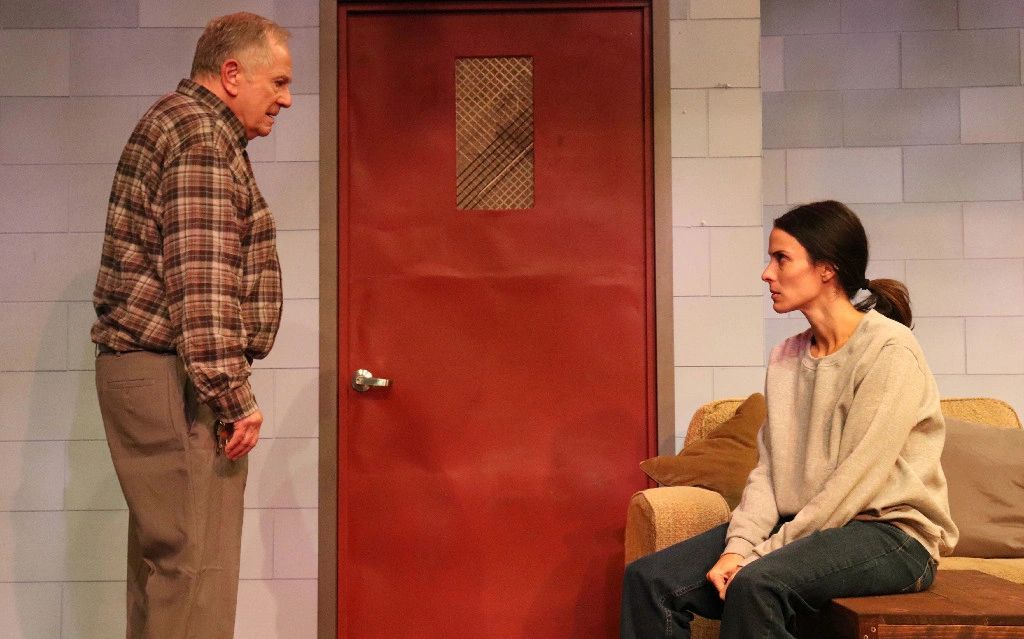
Sam Anderson and Verity Branco
The death penalty ignites emotions in everyone, whether pro or con. It’s a complicated and complex subject, just like Jason Karasev’s world-premiere play Death House, which tackles the topic from many angles with compassion, intelligence, and insight.
Sam Anderson plays George, a prison chaplain being forced to retire. When his replacement, a young, brash Allen (Chase Cargill), comes to learn the ropes from him the day of a prisoner’s (Verity Branco’s) execution, they’re set on a journey of discovery of blistering truths that is riveting, raw, and revealing.
Karasev’s script is tight and weighty. and explores all three characters in such depth, it’s exceedingly moving without being preachy. He’s not afraid to show both sides of the debate, coming from political as well as emotional viewpoints, which makes for fully realized roles, people who are flawed and even broken. They change and, through their own trajectories and histories, change the others as well.
It’s a very quiet show despite some of the emotional fireworks, and director Michael Peretzian uses that quiet to allow George, Allen, and Liliana space to grow, to breathe. And the actors luxuriate in that. The dialogue and the themes are heavy, and the actors meet the text with everything they have, giving modulated and layered performances. Branco gives a stunning, six- to eight-minute monologue that is devastating; she leaves you breathless with each word, giving Liliana intelligence, strength, and a sense of grace.
It all adds up to a shattering experience. You go on a journey with George, Allen, and Liliana, and though there are no easy answers or happy endings, it’s a journey you’ll be glad you took.
at Road Theatre
Reviewed by Harker Jones

Photo by Brian M. Cole
The death penalty ignites emotions in everyone, whether pro or con. It’s a complicated and complex subject, just like Jason Karasev’s world-premiere play Death House, which tackles the topic from many angles with compassion, intelligence, and insight.
Sam Anderson plays George, a prison chaplain being forced to retire. When his replacement, a young, brash Allen (Chase Cargill), comes to learn the ropes from him the day of a prisoner’s (Verity Branco’s) execution, they’re set on a journey of discovery of blistering truths that is riveting, raw, and revealing.
Karasev’s script is tight and weighty. and explores all three characters in such depth, it’s exceedingly moving without being preachy. He’s not afraid to show both sides of the debate, coming from political as well as emotional viewpoints, which makes for fully realized roles, people who are flawed and even broken. They change and, through their own trajectories and histories, change the others as well.
It’s a very quiet show despite some of the emotional fireworks, and director Michael Peretzian uses that quiet to allow George, Allen, and Liliana space to grow, to breathe. And the actors luxuriate in that. The dialogue and the themes are heavy, and the actors meet the text with everything they have, giving modulated and layered performances. Branco gives a stunning, six- to eight-minute monologue that is devastating; she leaves you breathless with each word, giving Liliana intelligence, strength, and a sense of grace.
Anderson’s George has the appropriate gravity of a man bearing the weight of decades of deathbed confessionals and who is broken from a lifetime of death. And in the showiest role, Cargill is the perfect mix of smugness and smarminess. He’s magnetic and has incredible presence. He gives Allen a depth a lesser actor might not be able to achieve. Starting off glib and condescending, Cargill changes Allen’s entire countenance as his layers are pulled away. He practically crumples into himself and is compelling in his own monologue.
David Mauer’s scenic design has the stifling sense of a prison cell: the action takes place entirely in a holding room for the convicts set for execution, with essentially just a sofa, a chair, and a table. The sound design by David B. Marling and the lighting by Derrick McDaniel are stark and add just the right punctuation to an already potent atmosphere. Even the fight choreography, directed by Bjorn Johnson, seems brutal and real, something which rarely comes off smoothly in a live production. It all adds up to a shattering experience. You go on a journey with George, Allen, and Liliana, and though there are no easy answers or happy endings, it’s a journey you’ll be glad you took.
January 29, 2019
Jan 18–March 10. 5108 Lankershim Blvd, North Hollywood. Thu–Sat, 8pm, Sun 2pm. Running time 2 hours, including intermission. $15-$34, Sundays are pay-what-you-can. (818) 761-8838.
Cabaret
Celebration Theatre
Reviewed by Harker Jones

Christopher Maikish and Talisa Friedman
Based on the play I Am a Camera by John Van Druten (itself based on Christopher Isherwood’s novel The Berlin Stories/Goodbye to Berlin), Cabaret is a legendary musical: both the eight-time Tony-winning 1966 Broadway production and the eight-time Oscar-winning 1972 film adaptation.
Those are big shoes to fill. But the Celebration Theatre in Hollywood is ace at taking huge, splashy shows and doing them justice in the tiniest of spaces — case in point, the recent production of Priscilla, Queen of the Desert. And this theater does it again with Cabaret.
Choreographer Janet Roston gets a stunning amount of action on such a small stage. The energy never flags as the ensemble uses every inch available to them. The scenic design by Stephen Gifford brings to life the Kit Kat Klub in all its opulence and also has it stand in for the foyer of a boarding house, a train, and a bedroom, among other things. Michael Mullen’s costumes evoke all the gaudy grandeur of the time, and the house band is a fantastic ensemble.
Celebration Theatre
Reviewed by Harker Jones

Photo by Matthew Brian Denman
Based on the play I Am a Camera by John Van Druten (itself based on Christopher Isherwood’s novel The Berlin Stories/Goodbye to Berlin), Cabaret is a legendary musical: both the eight-time Tony-winning 1966 Broadway production and the eight-time Oscar-winning 1972 film adaptation.
Those are big shoes to fill. But the Celebration Theatre in Hollywood is ace at taking huge, splashy shows and doing them justice in the tiniest of spaces — case in point, the recent production of Priscilla, Queen of the Desert. And this theater does it again with Cabaret.
Taking place in 1931 as the Nazis are beginning to take over Berlin on the eve of World War II, the show is set in and around the seedy, sexy, sleazy Kit Kat Klub, a nightclub where just about any desire is fulfilled, no matter one’s sexuality.
Here we meet the mesmerizing Emcee (Alex Nee), who’s the Puck of the club, mischievous, canny, and artful, moving the characters along their trajectories and acting as a sort of Greek chorus; and the impetuous and flighty Sally Bowles (Talisa Friedman), a British ex-pat and the star of the club, who has lost her way even if she isn’t willing to accept it yet. They and the rest of the club’s denizens party their days and nights away, burying their heads in the sand to avoid the oncoming political events for as long as they can before they’re eventually swept along by the winds of change.
Director Michael Matthews gets energetic and layered performances from his cast. Nee, in particular, is outstanding as the Emcee. He is magnetic and has an effortless carnality. He channels a darkness that’s both titillating and terrifying. He’s reminiscent of John Cameron Mitchell circa Hedwig and the Angry Inch. He owns every scene he is in and is a worthy successor to Joel Grey and Alan Cumming who originated and made this role his own, respectively, and both of whom won Tonys for their efforts.
Friedman is a hoot as Sally, though she may be playing her just a little more talented than she’s supposed to be. June Carryl as Fraulein Schneider, a landlady who falls in love with a Jewish fruit vendor, brings down the house with every number (her “So What” solo stops the show). She has an earthiness and warmth that grounds her while decadence swirls around her.Choreographer Janet Roston gets a stunning amount of action on such a small stage. The energy never flags as the ensemble uses every inch available to them. The scenic design by Stephen Gifford brings to life the Kit Kat Klub in all its opulence and also has it stand in for the foyer of a boarding house, a train, and a bedroom, among other things. Michael Mullen’s costumes evoke all the gaudy grandeur of the time, and the house band is a fantastic ensemble.
Sadly, the main thrust of the narrative—the last heady days before war—is still relevant in today’s America. It’s all happening again, which gives a chilling veneer to the usually bittersweet proceedings. That said, it’s still a fantastic way to go out, loving and singing and living.
July 3, 2018
May 25–Aug, 5. 6760 Lexington Ave., LA. Thu-Sat 8pm, Sun 2pm. Running time 2 hours, including intermission. $40–60. (323) 957-1884.
Clybourne Park
Laguna Playhouse
Reviewed by Melinda Schupmann
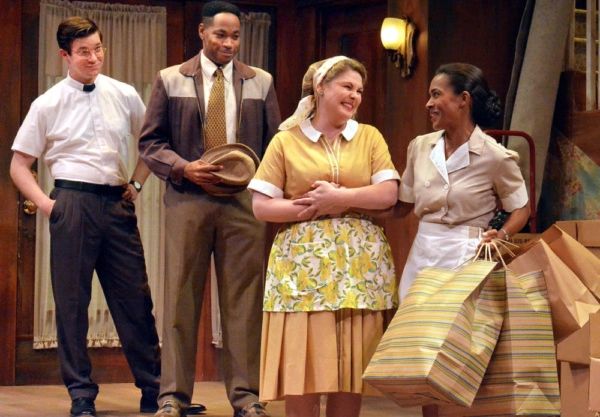
Bryan Porter, Jay Donnell, Heather Ayers, and Jennifer Shelton
Though it’s not necessary to be familiar with Lorraine Hansberry’s seminal A Raisin in the Sun, it provides a subliminal backdrop for Bruce Norris’s sharply satiric view of the machinations surrounding a house in a segregated neighborhood in the 1950s that allows for the examination of racism in America. Hansberry’s profoundly hopeful story chronicles the tale of the Younger family who have just received a life insurance check after the death of the family patriarch. Their decision to leave their apartment in the South Side of Chicago and move into Clybourne Park, an entirely white neighborhood, hints of possibilities, even though a neighborhood association has offered the Youngers a sizable amount of money to stay away.
Shelton is a standout in both time periods, especially as she tackles Lindner’s moronic protestations of modern racial sophistication. Donnell and Porter are excellent in understated roles that allow them to be observers and wry participants when called for.
Laguna Playhouse
Reviewed by Melinda Schupmann

Photo by Ed Krieger
Though it’s not necessary to be familiar with Lorraine Hansberry’s seminal A Raisin in the Sun, it provides a subliminal backdrop for Bruce Norris’s sharply satiric view of the machinations surrounding a house in a segregated neighborhood in the 1950s that allows for the examination of racism in America. Hansberry’s profoundly hopeful story chronicles the tale of the Younger family who have just received a life insurance check after the death of the family patriarch. Their decision to leave their apartment in the South Side of Chicago and move into Clybourne Park, an entirely white neighborhood, hints of possibilities, even though a neighborhood association has offered the Youngers a sizable amount of money to stay away.
At the play’s opening, Norris takes us into that house, where Russ (JD Cullum) and Bev (Heather Ayers) are packing after the sale for their move to a new home to be closer to Russ’s new job. Their son has committed suicide there, and the memories are too much to bear. A frenzied Karl Lindner (Christian Pedersen), the one character common to both plays, has arrived to try to persuade Russ to negate the sale, because common wisdom of the time was that if African-Americans moved into a neighborhood, property values would diminish and might even precipitate white flight. Russ refuses.
Karl is accompanied by his very pregnant and deaf wife, Betsy (Jennifer Cannon). Her inclusion allows for some bewildering and funny exchanges. Also on hand are Francine (Jennifer Shelton), the family maid; her husband, Albert (Jay Donnell), who has come to pick her up; and Jim (Bryan Porter), a well-meaning but largely clueless pastor who offers platitudes in place of wisdom. The dynamic among the group allows for varying viewpoints on the subject of race, which are almost eerily timely in this political year.
Act 2 is set in the same house 50 years later. Lindsey and Steve (Cannon and Pederson) have bought the house in what is now a largely troubled black neighborhood and plan to tear it down and rebuild. Lena and Tom (Shelton and Donnell), residents of the Park, are less than thrilled about the specter of gentrification and the loss of the history it destroys. In Act 2, political correctness is thrown to the wind, and the characters engage in often hilarious but unnerving verbal sparring that lays bare prejudice in its many forms.
It is easy to see why this well-crafted play won so many awards, including the Tony, Pulitzer, and Olivier. It is sharp, funny, and clever, and it explores a plethora of issues surrounding prejudice. That 2018 has brought so many changes to our national debate about equity and fairness, it is a stimulating choice for Laguna to end its 97th season with.The ensemble tackles the characterizations zealously, and Norris’s long, slow curve eases us into the diverging issues as we discover the anxieties and dilemmas facing this diverse group. Director Matt August handles both the wit and drama of the story with a fine touch, allowing each character to shine. Cullum is remarkable as the grieving father who has bottled up his torment, and Ayers skillfully delivers the slightly dim but well-meaning wife whose simplistic viewpoints make a nice foil for the ratcheting tension developing as the first act builds to a boiling point.
Lindner is a pivotal character in both time periods. He is suitably smarmy as he tries to lead the Clybourne Neighborhood Improvement Association, and his outrageous attempts later in the play at blasting social norms are cringe-worthy.Shelton is a standout in both time periods, especially as she tackles Lindner’s moronic protestations of modern racial sophistication. Donnell and Porter are excellent in understated roles that allow them to be observers and wry participants when called for.
D Martyn Bookwalter’s dual sets in both time periods add to the mood of the story. His graffiti-charged contemporary house helps show passage of time. Ann Closs-Farley’s costumes and Chris Rynne’s lighting also are effective.
This is a play that is exhilarating in its execution and allows for post-play reflection. It functions as an exercise in how we perceive all hot-button issues of race and gender. The varying viewpoints delivered will keep this play relevant for a long time.
June 13, 2018
The Last Five Years
The Actor’s Company at The Other Space
Reviewed by Harker Jones

Scott Porter and Janel Parrish
The same creative team who mounted last year’s One Flew Over the Cuckoo’s Nest: The Immersive Experience has brought a simpler production to the stage. But while Cuckoo’s Nest was an enthralling event that used audience members as participants throughout, The Actor’s Company production of Jason Robert Brown’s 2001 musical The Last Five Years is scaled back dramatically, to the detriment of the show.
Janel Parrish and Scott Porter play, respectively, Cathy, an aspiring actor from Ohio, and Jamie, an up-and-coming novelist, two 20-something New Yorkers who fall in and out of love. Told almost entirely through song on a spare, white, circular stage, the two-hander gives both performers a lot of material to work with. The problem is, neither character is particularly likable. Jamie is a self-absorbed douche through essentially their entire romance, and Cathy is a doormat. It’s difficult to root for them, when he doesn’t deserve her and she deserves some self-respect.
The Actor’s Company at The Other Space
Reviewed by Harker Jones

Photo by KJ Knies
The same creative team who mounted last year’s One Flew Over the Cuckoo’s Nest: The Immersive Experience has brought a simpler production to the stage. But while Cuckoo’s Nest was an enthralling event that used audience members as participants throughout, The Actor’s Company production of Jason Robert Brown’s 2001 musical The Last Five Years is scaled back dramatically, to the detriment of the show.
Janel Parrish and Scott Porter play, respectively, Cathy, an aspiring actor from Ohio, and Jamie, an up-and-coming novelist, two 20-something New Yorkers who fall in and out of love. Told almost entirely through song on a spare, white, circular stage, the two-hander gives both performers a lot of material to work with. The problem is, neither character is particularly likable. Jamie is a self-absorbed douche through essentially their entire romance, and Cathy is a doormat. It’s difficult to root for them, when he doesn’t deserve her and she deserves some self-respect.
Director Kari Hayter gets solid performances from her actors and utilizes the small space well. Parrish brings humor and nuance to Cathy, and Porter has an affable rakishness à la Chris Pratt, but with her story told in reverse chronological order as his moves forward, it’s difficult to follow. And with them meeting only briefly in the middle as their trajectories intersect, we spend almost no time with them together, so there’s no real sense of their love. Thus, it’s hard to invest in them.
In this production, it’s also distracting trying to figure out when the story takes place. Millennials referencing “Mr. Ed” and “Leave It to Beaver” doesn’t ring true. The show first launched in 2001, so that explains it to a degree, but the characters also use iPhones, which negates that explanation. Additionally, Jamie’s arc starts with him singing about the problems of dating outside his Jewish upbringing and how thrilled he is about it (which seems offensive to Jews, no?), yet this is never addressed again.The band, under musical director Jennifer Lin, is tight, taking on countless music styles, but their efforts are for naught as the score is unmemorable. Parrish and Porter give it their all, but none of the songs lands with any impact. Some are cute and some are dramatic, but by the time The Last Five Years is over, they’re already forgotten. This makes the 85-minute running time seem more like 120.
Prior to the show, guests who spring for the deluxe ticket are offered the option of tantalizing their senses with curated cocktails, and by visiting stations around the edge of the stage they can, among other things, take a mini Polaroid, leave a message to a loved one, and listen to a recorded conversation between two lovers. While it’s charming, the theater is so small, it gets crowded quickly, and suddenly everyone is in everyone’s way. And it’s just not enough to make up for uninspiring material.
July 3, 2019
July 3, 2019 June 7–July 14. 916-A North Formosa Ave, West Hollywood. Thu–Sat 8pm, Sun 7pm. Running time 85 minutes, no intermission. $75–$115.
An Inspector Calls
The National Theatre of Great Britain at Wallis Annenberg Center for the Performing Arts
Reviewed by Harker Jones

J.B. Priestley’s existential indictment of the British ruling class comes to the Wallis Annenberg Center for the Performing Arts in a pristine production from director Stephen Daldry, who first reinvigorated the play’s reputation in 1992. Originally launched in the Soviet Union in 1945, the script is perhaps timelier now than ever with the division of wealth at a staggering disproportion.
In fictional Brumley, England, the upper-crust Birling family finds an engagement party at their lush house disrupted when the titular Inspector Goole (Liam Brennan) calls, questioning them about the suicide of a working-class woman named Eva Smith.
Contrasting their opulent lifestyle is the seemingly bombed-out street (appearing to be based in the 1945 of World War II) where poor children play in the street and the Birlings’ ever-present maid, Edna (Diana Payne-Myers), hovers.
Still, the set by designer Ian MacNeil isn’t just stunning, it’s unlike anything else. The Birling’s house is elevated on stilts, and it’s enormous and ostentatious. The stormy English night sky is vivid, and you can practically feel the humidity. There’s a phone booth and a lamppost and actual rain.
The National Theatre of Great Britain at Wallis Annenberg Center for the Performing Arts
Reviewed by Harker Jones

Liam Brennan and ensemble
Photo by Mark Douet
J.B. Priestley’s existential indictment of the British ruling class comes to the Wallis Annenberg Center for the Performing Arts in a pristine production from director Stephen Daldry, who first reinvigorated the play’s reputation in 1992. Originally launched in the Soviet Union in 1945, the script is perhaps timelier now than ever with the division of wealth at a staggering disproportion.
In fictional Brumley, England, the upper-crust Birling family finds an engagement party at their lush house disrupted when the titular Inspector Goole (Liam Brennan) calls, questioning them about the suicide of a working-class woman named Eva Smith.
Contrasting their opulent lifestyle is the seemingly bombed-out street (appearing to be based in the 1945 of World War II) where poor children play in the street and the Birlings’ ever-present maid, Edna (Diana Payne-Myers), hovers.
As the three acts unfold over the course of just one night in April 1912, every member of the dysfunctional Birling family has his or her conscience combed and each of them discovers that they are complicit in some way in Eva’s death, even if it was unintentional, through self-absorption or sheer idiocy. As the family disintegrates under, not exactly threats, but insinuations, and then an out-of-the-blue twist blindsides them, twentysomethings Eric (Hamish Riddle), an impetuous alcoholic, and newly engaged Sheila (Lianne Harvey), having been shaken to the core by the revelations, are willing to take responsibility for both Eva and their own places in society, while the older generation is happy to continue on as before, showing a generational divide in terms of thinking about others around us.
A scathing indictment of classism following the end of World War I, Priestley’s politically charged messages are wrapped up in a mystery that is cloaked in a Twilight Zone–like mind twister. It plays like a radio serial (perfect for its 1940s-era context when written), and the melodramatic music by Stephen Warbeck sets a perfect tone, as does the dark and striking lighting by Rick Fisher and the beautifully stitched wardrobe by costume supervisor Caroline McCall and her team.Still, the set by designer Ian MacNeil isn’t just stunning, it’s unlike anything else. The Birling’s house is elevated on stilts, and it’s enormous and ostentatious. The stormy English night sky is vivid, and you can practically feel the humidity. There’s a phone booth and a lamppost and actual rain.
When BAFTA, Tony, and Golden Globe winner Daldry (who’s also nabbed three Oscar nominations) revived the show in the early ’90s, it won the Olivier, the Drama Desk, and the Tony for Best Revival of a play, and he hasn’t lost his touch with this relaunch. He has a deft hand with his actors, leading them to flawless performances. Christine Kavanagh as matriarch Sybil and Harvey as frivolous, spoiled Sheila own the stage whenever they are present.
The twist at the end will either negate everything that came before for you or will give even more weight to the proceedings. Either way, you’ll rethink the entirety of what you thought you knew.
February 5, 2019
Jan 22–Feb 10. 9390 N Santa Monica Blvd, Beverly Hills. Mon–Fri 7:30pm, Sat 2pm & 7:30pm, Sun 2pm & and 7pm. Running time 1 hour and 45 minutes, no intermission. $35–$105. (310) 746-4000.
You in Midair: Elegy for a Daughter
Hollywood Fringe Festival [show closed]
Reviewed by Harker Jones

Danna Schaeffer
Rebecca Schaeffer was a 21-year-old rising star in the late ’80s. She had starred for two years on the sitcom My Sister Sam and had nabbed roles in Paul Bartel’s independent comedy Scenes From the Class Struggle in Beverly Hills and Woody Allen’s nostalgic classic Radio Days (though her role was eventually edited out). She had graced the cover of Seventeen magazine, was a spokesperson for the Thursday’s Child charity, was dating up-and-coming writer-director Brad Silberling, and had garnered an audition for Francis Ford Coppola’s The Godfather Part III. Her career was so hot that she had two callbacks for Pretty Woman. She could have been Julia Roberts.
Then, in 1989, as she was awaiting delivery of the Godfather III script at her apartment in West Hollywood, she was shot and killed on her front step by the mentally ill Robert John Bardo. It was soon revealed that Bardo had been stalking Schaeffer for up to three years. Her murder shook Hollywood and the public at large. It was such a game-changing event that her death spawned California’s first anti-stalking law.
Her mother, playwright Danna Schaeffer, pays tribute to the life and death of her daughter in the one-woman show You in Midair, in which she starts her story by recounting charming anecdotes, like how she was jealous of a random extra when she visited Rebecca in Italy on the set of a TV-movie. Her memories are vivid and vividly brought to life—the happy ones and those that came in the aftermath of Rebecca’s murder.
With a sparse stage of just three chairs, a red rotary phone, and the issue of Seventeen magazine with Rebecca’s visage on the cover, Danna gives a vibrant performance with more heartfelt humor than one might expect considering the narrative revolves around a murder. But there is pathos in her levity. And there’s a steeliness in her maternal instincts. She’s a likable performer with a breezy style. She’s someone you’d like to know, which magnifies the tragedy that befalls her.
Her grief and rage are visceral (her recollection of identifying “the body” with open eyes and protruding tongue due to intubation is harrowing), yet she eventually finds a sort of peace. With Bardo sentenced to life in prison thanks to soon-to-be-world-famous prosecutor Marcia Clark, not much more can be done. You disintegrate or you march on. Rebecca’s boyfriend at the time, Silberling, exorcised his own demons by writing and directing the Jake Gyllenhaal drama Moonlight Mile, a loose retelling of how he dealt with Schaeffer’s murder.
Hollywood Fringe Festival [show closed]
Reviewed by Harker Jones

Photo by Owen Carey
Rebecca Schaeffer was a 21-year-old rising star in the late ’80s. She had starred for two years on the sitcom My Sister Sam and had nabbed roles in Paul Bartel’s independent comedy Scenes From the Class Struggle in Beverly Hills and Woody Allen’s nostalgic classic Radio Days (though her role was eventually edited out). She had graced the cover of Seventeen magazine, was a spokesperson for the Thursday’s Child charity, was dating up-and-coming writer-director Brad Silberling, and had garnered an audition for Francis Ford Coppola’s The Godfather Part III. Her career was so hot that she had two callbacks for Pretty Woman. She could have been Julia Roberts.
Then, in 1989, as she was awaiting delivery of the Godfather III script at her apartment in West Hollywood, she was shot and killed on her front step by the mentally ill Robert John Bardo. It was soon revealed that Bardo had been stalking Schaeffer for up to three years. Her murder shook Hollywood and the public at large. It was such a game-changing event that her death spawned California’s first anti-stalking law.
Her mother, playwright Danna Schaeffer, pays tribute to the life and death of her daughter in the one-woman show You in Midair, in which she starts her story by recounting charming anecdotes, like how she was jealous of a random extra when she visited Rebecca in Italy on the set of a TV-movie. Her memories are vivid and vividly brought to life—the happy ones and those that came in the aftermath of Rebecca’s murder.
How to process the death of a child? Especially one so senseless and unexpected? Rebecca’s acting career was blossoming, and she had aspirations to direct. Danna was writing a play. Husband and father Benson was going to have his textbook published in Spain. All systems were go.
And then Bardo, who had also stalked pop singers Tiffany and Debbie Gibson, arrived in Los Angeles from Tucson, rending their lives into a Before and an After.With a sparse stage of just three chairs, a red rotary phone, and the issue of Seventeen magazine with Rebecca’s visage on the cover, Danna gives a vibrant performance with more heartfelt humor than one might expect considering the narrative revolves around a murder. But there is pathos in her levity. And there’s a steeliness in her maternal instincts. She’s a likable performer with a breezy style. She’s someone you’d like to know, which magnifies the tragedy that befalls her.
Her grief and rage are visceral (her recollection of identifying “the body” with open eyes and protruding tongue due to intubation is harrowing), yet she eventually finds a sort of peace. With Bardo sentenced to life in prison thanks to soon-to-be-world-famous prosecutor Marcia Clark, not much more can be done. You disintegrate or you march on. Rebecca’s boyfriend at the time, Silberling, exorcised his own demons by writing and directing the Jake Gyllenhaal drama Moonlight Mile, a loose retelling of how he dealt with Schaeffer’s murder.
Sadly, Danna’s story is still timely. While Rebecca’s murder helped establish stalking laws, we’re still struggling with implementing laws keeping the mentally ill from legally purchasing firearms. Schaeffer’s death may have shocked Hollywood, but we still have a long way to go.
June 27, 2018
You in Midair was part of the Hollywood Fringe Festival. Running time 80 minutes, no intermission.
The following have generously supported ArtsInLA.com....
Jerry Charlson
Up & Running Arts Management and Consultants
(323) 733-7073
Up & Running Arts Management and Consultants
(323) 733-7073
Sandra Zeitzew
Tell them you read about it on ArtsInLA.com
...and contact us at info@ArtsInLA.com!
...or tweet us at @ArtsInLAcom (no dot)!
...or tweet us at @ArtsInLAcom (no dot)!
Daniel’s Husband
Fountain Theatre
Reviewed by Harker Jones

Bill Brochtrup, Tim Cummings, Jose Fernando, and Ed F. Martin
Michael McKeever’s devastating play Daniel’s Husband is a complex and nuanced look at the legal and emotional resonance of life in post-gay America. A lighthearted dinner party with two gay couples—one same-age, one intergenerational—sets the stage for a descent into a hellish nightmare that has no end.
Daniel (Bill Brochtrup) is a successful architect who’s in a 7-year relationship with his partner, Mitchell (Tim Cummings), a successful sellout of an author. Mitchell aspires to a more artistic career, but schlock sells, and he hates himself for capitulating to it. His agent, Barry (Ed F. Martin), loves it, of course, while Barry’s younger boyfriend, Trip (Jose Fernando), envies the solid foundation of Daniel and Mitchell’s relationship.
Unfortunately, it’s not everything Trip hopes for or assumes. Daniel very much wants to get married, to make their love legal in the eyes of society, while Mitchell doesn’t believe in it. At least not for himself. He’s glad there’s the option, but, in the words of playwright McKeever, he thinks it’s “outdated, musty, and fundamentally wrong… an archaic institution forged in that crucible of all things evil: religion.” Just because gay marriage is legal, should there be an obligation?
When Daniel’s mother, Lydia (Jenny O’Hara), comes to visit, he and Mitchell are overjoyed yet frustrated. She’s not suffocating, but she’s a bit much, and she’s starting to fear her life is small, with a large house and nothing to fill her time. Then, when tragedy befalls them, Daniel and Mitchell are thrust into a horrific ordeal neither is prepared for.
All five of the actors bring depth and humanity to their roles. Fernando brings both levity and gravity to his dewy-eyed ingénue. Martin’s Barry is smarmy but not sleazy. Brochtrup brings a sadness and almost a resignation to his vexation with both his mother and his partner. O’Hara is a force of nature. Her Lydia is magnetic and colorful and broken and desperate, sometimes all at the same time. And Cummings, who has the trickiest role of all, the biggest arc, is gentle and ferocious and outraged and regretful. If he’d made one simple, selfless concession, his life with Daniel would have ended entirely differently. All of this plays across his handsome, anguished face in delicate modulations.
There are no easy answers in this harrowing and topical show. The issues—both legal and emotional—are complicated. What is family? How is it defined in both society and by the law? How do we bridge chasms when neither is willing to cross, and there seems no way to compromise? McKeever allows us to fill in those answers ourselves, leaving us at a bleak yet wholly believable impasse.
Fountain Theatre
Reviewed by Harker Jones

Photo by Ed Krieger
Michael McKeever’s devastating play Daniel’s Husband is a complex and nuanced look at the legal and emotional resonance of life in post-gay America. A lighthearted dinner party with two gay couples—one same-age, one intergenerational—sets the stage for a descent into a hellish nightmare that has no end.
Daniel (Bill Brochtrup) is a successful architect who’s in a 7-year relationship with his partner, Mitchell (Tim Cummings), a successful sellout of an author. Mitchell aspires to a more artistic career, but schlock sells, and he hates himself for capitulating to it. His agent, Barry (Ed F. Martin), loves it, of course, while Barry’s younger boyfriend, Trip (Jose Fernando), envies the solid foundation of Daniel and Mitchell’s relationship.
Unfortunately, it’s not everything Trip hopes for or assumes. Daniel very much wants to get married, to make their love legal in the eyes of society, while Mitchell doesn’t believe in it. At least not for himself. He’s glad there’s the option, but, in the words of playwright McKeever, he thinks it’s “outdated, musty, and fundamentally wrong… an archaic institution forged in that crucible of all things evil: religion.” Just because gay marriage is legal, should there be an obligation?
When Daniel’s mother, Lydia (Jenny O’Hara), comes to visit, he and Mitchell are overjoyed yet frustrated. She’s not suffocating, but she’s a bit much, and she’s starting to fear her life is small, with a large house and nothing to fill her time. Then, when tragedy befalls them, Daniel and Mitchell are thrust into a horrific ordeal neither is prepared for.
McKeever has created a world and characters of such richness and intricacy that, as relationships are fractured irrevocably, no one is right and no one is wrong. As one of the characters says at the end, “There are no villains here.” That’s a hard line to walk and to write. Audience members will identify with each of them and understand their motives, which makes it difficult to take sides, which is what we’re used to. It’s easy to hiss at a villain. It’s less easy when it’s a not a villain but a fully formed human being. All of them are the protagonists in their own story.
Director Simon Levy infuses the stage with energy. The pacing never lags, even in the quiet, desperate moments of the second half. He allows his actors time to breathe and to let them give the lines (and the spaces between them) time to land. Scenic designer DeAnne Millais has created a beautiful, tasteful set that perfectly reflects the taste of wealthy gay men of a certain age. It’s also economic in how it allows for so many other parts of the home to be implied without ever seeing them.All five of the actors bring depth and humanity to their roles. Fernando brings both levity and gravity to his dewy-eyed ingénue. Martin’s Barry is smarmy but not sleazy. Brochtrup brings a sadness and almost a resignation to his vexation with both his mother and his partner. O’Hara is a force of nature. Her Lydia is magnetic and colorful and broken and desperate, sometimes all at the same time. And Cummings, who has the trickiest role of all, the biggest arc, is gentle and ferocious and outraged and regretful. If he’d made one simple, selfless concession, his life with Daniel would have ended entirely differently. All of this plays across his handsome, anguished face in delicate modulations.
There are no easy answers in this harrowing and topical show. The issues—both legal and emotional—are complicated. What is family? How is it defined in both society and by the law? How do we bridge chasms when neither is willing to cross, and there seems no way to compromise? McKeever allows us to fill in those answers ourselves, leaving us at a bleak yet wholly believable impasse.
July 19, 2019
May 1–July 28. 5060 Fountain Ave, Los Angeles. Fri 8pm, Sat 2 & 8pm, Sun 2pm, Mon 8pm. Running time 100 minutes, no intermission. $25–$45. (323) 663-1525.
Catch Me If You Can
Musical Theatre West at Carpenter Performing Arts Center
Reviewed by Jonas Schwartz

The ensemble
Catch Me If You Can, based on the hit Steven Spielberg movie, is a swingin’ ’60s musical by the composers that brought Hairspray to the stage. At Musical Theatre West, director Larry Raben captures the energy of ’60s television variety specials like Hullabaloo, The Judy Garland Show, and The Ed Sullivan Show to put audiences in the psyche of an adolescent con artist, who thinks life is as glorious as the shows he absorbs on his color TV set, Live In Living Color.
Like the movie and the true-life story, Frank Abagnale Jr. (Jacob Haren), a high school student, turns to crime, pretending to be an airline pilot and a doctor, while passing bad checks across the world. A strait-laced FBI agent (Jeff Skowron) dogs him, knowing that even the best criminals make a mistake eventually. The two are nemeses but admire each other’s savvy too much to be enemies.
Terrence McNally’s book takes the concept of the variety show to examine the mind of a delusional kid who never understands the stakes of the felonies he has compounded. The Frank character is breezy, as if he’s playing cops and robbers on the playground. In contrast, the FBI agent, Hanratty, follows the law to the letter, and even if he becomes a father figure to the kid, their chase must end with handcuffs.
Musical Theatre West at Carpenter Performing Arts Center
Reviewed by Jonas Schwartz

Photo by Caught in the Moment Photography
Catch Me If You Can, based on the hit Steven Spielberg movie, is a swingin’ ’60s musical by the composers that brought Hairspray to the stage. At Musical Theatre West, director Larry Raben captures the energy of ’60s television variety specials like Hullabaloo, The Judy Garland Show, and The Ed Sullivan Show to put audiences in the psyche of an adolescent con artist, who thinks life is as glorious as the shows he absorbs on his color TV set, Live In Living Color.
Like the movie and the true-life story, Frank Abagnale Jr. (Jacob Haren), a high school student, turns to crime, pretending to be an airline pilot and a doctor, while passing bad checks across the world. A strait-laced FBI agent (Jeff Skowron) dogs him, knowing that even the best criminals make a mistake eventually. The two are nemeses but admire each other’s savvy too much to be enemies.
Terrence McNally’s book takes the concept of the variety show to examine the mind of a delusional kid who never understands the stakes of the felonies he has compounded. The Frank character is breezy, as if he’s playing cops and robbers on the playground. In contrast, the FBI agent, Hanratty, follows the law to the letter, and even if he becomes a father figure to the kid, their chase must end with handcuffs.
One oddity in the text may be based on truth but does not paint Hanratty in a positive light: Twice within the musical, Hanratty runs into eyewitnesses who can identify Frank, but both times the seasoned agent never bothers to ask for a description. It services the plot, since Hanratty is going off the theory that his forger is an older man, but such poor detective work does not paint the agent as very bright.
Paying homage to Burt Bacharach, composers Marc Shaiman and Scott Wittman have written a groovin’ score. Several showstoppers stand out, like the silky “Doctor’s Orders” and the Bossa Nova-themed “Don’t Be a Stranger” for Frank’s seductive French mom. Raben transports audiences to the ring-a-ding-ding ’60s, the Playboy nation that was formed by Madison Avenue. Projections, filled with pastels and ’60s graphics and typefaces, give a candy-coated anti-reality. Peggy Hickey’s frug and pony dance moves are peppy reminders of the dances Bob Fosse and Michael Bennett made popular in that era.
Skowron has shaped into one of LA theater’s MVPs. He treats his character like an ordinary Joe, one who has a strong moral structure and a bloodhound mentality. Katie Sapper, as Frank’s girlfriend, reveals a tenderness and solitude for a small Southern girl unused to high-stakes deception. Sandy Bainum has fun as Frank’s mother, a woman who wants more from life than the male-oriented ’60 would normally offer. Michael Corbett is a likeable loser as Frank’s hapless, alcoholic dad.This story requires a compelling lead. After all, the protagonist is a scoundrel con artist who steals more than $5 million, and if you don’t adore him, the show is doomed. Haren has all the tangibles. He can sing and dance well. It’s the intangibles that are problematic. Haren just doesn’t sell that he’s an irresistible liar. He needs to be able to sell Playgirl subscriptions to a nunnery, but he doesn’t have that verve that Leonardo DiCaprio had in the movie and Aaron Tveit had in the original Broadway cast. That deficit turns Frank into a brat instead of a globetrotting confidence man.
Catch Me If You Can is a minor-league crowd pleaser, one that has panache but doesn’t resonate like most powerful musicals. By framing the musical around the variety show concept, it creates a story that is a bit superficial. However, during those two and a half hours, audiences are treated to zippy, innocuous fun.
April 3, 2019
March 30–April 14. 6200 E Atherton St, Long Beach. Fri 8pm, Sat 2pm & 8pm, Sun 1pm & 6pm. Running time approximately 2 hours and 40 minutes, including intermission. $20–92. (562) 856-1999, ext. 4.
Hello, Dolly!
Pantages Theatre
Reviewed by Jonas Schwartz

Betty Buckley
Zaks directs his cast toward stylized, animated performances, which plays into the book’s humor. Stadlen, a Broadway trouper, turns “Penny in My Pocket,” a song cut from the original production, into a snappy character piece and perfectly enacts the exasperated stuffed shirt amongst the energetic youngsters. As the secondary characters, Nic Rouleau as Cornelius and Analisa Leaming as Irene reveal powerful voices that lift their songs, particularly her “Ribbons Down My Back” and their love song “It Only Takes a Moment.” Kristen Hahn deadpans her way into audiences’ hearts as the millinery assistant Minnie Fay, while Jess LeProtto, as adolescent Barnaby, leaps as if filled with helium.
Pantages Theatre
Reviewed by Jonas Schwartz

Photo by Julieta Cervantes
Betty Buckley is a Broadway legend. Besides her Tony-winning turn in Cats, she originated Martha Jefferson in 1776, tortured her daughter in the notorious flop Carrie, and replaced Glenn Close in Sunset Boulevard. Last year, Angelenos welcomed her in Grey Gardens at the Ahmanson. So when it was announced that Buckley would be carrying the torch of Dolly Gallagher Levi in the Hello, Dolly! revival national tour, there was cause for celebration.
Sadly, Buckley came to town ill, which had prevented her from performing during her stop in Costa Mesa. Ever the trouper, Buckley pulls up her bootstraps and prances into the Pantages while still recovering. Though audiences missed a chance to hear that specular Betty belt, especially at the end of “Before the Parade Passes By,” the star kept her energy raised and embodied that Broadway catchphrase, that the show definitely must go on.
In turn-of-the-century New York, matchmaker and joyous pest Dolly Levi couples several innocents while saving the big whale, half-millionaire Horace Vandergelder (Lewis J. Stadlen), for herself. The grumpy miser passes over the inappropriate women whom Dolly wilily chooses for him, never realizing that the matchmaker has primed him for herself. After all her conniving, Horace has little chance but to fall wildly in love with this larger-than-life juggernaut.Michael Stewart’s hilarious book melds farcical elements with Broadway musical tropes. The character of Dolly is one of the great musical pied pipers, breathing live into all those souls desperate to break free. The score by Jerry Herman, with a contribution from Bob Merrill, features rousing numbers, including the aforementioned “Parade,” “Put on Your Sunday Clothes,” and the brassy, extravagant title number.
Director Jerry Zaks turns Dolly into a brash burlesque with vibrantly colored costumes and picture card etchings backdrops, both by Santo Loquasto. Using Gower Champion’s original choreography as a foundation, Warren Carlyle’s dances are athletic, witty, and precise. The production is a valentine to the early 20th-century, its culture, and humor.Zaks directs his cast toward stylized, animated performances, which plays into the book’s humor. Stadlen, a Broadway trouper, turns “Penny in My Pocket,” a song cut from the original production, into a snappy character piece and perfectly enacts the exasperated stuffed shirt amongst the energetic youngsters. As the secondary characters, Nic Rouleau as Cornelius and Analisa Leaming as Irene reveal powerful voices that lift their songs, particularly her “Ribbons Down My Back” and their love song “It Only Takes a Moment.” Kristen Hahn deadpans her way into audiences’ hearts as the millinery assistant Minnie Fay, while Jess LeProtto, as adolescent Barnaby, leaps as if filled with helium.
The remaining element is the presence of Buckley, fueled purely by gumption. It’s both a tragic and uplifting performance: tragic because Buckley has never been known as a comedienne nor dancer, but with her famous voice on the mend, she’s forced to rely on her weaknesses, yet uplifting, because even at 71, Buckley never phones it in. She knows audiences have come to see her and she refuses to disappoint. Therefore, though scenes like Dolly and Horace’s turkey dinner at the Harmonia Gardens falls flat, and though she must lower her range in songs temporarily, she nonetheless shines due to natural exuberance.
Hello, Dolly! continues to delight audiences, both as a showcase for Broadway royalty and as a throwback to the old-fashioned musical, with glorious, memorable songs, brainless hijinks and humor, and a return to a more innocent time.
February 2, 2019
Jan 29–Feb 17. 6233 Hollywood Blvd., Hollywood. Tue-Fri 8pm, Sat 2pm & 8pm, Sun 1pm & 6:30 pm. Running time 2 hours and 35 minutes, including intermission. $35-$445. (800) 982-2787.
1776
La Mirada Theatre for the Performing Arts
Reviewed by Jonas Schwartz
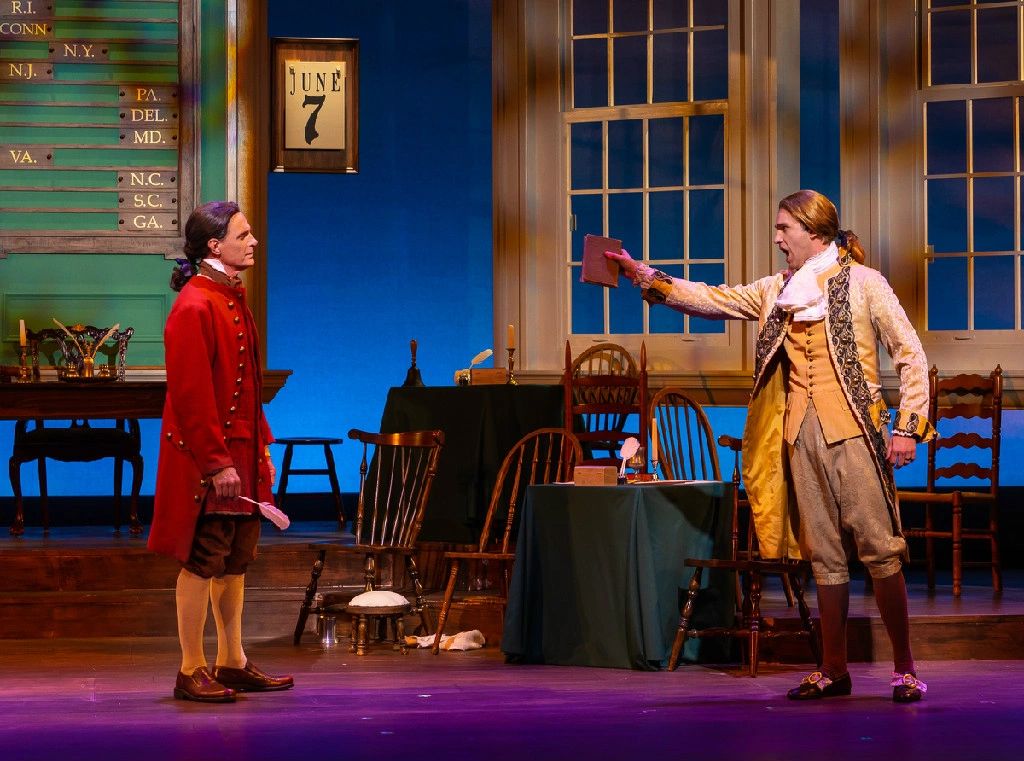
Andy Umberger and Caleb Shaw
We hold these truths to be self-evident about the musical 1776. Truth one: Even an American audience member with a D- grade point average knows how this play will end. Truth two: Due to Peter Stone’s glorious libretto, what conclusions may be inevitable to everyone will still seem for most of play to be impossible, and, despite logic, audiences will sit on the edge of their seats until the final bell chimes. 1776 is simply one of the best-written musicals of all time.
In the smoldering summer of 1776, a Continental Congress screams, barters, and attacks one another over a vote for independence. Resolute that the English crown represents tyranny, the gentleman from Massachusetts, John Adams (Andy Umberger), pushes for revolution. The conservatives, led by John Dickerson of Pennsylvania (Michael Stone Forrest), refuse to even bring the measure up for discussion. For the South, the ugly subject of slavery becomes a sticking point. Adams and his colleague Benjamin Franklin (Peter Van Norden) recruit Thomas Jefferson of Virginia to construct a Declaration of Independence to rally the troops. Meanwhile, letters flood in from General George Washington of the bleakness of the continuing war against the British, which appears to have no end in sight.
Jared A Sayeg’s stark white lighting visually clarifies the musical line from the opening number that “it’s hot as hell in Philadel-phia.” Shon LeBlanc’s costumes, aided by EB Bohks’s hair and makeup, transport audiences back to colonial times.
1776 is an indestructible show. The music, plotting, and dialogue reward the audience with a stirring sense of patriotism. Sadly, this production at La Mirada allows the show to carry them, instead of the other way around.
La Mirada Theatre for the Performing Arts
Reviewed by Jonas Schwartz

Photo by Jason Niedle
We hold these truths to be self-evident about the musical 1776. Truth one: Even an American audience member with a D- grade point average knows how this play will end. Truth two: Due to Peter Stone’s glorious libretto, what conclusions may be inevitable to everyone will still seem for most of play to be impossible, and, despite logic, audiences will sit on the edge of their seats until the final bell chimes. 1776 is simply one of the best-written musicals of all time.
In the smoldering summer of 1776, a Continental Congress screams, barters, and attacks one another over a vote for independence. Resolute that the English crown represents tyranny, the gentleman from Massachusetts, John Adams (Andy Umberger), pushes for revolution. The conservatives, led by John Dickerson of Pennsylvania (Michael Stone Forrest), refuse to even bring the measure up for discussion. For the South, the ugly subject of slavery becomes a sticking point. Adams and his colleague Benjamin Franklin (Peter Van Norden) recruit Thomas Jefferson of Virginia to construct a Declaration of Independence to rally the troops. Meanwhile, letters flood in from General George Washington of the bleakness of the continuing war against the British, which appears to have no end in sight.
Stone’s book should never be used as CliffsNotes for any history student’s midterm; he combines and deletes characters, changes conflicts, and fosters friendships and hatreds that didn’t actually exist in Philadelphia in 1776. In doing so, he streamlines the story and gives audiences characters who resonate. More a product of the times when it was written—1776 came out in 1969, another contentious period in U.S. history, when the anti-establishment fought their parents and the country’s leader, Richard Nixon. Much of the conflicts in the play are more reflective of 1969, particularly civil rights. Stone and composer Sherman Edwards lay the poisonous cancer of slavery not solely on the plates of the Southerners who directly own and exploit their slaves, but also on the Northerners who thrive from the benefits of free labor with their trade. The authors make clear in “Molasses to Rum” that no one’s hands are blood-free.
Edwards’s score is politically driven, reflecting on the travesties of war, the clash between the left and the right, while still containing some lovely ballads between adoring husband and wife John and Abigail Adams (Teri Bibb).The production at La Mirada benefits from such a commanding text. The final moments, particularly in this political climate, will lead to tears of joy and hope for a country for which one is always sorry-grateful. However, Glenn Casale’s direction lacks cohesion. Many of the performances never gel, with everyone playing their motivations on the surface, with no room for subtext. There’s an electricity missing from the cast, an urgency. The visual “erection” jokes could have easily been halved. Instead of being ribald, they came off as immature.
Umberger has the impulsive energy for Adams, but his singing range is limited. When he gets to high notes, they are swallowed in the back of his throat. Van Norden, as Franklin, lends humor and a sensibility that works for the character. Broadway star James Barbour sits around the stage uninvolved the majority of the time, seeming bored. When he takes center stage in “Molasses to Rum,” he finally erupts, bringing down fire and brimstone on his enemies; however, before that time, his lackadaisical presence sucks away the energy. The standout performances are from those who, due to the script, only have limited stage time, and the audience finds itself begging for their return. Nick McKenna, as the courier, gives a heartbreaking interpretation of “Mama Look Sharp.” Both Caleb Shaw and Ellie Wyman have tremendous voices as Thomas and Martha Jefferson.Jared A Sayeg’s stark white lighting visually clarifies the musical line from the opening number that “it’s hot as hell in Philadel-phia.” Shon LeBlanc’s costumes, aided by EB Bohks’s hair and makeup, transport audiences back to colonial times.
1776 is an indestructible show. The music, plotting, and dialogue reward the audience with a stirring sense of patriotism. Sadly, this production at La Mirada allows the show to carry them, instead of the other way around.
January 17, 2019
Jan 11–Feb 3. 14900 La Mirada Blvd, La Mirada (ample free parking). Wed-Thu 7:30pm, Fri 8pm, Sat 2 & 8pm, Sun 2pm. $15–$84. (562) 944-9801, (714) 994-6310.
Production moves to Younes and Soraya Nazarian Center for the Performing Arts (The Soraya) at CSUN, Feb 8–10. 18111 Nordhoff Street, Northridge. Fri 8pm, Sat 3 & 8pm, Sun 3pm.$41–$96. (818) 677-3000.
Scissorhands: A Musical Inspired by the Film
The Fuse Project and Rockwell Table & Stage at Rockwell
Reviewed by Harker Jones

The finale of Scissorhands
After showcasing cheeky musical adaptations of films as diverse as Bridesmaids, Jurassic Park, and Hocus Pocus, Rockwell Table & Stage is back with a seasonal story that has enchanted audiences for 28 years. Tim Burton’s 1990 film Edward Scissorhands is an enduring classic that all misfits identify with—and we’ve all felt like misfits.
A fairy tale, Scissorhands starts off like Pinocchio, when a lonely inventor creates Edward with scissors in place of his hands. But once Edward is adopted by a neighborhood Avon lady, the tale takes on a life of its own, heading in heartfelt and unexpected directions. The film had such an impact, it’s been adapted into a comic-book series, a play, and a ballet, in addition to having a heavy metal song devoted to it and even an extinct arthropod named Kootenichela deppi named after Johnny Depp, who played Edward, because of its scissor-like claws.
The Fuse Project, created by Kate Pazakis and Bradley Bredeweg, has breathed new life into the project with the bawdy humor and infectious enthusiasm we’ve come to expect from Rockwell. (Pazakis is the creator of the Unauthorized Musical Parody Of series that has produced many shows at Rockwell Table & Stage.) Amping up the absurdism of the film only serves to accentuate the wilder points as well as give needed contrast to the quieter moments.
The costumes are top-notch, and the band is superlative, zigging and zagging from songs as disparate as David Bowie’s “I’m Afraid of Americans,” Gary Jules’s “Mad World,” the Cranberries’s “Zombie,” Leona Lewis’s “Bleeding Love,” and Lady Gaga and Bradley Cooper’s “Shallow” from “A Star Is Born” nimbly and fluidly. And you’ll find the mash-up of Scissor Sisters’s “Let’s Have a Kiki” and holiday chestnut “It’s the Most Wonderful Time of the Year” the gift you didn’t know you needed.
With the show taking place throughout Rockwell’s space, not just on the central stage, no matter where you’re seated, you’re bound to be close to the action at some point. Be aware there is a lot of confetti stepping in for the “snow” Edward creates, adding to the Christmas themes of melancholy and joy.
The Fuse Project and Rockwell Table & Stage at Rockwell
Reviewed by Harker Jones

After showcasing cheeky musical adaptations of films as diverse as Bridesmaids, Jurassic Park, and Hocus Pocus, Rockwell Table & Stage is back with a seasonal story that has enchanted audiences for 28 years. Tim Burton’s 1990 film Edward Scissorhands is an enduring classic that all misfits identify with—and we’ve all felt like misfits.
A fairy tale, Scissorhands starts off like Pinocchio, when a lonely inventor creates Edward with scissors in place of his hands. But once Edward is adopted by a neighborhood Avon lady, the tale takes on a life of its own, heading in heartfelt and unexpected directions. The film had such an impact, it’s been adapted into a comic-book series, a play, and a ballet, in addition to having a heavy metal song devoted to it and even an extinct arthropod named Kootenichela deppi named after Johnny Depp, who played Edward, because of its scissor-like claws.
The Fuse Project, created by Kate Pazakis and Bradley Bredeweg, has breathed new life into the project with the bawdy humor and infectious enthusiasm we’ve come to expect from Rockwell. (Pazakis is the creator of the Unauthorized Musical Parody Of series that has produced many shows at Rockwell Table & Stage.) Amping up the absurdism of the film only serves to accentuate the wilder points as well as give needed contrast to the quieter moments.
Casting a woman, Jordan Kai Burnett, as Edward adds another layer to our titular hero’s quest for self. Edward doesn’t know who he is or why he is. It’s an existential crisis, especially when everyone in his adoptive subdivision projects their own issues, ignorances, and prejudices on him.
Emma Hunton as Peg is the show’s MVP. She gives a multilayered performance, imbuing her Avon lady with warmth and pathos, giving Scissorhands its heart. Natalie Masini (in perfect ’90s mom jeans) as Kim, the teenage girl who falls for Edward; Morgan Smith as religious fanatic Esmerelda; and Carly Casey as neighborhood sexpot Joyce fill their roles with vivacity and energy.The costumes are top-notch, and the band is superlative, zigging and zagging from songs as disparate as David Bowie’s “I’m Afraid of Americans,” Gary Jules’s “Mad World,” the Cranberries’s “Zombie,” Leona Lewis’s “Bleeding Love,” and Lady Gaga and Bradley Cooper’s “Shallow” from “A Star Is Born” nimbly and fluidly. And you’ll find the mash-up of Scissor Sisters’s “Let’s Have a Kiki” and holiday chestnut “It’s the Most Wonderful Time of the Year” the gift you didn’t know you needed.
With the show taking place throughout Rockwell’s space, not just on the central stage, no matter where you’re seated, you’re bound to be close to the action at some point. Be aware there is a lot of confetti stepping in for the “snow” Edward creates, adding to the Christmas themes of melancholy and joy.
Remember: At Rockwell there is always a two-item minimum in addition to the price of the show. And really prepare yourself for some jubilant confetti!
January 3, 2019
Dec 7–Jan 27. 1714 N Vermont Ave, LA. Fri-Sat 8pm, Sun noon. Running time: 120 minutes, including intermission. $20–$64.
Three Days in the Country
Antaeus Theatre Company
Reviewed by Jonas Schwartz

Jeanne Syquia and Nike Doukas
Three Days in the Country, Patrick Marber’s adaptation of Turgenev’s A Month in the Country, makes its West Coast premiere at Antaeus Theatre Company in Glendale. A comedy of sexual compulsion, the play should explode. The gunpowder has been poured, but due to miscasting of a vital character, the director forgot to light the fuse.
At Natalya and Arkady’s estate, Natalya (Nike Doukas) lusts for her son’s tutor, Belyaev (Peter Mendoza). The boy has a busy dance card, since Natalya’s ward Vera (Jeanne Syquia) has fallen in love with the young teacher, and servant girl Katya (Lila Dupree) has already been carnally knowledgeable of Belyaev’s body parts. Visiting the estate is Rakitin (Leo Marks), the boyhood friend of Arkady (Antonio Jaramillo). Rakitin (Leo Marks) adores his friend but is desperately in love with Natalya. She treats this infatuation as a lark, one over which she taunts Rakitin mercilessly. Like a square dance, the participants switch partners and do-si-dos until everyone is winded and exasperated.
Marber’s play fits with the author’s themes often found his works, like Closer and Notes on a Scandal, where lovers jump into affairs with no sense of abandon and no preparation for consequences. Like the mismatched combinations shuffled in Shakespeare’s A Midsummer Night’s Dream, these mortals act like damned fools.
Antaeus Theatre Company
Reviewed by Jonas Schwartz

Geoffrey Wade Photography
Three Days in the Country, Patrick Marber’s adaptation of Turgenev’s A Month in the Country, makes its West Coast premiere at Antaeus Theatre Company in Glendale. A comedy of sexual compulsion, the play should explode. The gunpowder has been poured, but due to miscasting of a vital character, the director forgot to light the fuse.
At Natalya and Arkady’s estate, Natalya (Nike Doukas) lusts for her son’s tutor, Belyaev (Peter Mendoza). The boy has a busy dance card, since Natalya’s ward Vera (Jeanne Syquia) has fallen in love with the young teacher, and servant girl Katya (Lila Dupree) has already been carnally knowledgeable of Belyaev’s body parts. Visiting the estate is Rakitin (Leo Marks), the boyhood friend of Arkady (Antonio Jaramillo). Rakitin (Leo Marks) adores his friend but is desperately in love with Natalya. She treats this infatuation as a lark, one over which she taunts Rakitin mercilessly. Like a square dance, the participants switch partners and do-si-dos until everyone is winded and exasperated.
Marber’s play fits with the author’s themes often found his works, like Closer and Notes on a Scandal, where lovers jump into affairs with no sense of abandon and no preparation for consequences. Like the mismatched combinations shuffled in Shakespeare’s A Midsummer Night’s Dream, these mortals act like damned fools.
Doukas plays Natalya like a cat in heat, hungry for a man to quench her fire. She runs on instinct, never thinking through her actions, while remaining cunning at the same time. Marks takes the foppish role, played in 1940s films by Clifton Webb or George Sanders, and infuses him with pathos. He allows himself to be a plaything to the house mistress, but when he bleeds, he blazes with fury. Either Syquia has all the funniest lines or she has taken straight dialogue and, with pitch perfect timing, shifted all her dialogue into hilarity. Whimsical and childlike, she ups the energy every time she skips on stage.
As a duplicitous doctor, Armin Shimerman is delightfully shifty, trying to marry off Vera for his own gain, and yet earnest when attempting to woo piano teacher Lizaveta (the always wonderful Lily Knight). Sadly, it’s the object of desire that extinguishes the sexual thirst. Mendoza lacks a beguiling presence to act as a catalyst for so much pain and passion. As the husband terrified of losing his love, Jaramillo is also underwhelming. His performance never clarifies that he still loves Natalya, so his devastation lacks audience support.
Director Andrew Paul allows the stagecraft to paint a portrait of summer whims. Scenic designer Se Hyun Oh and costumer A. Jeffrey Schoenberg use a palette of muted colors, whites, and browns, while lighting designer Jared A. Sayeg adds lighted leaves to the bare trees painted on Oh’s sets. Schoenberg’s frilly dresses are haute couture.
An enjoyable comedy about unadvisable love, Three Days in the Country is a well-crafted production. Doukas and Marks, who brought the production to Antaeus from its US premiere at the Kinetic Theatre Company in Pittsburgh, are exquisite. With a more bewitching Belyaev, the play could have matched their performances.Note: Antaeus double-casts its productions. The Blunderers cast is reviewed here.
July 17, 2018
July 12–Aug 26. 110 E. Broadway,
Glendale. Thu-Fri 8pm, Sat 2pm & 8pm, Sun 2pm. $30-34. (818) 506-1983.
The 39 Steps
International City Theatre
Reviewed by Melinda Schupmann

Bo Foxworth, Ashley Morton, Eric Wentz, and Louis Lotorto
When it comes to suspense, Alfred Hitchcock is the acknowledged master. In 1935 he directed The 39 Steps, an adaptation of John Buchan’s popular British spy novel. The hero of the book is Richard Hannay, an ordinary man on the run from the authorities because he is a suspect in a murder. The film arguably marks the beginning of Hitchcock’s commercial successes, and its popularity led to his eventual migration to Hollywood.
In 2005, comedic actor Patrick Barlow took a 1990s four-person version of the story by Nobby Dimon and Simon Corbie and adapted it, leading to countless award nominations, including the Tony. It is a masterful piece of derring-do with all the requisite mystery elements.
The story begins when Hannay (Eric Wentz) goes to the theater to see a demonstration by a man called Mr. Memory. A woman who claims to be a spy convinces him to take her to his London flat. After telling him a tale of an upcoming assassination plot, she is murdered, and Hannay’s dilemma is how to prove his innocence. His flight from capture is convoluted, providing opportunities for Barlow to slip in scenes from other Hitchcock films like North by Northwest, Psycho, and Strangers on a Train. He even slips in a sighting of Mr. Hitchcock himself.
From a seductively glamorous spy to an innocent bystander, Morton is a perfect foil for the shenanigans surrounding the events. Costumes by Kim DeShazo take her from femme fatale to Scottish housewife to the blonde heroine shackled to Hannay as the story progresses. Wentz makes the perfect handsome hero, managing humor and peril equally well.
DeShazo also creates a series of clever costumes for the clowning Lotorto and Foxworth. By design, Fred Kinney’s set is bare bones, including a ladder, a few chairs, tables, and some moveable props like an empty picture frame. It is the combined skill of the actors and the collective audience willingness to believe what is happening onstage that makes the show a delight.
International City Theatre
Reviewed by Melinda Schupmann

Photo by Tracey Roman
When it comes to suspense, Alfred Hitchcock is the acknowledged master. In 1935 he directed The 39 Steps, an adaptation of John Buchan’s popular British spy novel. The hero of the book is Richard Hannay, an ordinary man on the run from the authorities because he is a suspect in a murder. The film arguably marks the beginning of Hitchcock’s commercial successes, and its popularity led to his eventual migration to Hollywood.
In 2005, comedic actor Patrick Barlow took a 1990s four-person version of the story by Nobby Dimon and Simon Corbie and adapted it, leading to countless award nominations, including the Tony. It is a masterful piece of derring-do with all the requisite mystery elements.
The story begins when Hannay (Eric Wentz) goes to the theater to see a demonstration by a man called Mr. Memory. A woman who claims to be a spy convinces him to take her to his London flat. After telling him a tale of an upcoming assassination plot, she is murdered, and Hannay’s dilemma is how to prove his innocence. His flight from capture is convoluted, providing opportunities for Barlow to slip in scenes from other Hitchcock films like North by Northwest, Psycho, and Strangers on a Train. He even slips in a sighting of Mr. Hitchcock himself.
Louis Lotorto, Bo Foxworth, and Ashley Morton play the many characters Hannay encounters in his flight. Their rapid-fire switches from character to character, often onstage, are fascinating to watch and should delight even the most jaded audience member. Director Jamie Torcellini speeds the pace along, which leaves no time for an analysis of the absurdities piling up in the storyline. It is played for laughs, but it takes the story seriously, adding to the fun.
Lotorto and Foxworth play off each other in often devastatingly funny cameos. They play lingerie salesmen, a sinister spymaster, a Scottish farmer, and assorted policemen, among others. They easily manage the British-style comedy so beautifully perfected by Monty Python and in Benny Hill sketches.From a seductively glamorous spy to an innocent bystander, Morton is a perfect foil for the shenanigans surrounding the events. Costumes by Kim DeShazo take her from femme fatale to Scottish housewife to the blonde heroine shackled to Hannay as the story progresses. Wentz makes the perfect handsome hero, managing humor and peril equally well.
DeShazo also creates a series of clever costumes for the clowning Lotorto and Foxworth. By design, Fred Kinney’s set is bare bones, including a ladder, a few chairs, tables, and some moveable props like an empty picture frame. It is the combined skill of the actors and the collective audience willingness to believe what is happening onstage that makes the show a delight.
Summer is a perfect time for light comedy, and ICT delivers a delightful homage to Hitchcock and the mystery genre. It’s a familiar tale, but as played by the four actors, it becomes fresh and entertaining.
June 27, 2018
June 20–July 8. 330 E Seaside Way, Long Beach. Thu-Sat 8pm, Sun 2pm. $35-$49. (562) 436-4610.
Hostage
Skylight Theatre
Reviewed by Harker Jones

Satiar Pourvasei, Zachary Grant, Tracie Lockwood, and Vaneh Assadourian
Playwright Michelle Kholos Brooks’s new familial-political drama fits in with many of Skylight Theatre productions. It’s political, it’s topical (no matter when it takes place), and it’s intimate. But unlike Skylight’s recent presentations Rotterdam and The Madres, Hostage never quite lands.
Taking place in the spring of 1980, it’s a true story about a Wisconsin woman, Barbara Timm (Tracie Lockwood), and her current husband, Kenny (Jack Clinton), who visit her son, Kevin (Zachary Grant), who has been kidnapped and is being held hostage at the US embassy in Tehran by Iranian radicals. She’s a simple, salt-of-the-earth, devout Christian whose life is thrown onto the world stage and whose beliefs are expanded as she interacts with Tehran Mary (a soulful and matter-of-fact Vaneh Assadourian) and Ebrahim (Satiar Pourvasei), who are responsible for Kevin’s abduction. Barbara doesn’t anticipate the uproar when she returns to the States: People call her a traitor and a terrorist for visiting the Middle Eastern country, despite that she’s imploring the kidnappers to release her child.
Brooks’s script is good at showing both sides of the conflict. Ebrahim and especially Tehran Mary are presented as fully fleshed, with legit reasons for trying to make a statement (though abducting someone is quite a statement—they refer to Kevin as a guest). Both sides are human (Tehran Mary even wants Ali MacGraw to play her in the movie version of their international drama), showing that there truly are no easy answers, but the dialogue is a little too on-the-nose to be as effective as it needs to be.
With only a brisk intermissionless 80-minute run time, it might have worked better to expand the script so that we get to know the characters more, perhaps their lives before this incident brings their lives to this intersection. We spend time with Barb back home as her life unravels; and Christopher Hoffman is very good as her ex-husband, Richie, who gives insight into her past and character. They quarrel because her mind has been opened by her trip to Iran and he, essentially having never left the county he was born in, can’t get his head around how she could possibly have an understanding of the abductors.
Director Elina de Santos doesn’t create the tension necessary or elicit strong enough performances (an anomaly for Skylight) to give the show enough thrust. Lockwood’s Barb never hits the emotional punch to make her character grounded and complex. It’s a quiet show, with almost no score, which is admirable as some shows with a lesser director might rely on histrionics to create drama. But despite its good intentions, Hostage falls a little flat.
Skylight Theatre
Reviewed by Harker Jones

Satiar Pourvasei, Zachary Grant, Tracie Lockwood, and Vaneh Assadourian
Photo by Ed Krieger
Taking place in the spring of 1980, it’s a true story about a Wisconsin woman, Barbara Timm (Tracie Lockwood), and her current husband, Kenny (Jack Clinton), who visit her son, Kevin (Zachary Grant), who has been kidnapped and is being held hostage at the US embassy in Tehran by Iranian radicals. She’s a simple, salt-of-the-earth, devout Christian whose life is thrown onto the world stage and whose beliefs are expanded as she interacts with Tehran Mary (a soulful and matter-of-fact Vaneh Assadourian) and Ebrahim (Satiar Pourvasei), who are responsible for Kevin’s abduction. Barbara doesn’t anticipate the uproar when she returns to the States: People call her a traitor and a terrorist for visiting the Middle Eastern country, despite that she’s imploring the kidnappers to release her child.
Brooks’s script is good at showing both sides of the conflict. Ebrahim and especially Tehran Mary are presented as fully fleshed, with legit reasons for trying to make a statement (though abducting someone is quite a statement—they refer to Kevin as a guest). Both sides are human (Tehran Mary even wants Ali MacGraw to play her in the movie version of their international drama), showing that there truly are no easy answers, but the dialogue is a little too on-the-nose to be as effective as it needs to be.
With only a brisk intermissionless 80-minute run time, it might have worked better to expand the script so that we get to know the characters more, perhaps their lives before this incident brings their lives to this intersection. We spend time with Barb back home as her life unravels; and Christopher Hoffman is very good as her ex-husband, Richie, who gives insight into her past and character. They quarrel because her mind has been opened by her trip to Iran and he, essentially having never left the county he was born in, can’t get his head around how she could possibly have an understanding of the abductors.
Director Elina de Santos doesn’t create the tension necessary or elicit strong enough performances (an anomaly for Skylight) to give the show enough thrust. Lockwood’s Barb never hits the emotional punch to make her character grounded and complex. It’s a quiet show, with almost no score, which is admirable as some shows with a lesser director might rely on histrionics to create drama. But despite its good intentions, Hostage falls a little flat.
June 8, 2018
