Arts In LA
Arts In NY
Jagged Little Pill
Broadhurst Theater
Halfway Bitches Go Straight to Heaven
Atlantic Theater Company and LAByrinth Theater Company at Linda Gross Theater
A Bright Room Called Day
Public Theater
Reviewed by David Sheward
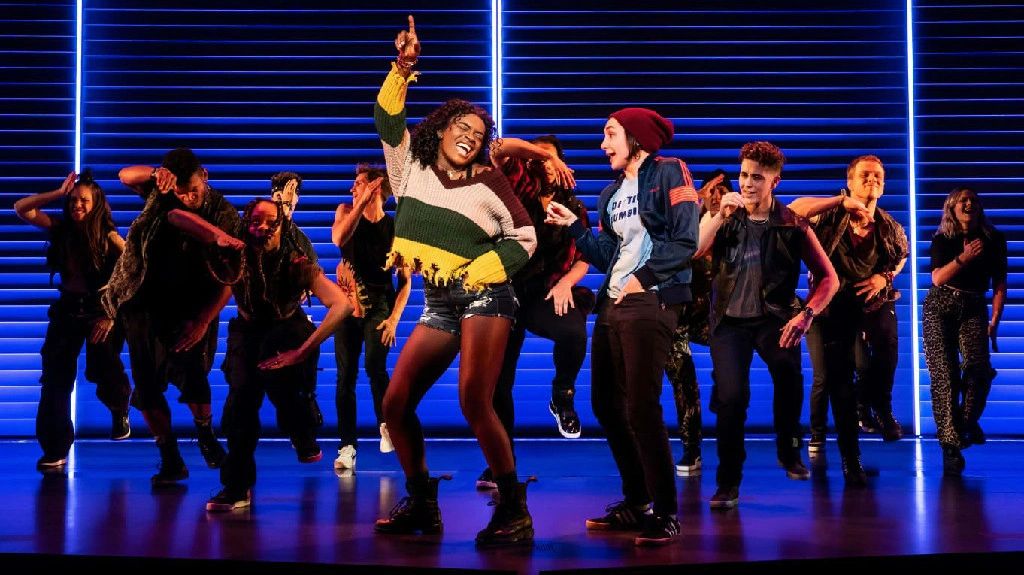
The cast of Jagged Little Pill
Jagged Little Pill is a jagged little musical, sometimes smooth, sometimes sharp, sometimes bland and predictable, sometimes edgy and shattering. This raw, uneven tale of modern angst in an upper-class Connecticut family employs Alanis Morissette’s groundbreaking 1995 album for its score. Tom Kitt did the skillful arrangements and orchestrations, combining Broadway smoothness with Morissette’s signature prickly texture. Her rage-filled tone informs the polished and funny book by Diablo Cody (Juno) who has crammed in so many current social issues it feels like a rock version of an Afterschool Special. We skip from opioid addiction to rape culture to marital miscommunication to bisexuality to racial identity with barely a pause for a breath, let alone a few minutes for reflection or analysis. Even climate change gets a brief mention. Fortunately Cody infuses wit and pathos into her fast-forward preachiness, and director Diane Paulus creates a inventive, surprising staging so that you don’t feel numbed by the constant crises.
The show opens with a chorus of refreshingly diverse dancers throwing themselves into Sidi Larbi Cherkaoui’s frenetic, all-body choreography. Then we meet the white-bread Healys who have a lot going on. Supermom Mary Jane (a steely and shattering Elizabeth Stanley) is addicted to painkillers and bent on presenting a perfect facade. Dad Steve (handsome Sean Allen Krill skillfully hiding pain) is constantly at the office, sneaking peeks at Internet porn and avoiding the cracks in family life. Daughter Frankie (full-voiced and mature Celia Rose Gooding), who is African-American and adopted, feels pressured to conceal her emerging racial awareness and bisexuality. Straight-arrow son Nick (expressive Derek Klena) has been accepted to Harvard but feels empty inside.
The lead characters’ barrage of woes gets a bit tiring. The stories of Jo, Frankie’s secret girlfriend, and Bella, Nick’s classmate who is sexually assaulted at a party, emerge as more compelling. Lauren Patten’s Jo is funny, scathing, razor-sharp, and achingly human. She literally stops the show cold with her gut-wrenching rendition of “You Oughta Know,” Morissette’s breakup cry of pain. Kathryn Gallagher is equally memorable as the tormented Bella. To paraphrase one of Morissette’s hits, it’s ironic that the supporting figures are the real stars here. As noted, Paulus gives us numerous dazzling sequences, particularly a heartbreaking backwards-in-time journey through Mary Jane’s day as she adds scoring illegal drugs to her shopping chores. Pill indeed has its jagged edges, but it’s ultimately a satisfying capsule.
The basic structure is compelling enough with Der Führer’s power grab detailed by menacing supertitles and images (Lucy MacKinnon’s projection design and Bray Poor’s sound design create a harrowing atmosphere). But in the original production, Kushner added a figure from 1985 named Zillah to draw parallels between the action of the play and Ronald Reagan’s shift of America toward the right. This awkward imposition drew the most criticism, and now Kushner has added a second interrupter called Xillah, a stand-in for the author himself, making further commentary and obvious connections among Hitler, Reagan, and the current occupant of the White House. Though Crystal Lucas-Perry’s Zillah and Jonathan Hadary’s Xillah are movingly played and the dialogue Kushner gives them is sometimes fascinatingly astute political observation, these characters slow down the action and drain the proceedings of drama. When they come on, the emphasis changes from frightening life-or-death decisions to dry seminar. Oskar Eustis, who directed the 1987 Eureka Theater production, gives this difficult, uneven work the best possible production, intensely human and paced with variety and wit. But, unlike the similarly overstuffed Jagged Little Pill and Halfway Bitches, Day is ultimately unsatisfying.
Broadhurst Theater
Halfway Bitches Go Straight to Heaven
Atlantic Theater Company and LAByrinth Theater Company at Linda Gross Theater
A Bright Room Called Day
Public Theater
Reviewed by David Sheward

Photo by Matthew Murphy
Jagged Little Pill is a jagged little musical, sometimes smooth, sometimes sharp, sometimes bland and predictable, sometimes edgy and shattering. This raw, uneven tale of modern angst in an upper-class Connecticut family employs Alanis Morissette’s groundbreaking 1995 album for its score. Tom Kitt did the skillful arrangements and orchestrations, combining Broadway smoothness with Morissette’s signature prickly texture. Her rage-filled tone informs the polished and funny book by Diablo Cody (Juno) who has crammed in so many current social issues it feels like a rock version of an Afterschool Special. We skip from opioid addiction to rape culture to marital miscommunication to bisexuality to racial identity with barely a pause for a breath, let alone a few minutes for reflection or analysis. Even climate change gets a brief mention. Fortunately Cody infuses wit and pathos into her fast-forward preachiness, and director Diane Paulus creates a inventive, surprising staging so that you don’t feel numbed by the constant crises.
The show opens with a chorus of refreshingly diverse dancers throwing themselves into Sidi Larbi Cherkaoui’s frenetic, all-body choreography. Then we meet the white-bread Healys who have a lot going on. Supermom Mary Jane (a steely and shattering Elizabeth Stanley) is addicted to painkillers and bent on presenting a perfect facade. Dad Steve (handsome Sean Allen Krill skillfully hiding pain) is constantly at the office, sneaking peeks at Internet porn and avoiding the cracks in family life. Daughter Frankie (full-voiced and mature Celia Rose Gooding), who is African-American and adopted, feels pressured to conceal her emerging racial awareness and bisexuality. Straight-arrow son Nick (expressive Derek Klena) has been accepted to Harvard but feels empty inside.
The lead characters’ barrage of woes gets a bit tiring. The stories of Jo, Frankie’s secret girlfriend, and Bella, Nick’s classmate who is sexually assaulted at a party, emerge as more compelling. Lauren Patten’s Jo is funny, scathing, razor-sharp, and achingly human. She literally stops the show cold with her gut-wrenching rendition of “You Oughta Know,” Morissette’s breakup cry of pain. Kathryn Gallagher is equally memorable as the tormented Bella. To paraphrase one of Morissette’s hits, it’s ironic that the supporting figures are the real stars here. As noted, Paulus gives us numerous dazzling sequences, particularly a heartbreaking backwards-in-time journey through Mary Jane’s day as she adds scoring illegal drugs to her shopping chores. Pill indeed has its jagged edges, but it’s ultimately a satisfying capsule.
The Healys of Jagged Little Pill are confronting a plethora of problems, but they’re having a day at the beach compared to the crowd at Halfway Bitches Go Straight to Heaven Off-Broadway at the Atlantic Theater Company. Stephen Adly Guirgis’s new super-sized comedy-drama contains a stageful of characters—the huge cast numbers 18, a rarity for a straight play on or Off-Broadway—each exploding with his or her own trauma. We are in a women’s halfway housing shelter (Narelle Sissons designed the appropriately crumbling set), and as with the Healys, a lot is going on. Sarge, a lesbian army vet, is furious that transgender prostitute Venus is taking a bed that should go to a “real woman.” Sarge’s girlfriend, Bella, a stripper from Baltimore, wants a normal life, but Sarge’s alcoholism and anger issues keep getting in the way. Former dancer Wanda, now confined to a wheelchair, refuses to take her medication. Rockaway Rosie still mourns the rejection of her fiancé who stole her life savings hidden in a bucket of detergent. Betty refuses to take a bath. Teenagers Melba and Mateo just want to get through high school. Father Miguel and Miss Rivera attempt to run the place, but their own nerves are starting to fray as pressure mounts to close the place. And that’s just a sampling of the multiple goings-on.
As he has done with his numerous previous works—including Our Lady of 121st Street, The Motherf—r with the Hat, and the Pulitzer Prize–winning Between Riverside and Crazy—Adly Guirgis solidly delivers a brutally honest depiction of vital, struggling people on the edge who speak in hilarious, profanity-laced slang. The script is a riot, but there are so many plot threads and characters that despite John Ortiz’s controlled, muscular direction and stellar performances from the entire company (particularly Elizabeth Canavan’s addled, endearing Rosie; Patrice Johnson Chevannes’s regal Wanda, Liza Colon-Zayas’s hair-trigger yet vulnerable Sarge, and Elizabeth Rodriguez’s fierce Miss Rivera), it’s nearly impossible to keep them all straight. In addition, the author doesn’t fully develop some of characters or resolve their stories. Towards the end of two hours and 45 minutes of nudity, drug abuse, assaults, stabbings, backroom sex, and a visit from a live goat, one of the characters emerges with a baby she hasn’t even mentioned heretofore.
Despite its excesses, Halfway Bitches is an entertaining, frightening ride, and its nearly three-hour running time is never dull. The same cannot be said for the Public Theater’s revival of Tony Kushner’s A Bright Room Called Day. This 1985 work was Kushner’s first and definitely shows the sparks of genius later responsible for Angels in America, but it’s also overlong, talky, and still doesn’t entirely work in theatrical terms in spite of revisions by Kushner for this production. (Day was workshopped off-Off-Broadway in 1985. Its professional premiere was in 1987 at San Francisco’s Eureka Theatre. The Public presented the first Off-Broadway production in 1990.)
Set in Germany during the early 1930s, Day follows a group of progressive intellectuals as they ineffectually cope with the rise of Hitler. Sometime actor Agnes (brilliantly conflicted Nikki M. James) seeks to avoid confrontation and action, hoping the Nazi regime will blow over. Her Hungarian lover Husz (fiery Michael Esper) and Communist activist Annabella (solid Linda Emond) advocate revolution. Fellow actor Paulinka (sleek Grace Gummer) and gay chum Gregor (vital Michel Urie) escape the pending disaster by smoking opium and pursuing anonymous sex, respectively. In addition, Agnes’s surprisingly well-appointed flat (the room of the title, beautifully realized by designer David Rockwell) is visited by a mysterious old woman representing hunger and complacency (Estelle Parsons, still powerful at 92) and the devil himself in the person of a vulgar middle-class merchant (commandingly crude Mark Margolis).The basic structure is compelling enough with Der Führer’s power grab detailed by menacing supertitles and images (Lucy MacKinnon’s projection design and Bray Poor’s sound design create a harrowing atmosphere). But in the original production, Kushner added a figure from 1985 named Zillah to draw parallels between the action of the play and Ronald Reagan’s shift of America toward the right. This awkward imposition drew the most criticism, and now Kushner has added a second interrupter called Xillah, a stand-in for the author himself, making further commentary and obvious connections among Hitler, Reagan, and the current occupant of the White House. Though Crystal Lucas-Perry’s Zillah and Jonathan Hadary’s Xillah are movingly played and the dialogue Kushner gives them is sometimes fascinatingly astute political observation, these characters slow down the action and drain the proceedings of drama. When they come on, the emphasis changes from frightening life-or-death decisions to dry seminar. Oskar Eustis, who directed the 1987 Eureka Theater production, gives this difficult, uneven work the best possible production, intensely human and paced with variety and wit. But, unlike the similarly overstuffed Jagged Little Pill and Halfway Bitches, Day is ultimately unsatisfying.
December 10, 2019
Jagged Little Pill: Opened Dec 5 for an open run. Broadhurst Theater, 235 W 44th St, NYC. Tue 7pm, Wed 2pm & 7:30pm, Thu 7pm, Fri 8pm, Sat 2pm & 8pm, Sun 3pm. Running time 2 hours and 20 minutes, including intermission. $59–$399. (212) 239-6200.
Halfway Bitches Go Straight to Heaven: Dec 9–29. Atlantic Theater Company and LAByrinth Theater Company at the Linda Gross Theater, 336 W 20th St, NYC. Tue 7pm, Wed 2pm & 8pm, Thu-Fri 7:30pm, Sat 2pm & 8pm, Sun 2pm & 7:30pm. Running time 2 hours and 45 minutes, including intermission. $81.50–$101.50. (866) 811-4111.
A Bright Room Called Day: Nov 25–Dec 22. Public Theater, 425 Lafayette St, NYC. Tue–Fri 7pm, Sat-Sun 1pm & 7pm. Running time 2 hours and 45 minutes, including intermission. $50-$75. (212) 967-7555.
Note: check websites for schedule changes during Christmas and New Year’s week.
The Inheritance
Barrymore Theatre
The Young Man From Atlanta
Signature Theatre at the Pershing Square Signature Center
Reviewed by David Sheward
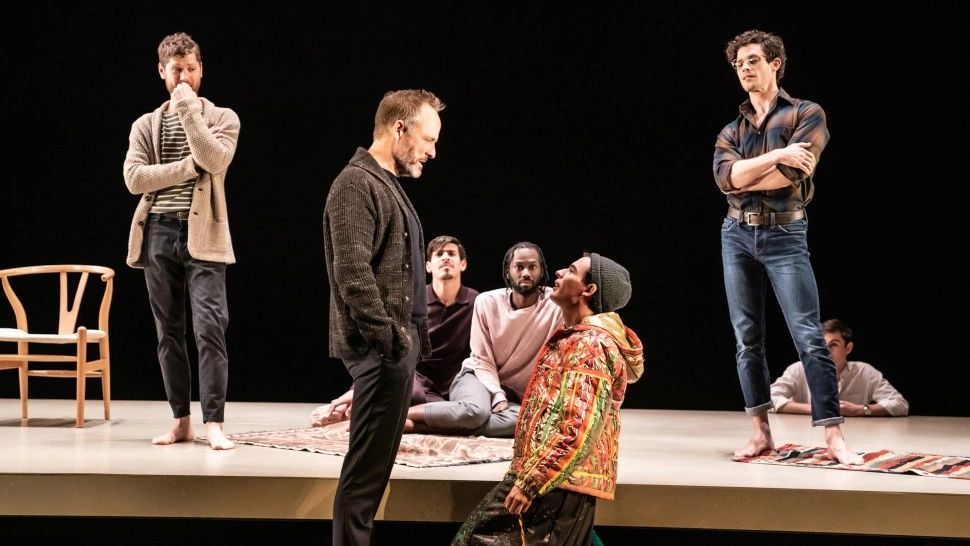
John Benjamin Hickey, Dylan Frederick, and cast of The Inheritance
Every generation or so since the late 1960s, a new play encapsulating the gay experience opens in New York. The Boys in the Band, Torch Song Trilogy, Love! Valour! Compassion!, and Angels in America have defined their respective gay moment and how the general society is reacting to it. Matthew Lopez’s The Inheritance is the latest theatrical chronicle of the American gay journey. The massive work checks all the right boxes for a certifiable hit: a smash production in London complete with Olivier Awards; glowing reviews and snob appeal; an epic two-evening running time of more than seven hours; a fluid, funny, clever production from director Stephen Daldry; and moving, intense performances. The play itself, inspired by Howard’s End, E.M. Forster’s classic novel of connection and redemption, is a mixed bag of brilliant moments of pathos, insight, and observation, as well as extraneous, melodramatic, and forced scenes.
Lopez does not slavishly adhere to Forster’s original text of Edwardian class conflict in pre–World War I England. He used the plot template of the liberal Schlegel sisters and their interactions with the conservative, ultra-rich Wilcox clan to explore where we are as a culture and how gay men have adjusted to the aftermath of the AIDS crisis, marriage equality, and the resurgence of a homophobic political agenda from the right. There is much to savor here, but there are plenty of bumps and rough stretches along the way.
The play begins simply, then Lopez and Daldry skillfully develop and build the perspective into a deeper, more complex view. The casually dressed cast is seated around Bob Crowley’s bare set, scribbling in notebooks as if in a creative writing class. A figure dressed in 1910s style (Crowley also designed the subtly appropriate costumes) emerges. This is Forster (played with elegant understatement by Paul Hilton) offering his advice to the next generation of gays on constructing their narrative. The actors address the audience, finishing each other’s sentences, and tell the fraught story of empathetic political activist Eric (wonderfully sincere Kyle Soller) and self-destructive writer Toby (overacting Andrew Burnap), a couple whose connection parallels the battle between self-love and self-deprecation many gay men endure. There are a plethora of subplots, but the central thread concerns the duo’s relationship to the wealthy, covetous Henry Wilcox (solid and shaded John Benjamin Hickey) and his more compassionate partner Walter Poole (also played by Hilton). Also figuring prominently are narcissistic actor Adam and pathetic hustler Leo, both enacted with precision and variety by Samuel H. Levine.
For every emotionally impactful punch, such as the devastating Part One finale where Eric encounters the ghosts of AIDS victims in a parade of stolen lives, there is a superfluous segment such as an endless debate on the values of camp. Another example is cameo, late in Part Two, of the only female character, Margaret. Though her monologue recounting the death of her son from AIDS is shatteringly written and sensitively played by the magnificent Lois Smith, it does not convey any new information or insight, and the character feels tossed in out of left field. None of the minor characters is fully developed, and Toby’s long spiral downward after achieving success with a supposedly autobiographical novel and play is melodramatic and over-the-top, particularly as played by the hyperventilating Burnap. Yet, Inheritance’s strengths outweigh its shortcomings, and Daldry’s well-paced, versatile staging makes the marathon length fly by.
The play has clunky structural problems. The first scene is all exposition with Will pouring his life story out to a young co-worker (Dan Bittner). Later, Pete’s great-nephew Carson (Jon Orsini), who just happened to be living in the same Atlanta boarding house as Bill and Randy, conveniently comes to call. But like The Inheritance, the production overcomes the script’s flaws. Young Man honestly examines American middle-class mores of equating wealth with happiness and unflinchingly rips away the prosperous facade of the couple’s elegant existence as they must confront economic and emotional reality. Michael Wilson, who has helmed many previous Foote plays including the epic The Orphans’ Home Cycle, delivers a heartfelt, straightforward staging with an impeccable and moving cast capturing the quiet desperation of Foote’s lonely family, detached from their gay son.
Barrymore Theatre
The Young Man From Atlanta
Signature Theatre at the Pershing Square Signature Center
Reviewed by David Sheward

Photo by Matthew Murphy
Every generation or so since the late 1960s, a new play encapsulating the gay experience opens in New York. The Boys in the Band, Torch Song Trilogy, Love! Valour! Compassion!, and Angels in America have defined their respective gay moment and how the general society is reacting to it. Matthew Lopez’s The Inheritance is the latest theatrical chronicle of the American gay journey. The massive work checks all the right boxes for a certifiable hit: a smash production in London complete with Olivier Awards; glowing reviews and snob appeal; an epic two-evening running time of more than seven hours; a fluid, funny, clever production from director Stephen Daldry; and moving, intense performances. The play itself, inspired by Howard’s End, E.M. Forster’s classic novel of connection and redemption, is a mixed bag of brilliant moments of pathos, insight, and observation, as well as extraneous, melodramatic, and forced scenes.
Lopez does not slavishly adhere to Forster’s original text of Edwardian class conflict in pre–World War I England. He used the plot template of the liberal Schlegel sisters and their interactions with the conservative, ultra-rich Wilcox clan to explore where we are as a culture and how gay men have adjusted to the aftermath of the AIDS crisis, marriage equality, and the resurgence of a homophobic political agenda from the right. There is much to savor here, but there are plenty of bumps and rough stretches along the way.
The play begins simply, then Lopez and Daldry skillfully develop and build the perspective into a deeper, more complex view. The casually dressed cast is seated around Bob Crowley’s bare set, scribbling in notebooks as if in a creative writing class. A figure dressed in 1910s style (Crowley also designed the subtly appropriate costumes) emerges. This is Forster (played with elegant understatement by Paul Hilton) offering his advice to the next generation of gays on constructing their narrative. The actors address the audience, finishing each other’s sentences, and tell the fraught story of empathetic political activist Eric (wonderfully sincere Kyle Soller) and self-destructive writer Toby (overacting Andrew Burnap), a couple whose connection parallels the battle between self-love and self-deprecation many gay men endure. There are a plethora of subplots, but the central thread concerns the duo’s relationship to the wealthy, covetous Henry Wilcox (solid and shaded John Benjamin Hickey) and his more compassionate partner Walter Poole (also played by Hilton). Also figuring prominently are narcissistic actor Adam and pathetic hustler Leo, both enacted with precision and variety by Samuel H. Levine.
For every emotionally impactful punch, such as the devastating Part One finale where Eric encounters the ghosts of AIDS victims in a parade of stolen lives, there is a superfluous segment such as an endless debate on the values of camp. Another example is cameo, late in Part Two, of the only female character, Margaret. Though her monologue recounting the death of her son from AIDS is shatteringly written and sensitively played by the magnificent Lois Smith, it does not convey any new information or insight, and the character feels tossed in out of left field. None of the minor characters is fully developed, and Toby’s long spiral downward after achieving success with a supposedly autobiographical novel and play is melodramatic and over-the-top, particularly as played by the hyperventilating Burnap. Yet, Inheritance’s strengths outweigh its shortcomings, and Daldry’s well-paced, versatile staging makes the marathon length fly by.
Horton Foote’s The Young Man From Atlanta, now playing Off-Broadway at the Signature Theater, also examines gay characters, though only peripherally and through a totally different lens. Premiered in 1995 at Signature and revived on Broadway in 1997, this Pulitzer Prize winner reflects the attitude toward gays of the era of its setting (Houston in 1950). The queer figures are not even onstage, one of them has committed suicide, and they are only important in how they affect straight people.
The main struggle is that of bragging businessman Will Kidder (bluff but vulnerable Aidan Quinn) and his flighty, sweet wife Lily Dale (simultaneously tragic and comic Kristin Nielsen). Several months after the mysterious death of their only son, Bill, they are confronted by the unwelcome visit of the title character, Randy, Bill’s much younger roommate. Will does not want to see Randy, but Lily Dale craves his company as a reminder of her child. While the words gay, queer, and homosexual are never even spoken and Randy remains offstage, it’s clear he and Bill were in a relationship, and neither parent can face the truth. This unmentionable secret is but one of many problems confronting the Kidders. Will loses his job just as they move into an expensive new home (Jeff Cowie created the period-perfect suburban 1950s set) along with Lily Dale’s stepfather, Pete (subtly tender Stephen Payne).The play has clunky structural problems. The first scene is all exposition with Will pouring his life story out to a young co-worker (Dan Bittner). Later, Pete’s great-nephew Carson (Jon Orsini), who just happened to be living in the same Atlanta boarding house as Bill and Randy, conveniently comes to call. But like The Inheritance, the production overcomes the script’s flaws. Young Man honestly examines American middle-class mores of equating wealth with happiness and unflinchingly rips away the prosperous facade of the couple’s elegant existence as they must confront economic and emotional reality. Michael Wilson, who has helmed many previous Foote plays including the epic The Orphans’ Home Cycle, delivers a heartfelt, straightforward staging with an impeccable and moving cast capturing the quiet desperation of Foote’s lonely family, detached from their gay son.
December 3, 2019
The Inheritance: Nov 17–March 1. Barrymore Theatre, 243 W 47th St, NYC. Part One: Wed 1pm, Thu-Fri 7pm, Sat-Sun 1pm. Part Two: Wed 7pm, Sat-Sun 7pm. Running time: Part One: 3 hours and 15 minutes, including two intermissions. Part Two: 3 hours and 10 minutes, including one intermission and a brief pause. $39–$199 per part. (212) 239-6200.
The Young Man From Atlanta: Nov 24–Dec 15. Signature Theatre at the Pershing Square Signature Center, 480 W 42nd St, NYC. Tue 7:30pm, Wed 2pm & 7:30pm, Thu-Fri 7:30pm, Sat 2pm & 8pm, Sun 2pm. Running time 2 hours and five minutes, including intermission. $35–$55. (212) 244-7529.
Soft Power
The Public Theater
Is This a Room
Vineyard Theatre
Bella Bella
Manhattan Theater Club at City Center Stage I
Reviewed by David Sheward
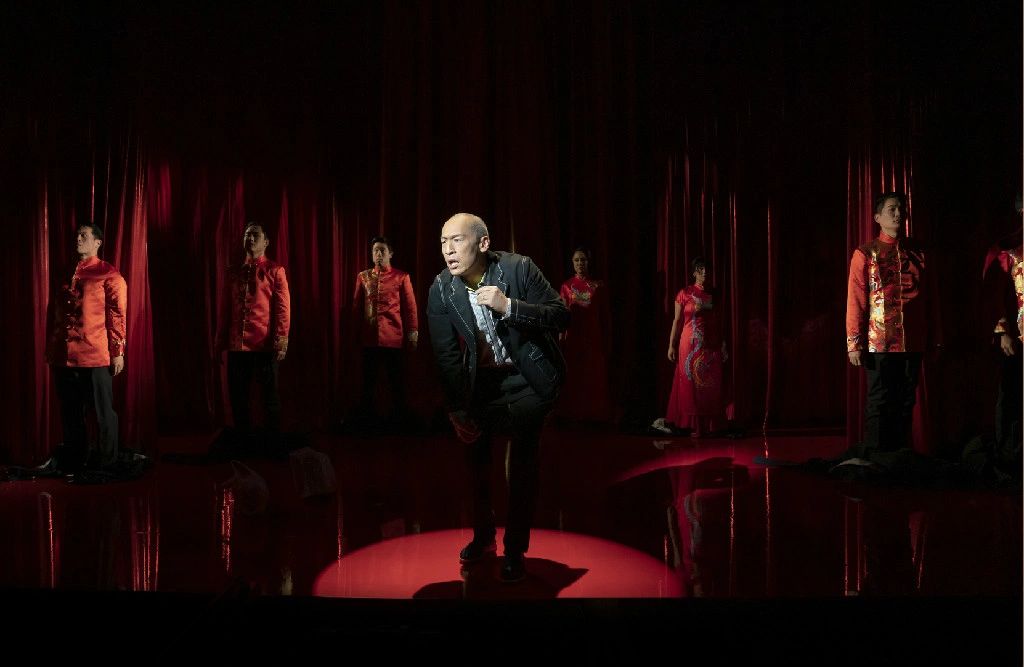
Francis Jue and the ensemble of Soft Power
Soft Power, the gloriously messy but idea-packed new musical from two of our most vital and prolific theater artists, David Henry Hwang and Jeanine Tesori, is anything but soft. The title refers to countries’ gaining world dominance through cultural influence rather than military hardware and muscle flexing. Hwang’s hilariously satiric and complex book also addresses the 2016 election, ethnic stereotyping, romantic comedies, musical theater conventions, hate crimes, and China’s relationship with the US. Yeah, it’s a lot to take in, but the creators and their inventive director Leigh Silverman address all of these issues and more in a fast-paced, funny, yet deep concoction that, unlike most musicals, actually makes you think while it entertains you.
The inspiration comes from an actual horrific event that occurred to Hwang. On the morning after Donald Trump’s presidential triumph, the playwright was stabbed in the neck by an unknown assailant. (The case still has not been solved.) In the musical’s alternate universe, an Asian-American playwright referred to as DHH is recruited by Xue Xang, a Shanghai-based producer, to write a splashy musical based on a popular Chinese rom-com. The author and entrepreneur clash over American and Chinese attitudes toward romance and marriage. During the course of their collaboration, they attend a fundraising performance of The King and I for presidential candidate and presumptive winner Hillary Clinton. The unexpected results of the election lead DHH and Xang to question their future in America. Then Hwang is stabbed and the rest of the show is a musical-within-in-a-musical combining elements of the film-based script DHH was working on, references to The King and I, a liaison between Clinton and Xang, and pointed, uncomfortable observations on our political system and cultural stereotypes.
In the most unconventional, bracing choice, Asian performers flip the script and, with one exception (that of the actress playing Hillary), play all the white roles. This parodies the convention of white actors playing Asian roles and introduces various clichés about America, turning the tables on New York audiences as they see how we are viewed from abroad. The Golden Gate Bridge is in New York, all US citizens are armed to the teeth, and MacDonald’s is the height of dining sophistication. Hwang’s book hilariously blends these tropes with his deadly serious barbs on how we elect our officials. Tesori's versatile score mixes Broadway sounds from both the Sondheim and Rodgers and Hammerstein eras, as well as rap, hip-hop, country-western, Asian, and the blues.
Conrad Ricamora makes for a virile, attractive leading man as Xue, while Alyse Alan Louis creates an intensely human Hillary Clinton who is both political cartoon and idealistic woman. As DHH, Francis Jue skillfully leads us through this hall of mirrors, with spiky supporting turns from Jon Hoche, Austin Ku, Raymond J. Lee, Kendyl Ito, and the rest of the versatile ensemble. Set designer Clint Ramos creates a wacky caricature world, and Anita Yavich’s costumes are as humorous as the relevant, dangerously funny script and score.
At first it seemed to me the name Reality Winner was an ironic code name to protect the woman’s identity, but it is in fact her real moniker, and, as of this writing, she is still serving a prison sentence. Emily Davis subtly conveys Reality’s reality, her shrinking self-esteem and confidence, and the importance of the subtextual details of her life as they are taken from her. Pete Simpson, TL Thompson, and Becca Blackwell underplay the authority and power of the agents, but still impart a sense of intimidation and menace. Room is more about tone and feelings than story. It may be brief and lacking in plot, but it definitely leaves you shaken and rattled.
The Public Theater
Is This a Room
Vineyard Theatre
Bella Bella
Manhattan Theater Club at City Center Stage I
Reviewed by David Sheward

Photo by Joan Marcus
Soft Power, the gloriously messy but idea-packed new musical from two of our most vital and prolific theater artists, David Henry Hwang and Jeanine Tesori, is anything but soft. The title refers to countries’ gaining world dominance through cultural influence rather than military hardware and muscle flexing. Hwang’s hilariously satiric and complex book also addresses the 2016 election, ethnic stereotyping, romantic comedies, musical theater conventions, hate crimes, and China’s relationship with the US. Yeah, it’s a lot to take in, but the creators and their inventive director Leigh Silverman address all of these issues and more in a fast-paced, funny, yet deep concoction that, unlike most musicals, actually makes you think while it entertains you.
The inspiration comes from an actual horrific event that occurred to Hwang. On the morning after Donald Trump’s presidential triumph, the playwright was stabbed in the neck by an unknown assailant. (The case still has not been solved.) In the musical’s alternate universe, an Asian-American playwright referred to as DHH is recruited by Xue Xang, a Shanghai-based producer, to write a splashy musical based on a popular Chinese rom-com. The author and entrepreneur clash over American and Chinese attitudes toward romance and marriage. During the course of their collaboration, they attend a fundraising performance of The King and I for presidential candidate and presumptive winner Hillary Clinton. The unexpected results of the election lead DHH and Xang to question their future in America. Then Hwang is stabbed and the rest of the show is a musical-within-in-a-musical combining elements of the film-based script DHH was working on, references to The King and I, a liaison between Clinton and Xang, and pointed, uncomfortable observations on our political system and cultural stereotypes.
In the most unconventional, bracing choice, Asian performers flip the script and, with one exception (that of the actress playing Hillary), play all the white roles. This parodies the convention of white actors playing Asian roles and introduces various clichés about America, turning the tables on New York audiences as they see how we are viewed from abroad. The Golden Gate Bridge is in New York, all US citizens are armed to the teeth, and MacDonald’s is the height of dining sophistication. Hwang’s book hilariously blends these tropes with his deadly serious barbs on how we elect our officials. Tesori's versatile score mixes Broadway sounds from both the Sondheim and Rodgers and Hammerstein eras, as well as rap, hip-hop, country-western, Asian, and the blues.
Conrad Ricamora makes for a virile, attractive leading man as Xue, while Alyse Alan Louis creates an intensely human Hillary Clinton who is both political cartoon and idealistic woman. As DHH, Francis Jue skillfully leads us through this hall of mirrors, with spiky supporting turns from Jon Hoche, Austin Ku, Raymond J. Lee, Kendyl Ito, and the rest of the versatile ensemble. Set designer Clint Ramos creates a wacky caricature world, and Anita Yavich’s costumes are as humorous as the relevant, dangerously funny script and score.
Speaking of theater based on real life political events, Tina Satter’s Is This a Room at the Vineyard goes even further than Soft Power into meta territory. The entire text is composed of a transcript of FBI agents questioning a former Air Force linguist named Reality Winner in 2017. She was interrogated in her own home and then charged with leaking classified government information on Russian interference with the 2016 presidential election. In 70 tense minutes, Satter and a quartet of actors transform Parker Lutz’s bare set into a chamber of intimidation and fear. Lee Kinney and Sanae Yamada’s metallic sound design re-creating the aural landscape of a tape recording adds to the eerie, otherworldly atmosphere.
Reality’s defenses crumble as the agents casually chat about her pets, the groceries she’s carrying (she is just returning from the supermarket), and her workout routines. Her personal space grows smaller and smaller as her questioners take over her home, move closer into her domain, and eventually corner her in a tiny space for her cat and dog (hence the title). The subject of the documents is not even directly mentioned, and, whenever it comes up, the lights black out and sound designers Kinney and Yamada provide an ominous boom representing a redaction. Context would help somewhat (there are explanations in the program), but Satter is after creating a mood of tension and fear and exploring how authority figures by their very presence can easily instill panic.At first it seemed to me the name Reality Winner was an ironic code name to protect the woman’s identity, but it is in fact her real moniker, and, as of this writing, she is still serving a prison sentence. Emily Davis subtly conveys Reality’s reality, her shrinking self-esteem and confidence, and the importance of the subtextual details of her life as they are taken from her. Pete Simpson, TL Thompson, and Becca Blackwell underplay the authority and power of the agents, but still impart a sense of intimidation and menace. Room is more about tone and feelings than story. It may be brief and lacking in plot, but it definitely leaves you shaken and rattled.
For a more uplifting true politically themed story, hightail it over to City Center for Manhattan Theater Club’s intimate production of Bella Bella, written by and starring Harvey Fierstein as the late firebrand Bella Abzug, directed with economy and verve by Kimberly Senior. Set in 1976 as she awaits the results of her Democratic primary run for US Senator from New York—she eventually lost to Daniel Patrick Moynihan—this funny and moving solo show retraces Abzug’s career from crusading lawyer to one of the few women in the US House of Representatives to feminist icon. Employing the subject’s own writings, Fierstein lovingly creates a portrait of strength and humor. There is no attempt at imitation or cross-dressing. Costume designer Rita Ryack dresses the actor in gender-neutral pajamas. But Fierstein captures the essence of Abzug’s spirit. Given his history of fighting for and creating positive gay roles, it doesn’t feel odd that he is playing a woman breaking barriers for her gender. John Lee Beatty’s stylish hotel bathroom set becomes a political platform, lecturer’s rostrum, standup-comedy stage, and storyteller’s cozy corner in Fierstein’s capable hands.
December 3, 2019
Soft Power: Oct 15–Nov 17. Public Theater, 425 Lafayette St, NYC. Tue–Fri 8pm, Sat-Sun 2pm & 8pm. Running time 2 hours and 15 minutes, including intermission. $60–70. (212) 967-7555.
Is This a Room: Oct. 22–Nov. 24. Vineyard Theater, 108 E 15th St, NYC. Tue–Thu 7pm, Fri 8pm, Sat 3pm & 8pm, Sun 3pm. Running time 70 minutes, no intermission. $45–$100. (212) 353-0303.
Bella Bella: Oct. 22–Dec. 1. Manhattan Theater Club at City Center Stage I, 131 W 55th St, NYC. Schedule varies. Running time 90 minutes, no intermission. $99–$139. (212) 581-1212.
A Christmas Carol
David Byrne’s American Utopia
Hudson Theater
Reviewed by David Sheward

Andrea Martin, LaChanze, Campbell Scott, and Rachel Prather in A Christmas Carol
The holiday cheer begins at the Lyceum Theater before the latest incarnation of Dickens’s classic A Christmas Carol even commences. The holiday outing arrives on Broadway after a hit run in London. Lighting designer Hugh Vanstone has created a warm 19th-century glow aided by lit candles throughout the theater. Patrons are greeted by cheerful staffers dressed in period costumes offering free cookies and clementine oranges. Cast members and musicians stroll onstage and play traditional yuletide favorites. The atmosphere is comfy and cozy for the beloved tale of the cold-hearted Ebenezer Scrooge and his redemption by a gaggle of benevolent ghosts, told with new shadings and vigor.
There have been so many iterations of this tale it’s difficult to imagine a new way of telling it. From the gold standard of the 1951 Alastair Sim film version to multiple musical variations to countess cartoons and parodies, Scrooge is part of our collective Christmas consciousness. Director Matthew Warchus and playwright Jack Thorne, who won a Tony for updating another legendary British icon in Harry Potter and the Cursed Child, meet the challenge by adding to the misanthropic miser’s complexity and building a frighteningly justifiable case for his tight-fistedness.
Sounding like a Trumpian capitalist, Campbell Scott as Scrooge mounts a steely resistance against the pleas of Jacob Marley and his fellow spirits for the old skinflint to put humanity before money. Scott, whose father George C. also played the role in a memorable 1984 made-for-TV movie, is a much younger and more vital Scrooge than usual. He’s not a caricature of inhumanity but a twisted soul battered down by the economic brutalities of his age. His metamorphosis into a cheery old soul is all the more miraculous for his convincing and subtle portrayal of the character’s grinchiness. Thorne also adds details to the character’s oppressive family life and blighted romance with the strong-willed, idealistic Belle (fierce and fine Sarah Hunt). There is much symbolism, and the specter of death is ever present. Scrooge’s first employer Fezziwig (an effervescent Evan Harrington) is now an undertaker.
The script hits the nail on the head a bit too much and could use some cutting. The intermission is unnecessary and some of Thorne’s additions feel extraneous. But Warchus’s quick paced, jovial staging counters the weightiness of Thorne’s expansion on Dickens’s taut original with a lighthearted holiday sprit and spooky effects, augmented by Rob Howell’s versatile set and Vanstone’s spectral lighting. There’s a great deal of audience involvement, which adds to the running time but not to the entertainment. One sequence involving the theatergoers passing food onto the stage for the Crachit family feast goes on too long.
The ghosts of Christmas Past, Present, and Future are not their traditional templates of holiday cutouts but variations on Scrooge’s dead little sister Fan, all similarly costumed by Howell. Each pushes a baby carriage that eventually evolves into a coffin.
As Christmas Past, Andrea Martin displays her customary dry wit (she hilariously goes “Boo” when introducing herself as a ghost). LaChanze make Christmas Present a stern West Indian taskmaster who will put up with none of Scrooge’s nonsense. Rachel Prather transforms the usually horrifying Christmas Future into a benevolent promise of hope. Chris Hoch provides the appropriate gnarled nastiness as Scrooge’s unloving father and a truly frightening reminder of what Scrooge could become as Marley’s Ghost (tethered to the underworld by an endless chain in Howell’s otherworldly costume). This is altogether a wondrous Carol celebrating the spirit of the season and the magic of theater.
Lyceum Theater
David Byrne’s American Utopia
Hudson Theater
Reviewed by David Sheward

Photo by Joan Marcus
The holiday cheer begins at the Lyceum Theater before the latest incarnation of Dickens’s classic A Christmas Carol even commences. The holiday outing arrives on Broadway after a hit run in London. Lighting designer Hugh Vanstone has created a warm 19th-century glow aided by lit candles throughout the theater. Patrons are greeted by cheerful staffers dressed in period costumes offering free cookies and clementine oranges. Cast members and musicians stroll onstage and play traditional yuletide favorites. The atmosphere is comfy and cozy for the beloved tale of the cold-hearted Ebenezer Scrooge and his redemption by a gaggle of benevolent ghosts, told with new shadings and vigor.
There have been so many iterations of this tale it’s difficult to imagine a new way of telling it. From the gold standard of the 1951 Alastair Sim film version to multiple musical variations to countess cartoons and parodies, Scrooge is part of our collective Christmas consciousness. Director Matthew Warchus and playwright Jack Thorne, who won a Tony for updating another legendary British icon in Harry Potter and the Cursed Child, meet the challenge by adding to the misanthropic miser’s complexity and building a frighteningly justifiable case for his tight-fistedness.
Sounding like a Trumpian capitalist, Campbell Scott as Scrooge mounts a steely resistance against the pleas of Jacob Marley and his fellow spirits for the old skinflint to put humanity before money. Scott, whose father George C. also played the role in a memorable 1984 made-for-TV movie, is a much younger and more vital Scrooge than usual. He’s not a caricature of inhumanity but a twisted soul battered down by the economic brutalities of his age. His metamorphosis into a cheery old soul is all the more miraculous for his convincing and subtle portrayal of the character’s grinchiness. Thorne also adds details to the character’s oppressive family life and blighted romance with the strong-willed, idealistic Belle (fierce and fine Sarah Hunt). There is much symbolism, and the specter of death is ever present. Scrooge’s first employer Fezziwig (an effervescent Evan Harrington) is now an undertaker.
The script hits the nail on the head a bit too much and could use some cutting. The intermission is unnecessary and some of Thorne’s additions feel extraneous. But Warchus’s quick paced, jovial staging counters the weightiness of Thorne’s expansion on Dickens’s taut original with a lighthearted holiday sprit and spooky effects, augmented by Rob Howell’s versatile set and Vanstone’s spectral lighting. There’s a great deal of audience involvement, which adds to the running time but not to the entertainment. One sequence involving the theatergoers passing food onto the stage for the Crachit family feast goes on too long.
The ghosts of Christmas Past, Present, and Future are not their traditional templates of holiday cutouts but variations on Scrooge’s dead little sister Fan, all similarly costumed by Howell. Each pushes a baby carriage that eventually evolves into a coffin.
As Christmas Past, Andrea Martin displays her customary dry wit (she hilariously goes “Boo” when introducing herself as a ghost). LaChanze make Christmas Present a stern West Indian taskmaster who will put up with none of Scrooge’s nonsense. Rachel Prather transforms the usually horrifying Christmas Future into a benevolent promise of hope. Chris Hoch provides the appropriate gnarled nastiness as Scrooge’s unloving father and a truly frightening reminder of what Scrooge could become as Marley’s Ghost (tethered to the underworld by an endless chain in Howell’s otherworldly costume). This is altogether a wondrous Carol celebrating the spirit of the season and the magic of theater.
David Byrne’s American Utopia is another celebratory theater event unusual for Broadway. The former front man for Talking Heads and a genius-level solo artist, Byrne presents an intoxicating hybrid of rock concert, dance program, and howlingly fun party. Audience members at the performance attended had no hesitation to stand and dance in the aisles to “The Road to Nowhere,” “Once in a Lifetime,” and the ultimate shake-your-booty inducer “Burning Down the House.”
Byrne, in remarkable shape and voice at 67, is accompanied by a stageful of international instrumentalists, mostly percussionists, and two charismatic backup singers (Daniel Freedman and Tenda Yi Kuumba), creating finger-snapping, infectious music. All are barefoot and dressed in identical grey suits. Choreographer Annie-B Parson’s stylized movement and patterns of staging lend variety and eccentricity to each number. Alex Timbers, who collaborated with Byrne on the immersive musical Here Lies Love, is listed as production consultant, so it’s difficult to judge where his contribution begins and Parson’s ends. The storyless concert is stitched together by Byrne’s commentary and his desire for connection between the ordinary world and the vibrant spirit that binds us together. It’s a fun evening, even if you’re not a Byrne-head.
November 27, 2019
A Christmas Carol: Nov 20–Jan 5. Lyceum Theater, 149 W 45th St, NYC. Tue 7pm, Wed 2pm & 7pm, Thu 7pm, Fri 8pm, Sat 2pm & 8pm, Sun 3pm. Running time 2 hours, including intermission. $69–$299. (212) 239-6200.
David Byrne’s American Utopia: Oct 20–Feb 16. Hudson Theater, 141 W 44th St, NYC. Wed–Fri 8pm, Sat 5:30pm & 9pm, Sun 3pm. Running time 1 hour and 40 mins, no intermission. $69–$499. (855) 801-5876.
Maestro
Ensemble for the Romantic Century at The Duke on 42nd Street
Reviewed by David Sheward

The musicians of Maestro
The life of Arturo Toscanini, perhaps the greatest conductor of the 20th century, would make a fascinating drama. In addition to collaborating with all the top names of the music world in his decades-long career, he bravely took a stance against fascism in his native Italy and in Nazi Germany, leaving Europe in the late 1930s to lead the NBC Orchestra and bring the classics into millions of American homes over the radio waves. Plus, a recent discovery of a cache of letters offers a glimpse into his intimate life, particularly a long-term affair with the pianist Ada Colleone Mainardi. Unfortunately, Maestro, a strange combination of solo show and concert presented by Ensemble for the Romantic Century, is not that work.
Playwright Eve Wolf, the company’s executive artistic director, stitches together excerpts from the newly discovered letters with performances by a sterling ensemble of musicians of memorable pieces Toscanini conducted. The framing device is a 1938 rehearsal where the conductor displays his legendary temper at the NBC Orchestra (the audience), then recounts how he got to this celebrated position. Actor John Noble bears a striking resemblance to the subject, and he imparts some of Toscanini’s renowned passion for his music, but we do not see much of the man beyond histrionics and pining for Mainardi, who remained in Germany while Hitler was in power. Noble delivers a mostly one-note performance, varying little from angry rants. Wolf’s script doesn’t tell us much about Toscanini’s artistry, and Donald T. Saunders’s direction is sluggish.
But the real heart of Maestro is the glittering professionalism of its musicians, particularly pianist Zhenni Li, who gives brilliant life and fingering to Wagner’s “Liebestod” and Gershwin’s “Rhapsody in Blue.” The latter also provides a magnificent solo for trumpeter Maximilian Morel, who wrote the special arrangement for this glorious piece evocative of 1930s Manhattan. David Bengali’s imaginative projections create striking images to accompany the sublime sounds. Ironically, the climax of the first act and that of the show itself are marked by musical performances with Noble as the main character offstage. This tells us the music, and not the actor or the script, is the center of this show.
Ensemble for the Romantic Century at The Duke on 42nd Street
Reviewed by David Sheward

Photo by Shirin Tinati
The life of Arturo Toscanini, perhaps the greatest conductor of the 20th century, would make a fascinating drama. In addition to collaborating with all the top names of the music world in his decades-long career, he bravely took a stance against fascism in his native Italy and in Nazi Germany, leaving Europe in the late 1930s to lead the NBC Orchestra and bring the classics into millions of American homes over the radio waves. Plus, a recent discovery of a cache of letters offers a glimpse into his intimate life, particularly a long-term affair with the pianist Ada Colleone Mainardi. Unfortunately, Maestro, a strange combination of solo show and concert presented by Ensemble for the Romantic Century, is not that work.
Playwright Eve Wolf, the company’s executive artistic director, stitches together excerpts from the newly discovered letters with performances by a sterling ensemble of musicians of memorable pieces Toscanini conducted. The framing device is a 1938 rehearsal where the conductor displays his legendary temper at the NBC Orchestra (the audience), then recounts how he got to this celebrated position. Actor John Noble bears a striking resemblance to the subject, and he imparts some of Toscanini’s renowned passion for his music, but we do not see much of the man beyond histrionics and pining for Mainardi, who remained in Germany while Hitler was in power. Noble delivers a mostly one-note performance, varying little from angry rants. Wolf’s script doesn’t tell us much about Toscanini’s artistry, and Donald T. Saunders’s direction is sluggish.
But the real heart of Maestro is the glittering professionalism of its musicians, particularly pianist Zhenni Li, who gives brilliant life and fingering to Wagner’s “Liebestod” and Gershwin’s “Rhapsody in Blue.” The latter also provides a magnificent solo for trumpeter Maximilian Morel, who wrote the special arrangement for this glorious piece evocative of 1930s Manhattan. David Bengali’s imaginative projections create striking images to accompany the sublime sounds. Ironically, the climax of the first act and that of the show itself are marked by musical performances with Noble as the main character offstage. This tells us the music, and not the actor or the script, is the center of this show.
February 6, 2019
Jan 15–Feb 9. Ensemble for the Romantic Century at The Duke on 42nd Street, 229 W. 42nd St., NYC. Tue 7:30pm, Wed 2pm & 7:30pm, Thu 7:30pm, Fri 8pm, Sat 2pm & 8pm. Running time 2 hours and 10 minutes, including intermission. (646) 223-3010.
Pelléas et Mélisande
Metropolitan Opera
Reviewed by David Sheward

Paul Appleby and Isabel Leonard
Claude Debussy’s moving Pelléas et Mélisande defies operatic convention. Eschewing passionate arias where the divas pour out every thought and motive for their extreme actions, this mysterious love triangle is all recitative with inner feelings largely unexpressed in words. The music does that, exquisitely conducted at the Metropolitan Opera by new music director Yannick Nézet-Séguin. Those yearning for a splashy solo will be disappointed. The music is delicate and subtle, requiring careful attention. When it opened in Paris in 1902, some critics found it “sickly and practically lifeless.” But there are contemplative joys to be found in its nuances and complex melodies. The Metropolitan Opera’s revival of Jonathan Miller’s 1995 production (restaged by Paula Williams) takes its time to establish an emotional connection among characters, music and audience, but by the third act a mystical spell has been woven.
The plot, based on Maurice Maeterlinck’s symbolic, anti-naturalistic stage play, has been seen a million times before and since. The title lovers engage in forbidden flirting though the innocent young Mélisande is married to the elder brother of the impetuous Pélleas. Suffice it to say things do not end well. Miller has transported the setting from a medieval milieu to a ruined early 20th-century castle, replete with covered furniture and crumbling statues. (The eerie sets and period costumes are by John Conklin and Clare Mitchell, respectively.)
Paul Appleby and Isabel Leonard give lyrically beautiful renditions of the titular sweethearts—their Act III duet is soaringly sublime—but the show is stolen by Kyle Ketelsen as Golaud, Pélleas’s gruff sibling and Mélisande’s possessive husband. While the principal swooners display limited character development, Golaud goes through a full spectrum of emotions from enchantment with his waif-like bride to jealous rage to gut-wrenching remorse. Ketelsen gives full voice and color to these varied passions with his rich bass-baritone. Ferruccio Furlanetto provides girder-like support and a rumbling tone to the aging king Arkel and Marie-Nicole Lemieux is a warm Geneviève, mother to the battling siblings.
Pelléas et Mélisande may not be for every opera fan, but those willing to listen to its sweetly seductive charms will be rewarded.
Metropolitan Opera
Reviewed by David Sheward

Photo courtesy of the Met
Claude Debussy’s moving Pelléas et Mélisande defies operatic convention. Eschewing passionate arias where the divas pour out every thought and motive for their extreme actions, this mysterious love triangle is all recitative with inner feelings largely unexpressed in words. The music does that, exquisitely conducted at the Metropolitan Opera by new music director Yannick Nézet-Séguin. Those yearning for a splashy solo will be disappointed. The music is delicate and subtle, requiring careful attention. When it opened in Paris in 1902, some critics found it “sickly and practically lifeless.” But there are contemplative joys to be found in its nuances and complex melodies. The Metropolitan Opera’s revival of Jonathan Miller’s 1995 production (restaged by Paula Williams) takes its time to establish an emotional connection among characters, music and audience, but by the third act a mystical spell has been woven.
The plot, based on Maurice Maeterlinck’s symbolic, anti-naturalistic stage play, has been seen a million times before and since. The title lovers engage in forbidden flirting though the innocent young Mélisande is married to the elder brother of the impetuous Pélleas. Suffice it to say things do not end well. Miller has transported the setting from a medieval milieu to a ruined early 20th-century castle, replete with covered furniture and crumbling statues. (The eerie sets and period costumes are by John Conklin and Clare Mitchell, respectively.)
Paul Appleby and Isabel Leonard give lyrically beautiful renditions of the titular sweethearts—their Act III duet is soaringly sublime—but the show is stolen by Kyle Ketelsen as Golaud, Pélleas’s gruff sibling and Mélisande’s possessive husband. While the principal swooners display limited character development, Golaud goes through a full spectrum of emotions from enchantment with his waif-like bride to jealous rage to gut-wrenching remorse. Ketelsen gives full voice and color to these varied passions with his rich bass-baritone. Ferruccio Furlanetto provides girder-like support and a rumbling tone to the aging king Arkel and Marie-Nicole Lemieux is a warm Geneviève, mother to the battling siblings.
Pelléas et Mélisande may not be for every opera fan, but those willing to listen to its sweetly seductive charms will be rewarded.
January 27, 2019
Jan 15–Jan 31. Metropolitan Opera, 30 Lincoln Center Plaza, Broadway at 66th St., NYC. Remaining performance: Jan 31, 7:30pm. Running time 4 hours, including two intermissions. $30–$445. (212) 362-6000.
Choir Boy
Manhattan Theatre Club at Samuel J. Friedman Theatre
Slave Play
New York Theatre Workshop
Reviewed by David Sheward

The cast of Choir Boy
You can count on the fingers of two hands the number of African-American playwrights who have had more than one financially successful play on Broadway in the past few decades (August Wilson and Lynn Nottage are among the few). Add gay and the number gets even smaller or even non-existent, indicating that black queer voices have a difficult time being heard on America’s main commercial theatrical venue. Two current productions—one on Broadway and the other off—address the experiences not only of African-American gays but also of individuals of varying race, sexuality, and gender in interracial relations. Both playwrights offer startling different theatrical experiences and force us to examine hard questions—though one is rougher, rawer, and scarier.
Choir Boy, at Manhattan Theatre Club’s Samuel J. Friedman Theatre, marks the Broadway debut of Tarell Alvin McCraney who won an Oscar for Moonlight, which was based on his play In Moonlight Black Boys Look Blue. Choir Boy premiered in 2013 at MTC’s Off-Broadway space and, like Moonlight, focuses on the struggles of being gay in an African-American community. This time the microcosm is a boys prep school where flamboyant tenor Pharus Jonathan Young leads the prestigious gospel choir. Pharus’s unabashedly open style of performance and carriage bring him into direct conflict with the homophobic Bobby. But Pharus must also weave his way through the subtle maze of hetero prejudice, accentuated among black straight men because of the almost daily encounters with challenges to their masculinity from white racist attitudes.
In one telling scene, Pharus seeks to expand the appeal of traditional spirituals to include all minorities. Bobby is offended at Pharus’s implied conflation of black and gay oppression. And therein is the central conflict of the play: inclusion versus separation. Pharus demands openness, while most of his peers can tolerate his orientation if only he would tone it down. McCraney explores the myriad variations on this theme in a compelling hour and 45 minutes, staged with economy and passion by Trip Cullman, punctuated by stirring gospel numbers featuring Jason Michael Webb’s dynamic arrangements and Camille A. Brown’s exciting movement.
Jeremy Pope, who sports amazing pipes, captures Pharus’s sparkling fabulousness as well as his tender vulnerability, particularly when he drops the fierce mask and shows his aching need for love. J. Quentin Johnson makes Bobby much more than a bully by infusing his complex motivation for his anger at Pharus with depth. Chuck Cooper brings humor and dimension to the wise headmaster combatting his own biases. Austin Pendleton gives rumpled dignity to the absent-minded instructor, John Clay III lends compassion to Pharus’s jock roommate AJ, and Caleb Eberhardt captures the tortured soul of David, who shares a painful secret with Pharus. Their voices and those of the playwright make Choir Boy a beautiful song of acceptance and struggle.
Manhattan Theatre Club at Samuel J. Friedman Theatre
Slave Play
New York Theatre Workshop
Reviewed by David Sheward

Photo by Matthew Murphy
You can count on the fingers of two hands the number of African-American playwrights who have had more than one financially successful play on Broadway in the past few decades (August Wilson and Lynn Nottage are among the few). Add gay and the number gets even smaller or even non-existent, indicating that black queer voices have a difficult time being heard on America’s main commercial theatrical venue. Two current productions—one on Broadway and the other off—address the experiences not only of African-American gays but also of individuals of varying race, sexuality, and gender in interracial relations. Both playwrights offer startling different theatrical experiences and force us to examine hard questions—though one is rougher, rawer, and scarier.
Choir Boy, at Manhattan Theatre Club’s Samuel J. Friedman Theatre, marks the Broadway debut of Tarell Alvin McCraney who won an Oscar for Moonlight, which was based on his play In Moonlight Black Boys Look Blue. Choir Boy premiered in 2013 at MTC’s Off-Broadway space and, like Moonlight, focuses on the struggles of being gay in an African-American community. This time the microcosm is a boys prep school where flamboyant tenor Pharus Jonathan Young leads the prestigious gospel choir. Pharus’s unabashedly open style of performance and carriage bring him into direct conflict with the homophobic Bobby. But Pharus must also weave his way through the subtle maze of hetero prejudice, accentuated among black straight men because of the almost daily encounters with challenges to their masculinity from white racist attitudes.
In one telling scene, Pharus seeks to expand the appeal of traditional spirituals to include all minorities. Bobby is offended at Pharus’s implied conflation of black and gay oppression. And therein is the central conflict of the play: inclusion versus separation. Pharus demands openness, while most of his peers can tolerate his orientation if only he would tone it down. McCraney explores the myriad variations on this theme in a compelling hour and 45 minutes, staged with economy and passion by Trip Cullman, punctuated by stirring gospel numbers featuring Jason Michael Webb’s dynamic arrangements and Camille A. Brown’s exciting movement.
Jeremy Pope, who sports amazing pipes, captures Pharus’s sparkling fabulousness as well as his tender vulnerability, particularly when he drops the fierce mask and shows his aching need for love. J. Quentin Johnson makes Bobby much more than a bully by infusing his complex motivation for his anger at Pharus with depth. Chuck Cooper brings humor and dimension to the wise headmaster combatting his own biases. Austin Pendleton gives rumpled dignity to the absent-minded instructor, John Clay III lends compassion to Pharus’s jock roommate AJ, and Caleb Eberhardt captures the tortured soul of David, who shares a painful secret with Pharus. Their voices and those of the playwright make Choir Boy a beautiful song of acceptance and struggle.
Jeremy O. Harris has not yet achieved the prominence of McCraney, but his premiere work at New York Theater Workshop, Slave Play, marks him as a daring and innovative new dramatist. Without revealing too much of the plot twist, suffice to say that Harris explores multifaceted takes on race and sex in a surprising and satiric comedy. The intermissionless play opens with the audience viewing set designer Clint Ramos’s fractured vision of an antebellum plantation reflected in a wall of mirrors, while sound designer Lindsay Jones’s eerie broken¬ music-box melody plays on a loop. We are then presented with what appear to be three 19th-century master-slave couples engaging in weird amorous play— this is the first play I’ve ever seen with a credit for “Intimacy & Fight Director,” sizzling and sweaty done by Claire Warden. Then one of the participants jarringly calls out “Starbucks!” and the rug is ripped out from under us. We haven’t fallen down a rabbit hole of time and perception in the tradition of Bruce Norris’s Clybourne Park and Jonathan Reynolds’s Stonewall Jackson’s House. What follows is a riotous, uncompromising look at how black and white people see and react to each other, staged with the right balance of outrageous humor and prickly reality by Robert O’Hara, who has explored similar territory in his own plays Barbecue and Bootycandy.
The eight-member cast—another couple joins the sextet halfway through the action—delivers intensely funny and searingly dramatic performances, especially Teyonah Parris as a woman wrestling with racial demons and Annie McNamara in a hilarious parody of Southern belle-hood and modern hipness. Gay, straight, black, white, psychological, and sexual issues are given an unscrupulous eyeballing in this uncomfortably laugh-filled play. Harris has another show, Daddy, coming up this season in a joint production from the Vineyard Theater and the New Group. It’ll be exciting to see what surprises he has in store.
January 10, 2019
Choir Boy: Jan 8–Feb 17. Manhattan Theatre Club at the Samuel J. Friedman Theatre, 261 W. 47th St., NYC. Tue 7pm, Wed 2pm & 8pm, Thu-Fri 8pm, Sat 2pm & 8pm, Sun 2pm. Running time 1 hour and 45 minutes, no intermission. $79–$149. (212) 239-6200.
Slave Play: Dec 9–Jan 13. New York Theater Workshop, 79 E. 4th St., NYC. Tue-Thu 7pm, Fri 8pm, Sat 2pm & 8pm, Sun 2pm & 7pm. Running time 2 hours, no intermission. $99. (212) 460-5475.
Network
Belasco Theatre
The Hard Problem
Lincoln Center Theater at the Mitzi E. Newhouse Theatre
Reviewed by David Sheward

Bryan Cranston in Network
When the film Network was released in 1976, legendary screenwriter Paddy Chayefsky’s wild portrait of an America saturated by media was seen as an hilarious fantasy. Now as director Ivo van Hove’s stage version opens on Broadway after a smash run in London, the vision of a dumbed-down populace hypnotized by its screens seems tame in comparison to the reality of 2018. In another frightening parallel to our dystopian present, deranged anchorman Howard Beale (Oscar winner Peter Finch in the movie) awoke the senseless rage of his viewing audience with the now familiar catchphrase, “I’m as mad as hell and I’m not going to take it anymore.” Our reality-TV star president similarly touched a nerve of undirected anger and rode that wave into the White House, making this production terrifyingly relevant.
Lee Hall’s adaptation largely lifts Chayefsky’s screenplay with a few cuts—the terrorist group with its own TV hour has been downplayed. The true author of this inventive, involving piece of theater is van Hove who, along with his design partner Jan Versweyveld, has transformed the Belasco Theater into a world where video, stage, audience, and actors overlap and intermingle. Video screens are everywhere. An onstage restaurant provides meals for theatergoers as well as settings for the characters. The lines between TV and reality blur as when Beale and his news producer Max have a scene together at the corner of the stage. Their backs are to the audience, but their images are televised on a gigantic screen so that we are relating to their video avatars rather than to the flesh-and-blood actors. The medium becomes the message as images supersede and dwarf the actual. It’s arresting, dazzling theater and a frightening message of dehumanization in the age of 24/7 streaming.
Occasionally, the staging gets a bit gimmicky and lessens Chayefsky’s theme of the deadening force of TV. This occurs when Bryan Cranston’s edgy and unpredictable Beale wades into the audience to deliver a chilling message of hopelessness amid corporate tyranny. Cranston jokes with the first few rows as he sits among them, and suddenly we’re at a fun Broadway show instead of a devastating nightmare. Fortunately, there are few of these jolting slips.
Von Hove has previously taken classic American plays A View From the Bridge, The Little Foxes, The Crucible, and A Streetcar Named Desire, stripped them down and turned them inside out, giving new takes on classic views of our country. Here he creates a sense-stunning, funhouse mirror reflecting the bizarre world where truth is stranger than satire.
Belasco Theatre
The Hard Problem
Lincoln Center Theater at the Mitzi E. Newhouse Theatre
Reviewed by David Sheward

Photo by Jan Versweyveld
When the film Network was released in 1976, legendary screenwriter Paddy Chayefsky’s wild portrait of an America saturated by media was seen as an hilarious fantasy. Now as director Ivo van Hove’s stage version opens on Broadway after a smash run in London, the vision of a dumbed-down populace hypnotized by its screens seems tame in comparison to the reality of 2018. In another frightening parallel to our dystopian present, deranged anchorman Howard Beale (Oscar winner Peter Finch in the movie) awoke the senseless rage of his viewing audience with the now familiar catchphrase, “I’m as mad as hell and I’m not going to take it anymore.” Our reality-TV star president similarly touched a nerve of undirected anger and rode that wave into the White House, making this production terrifyingly relevant.
Lee Hall’s adaptation largely lifts Chayefsky’s screenplay with a few cuts—the terrorist group with its own TV hour has been downplayed. The true author of this inventive, involving piece of theater is van Hove who, along with his design partner Jan Versweyveld, has transformed the Belasco Theater into a world where video, stage, audience, and actors overlap and intermingle. Video screens are everywhere. An onstage restaurant provides meals for theatergoers as well as settings for the characters. The lines between TV and reality blur as when Beale and his news producer Max have a scene together at the corner of the stage. Their backs are to the audience, but their images are televised on a gigantic screen so that we are relating to their video avatars rather than to the flesh-and-blood actors. The medium becomes the message as images supersede and dwarf the actual. It’s arresting, dazzling theater and a frightening message of dehumanization in the age of 24/7 streaming.
Occasionally, the staging gets a bit gimmicky and lessens Chayefsky’s theme of the deadening force of TV. This occurs when Bryan Cranston’s edgy and unpredictable Beale wades into the audience to deliver a chilling message of hopelessness amid corporate tyranny. Cranston jokes with the first few rows as he sits among them, and suddenly we’re at a fun Broadway show instead of a devastating nightmare. Fortunately, there are few of these jolting slips.
Cranston gives a titanic rendition of the mad anchorman, rooted in logic and compassion, yet tinged with insanity. When he implores Beale’s viewers to rage, there is a true human connection. He really wants to save them from the despair of modern society, but we can see the deranged intensity lurking beneath his railing.
Tony Goldwyn has the less showy role of Max Schumacher, representing stability in an insane universe, and he provides the foundation from which van Hove and Cranston can take off on their flights of excess and nuttiness. Tatiana Maslany is the soulless programmer Diana Christensen (Oscar-winning Faye Dunaway in the film) who twists Max’s news show into an entertainment spectacle. She captures Diana’s narcissistic ambition and charisma without making her into a harpy. It’s understandable why Max would launch an affair with her (depicted in graphic onstage detail in a breathtaking sequence which begins outside the theater and ends in the onstage eatery). Alyssa Bresnahan is moving in the tiny role of Max’s wife (Beatrice Straight took the Best Supporting Actress Academy Award for the original), and Nick Wyman is icily effective as the financial giant who gives Beale the lowdown on who’s really running the show.Von Hove has previously taken classic American plays A View From the Bridge, The Little Foxes, The Crucible, and A Streetcar Named Desire, stripped them down and turned them inside out, giving new takes on classic views of our country. Here he creates a sense-stunning, funhouse mirror reflecting the bizarre world where truth is stranger than satire.
Network confronts us with the dire implications of endless TV, but Tom Stoppard’s new play The Hard Problem, at Lincoln Center’s Mitzi Newhouse Theatre, asks us to consider the even deeper question of human consciousness itself. In a sleek production from Jack O’Brien, this intimate yet infinite comedy-drama tackles the imponderable issues of God, man, good, evil, computers, art, and altruism in less than two hours without a break. For Stoppard, Britain’s most complex and brilliant playwright for almost six decades, this is a mere bagatelle of a play, but it’s an intellectual feast compared to the weightiest works of others.
Scientist Hilary (a delightfully earnest Adelaide Clemens) and her sometime lover Spike (appropriately snarky Chris O’Shea) spar over whether the human brain can be re-created as a machine and if we are nothing more than a set of impulses. Hilary argues for the existence of God and the possibility of goodness, while Spike sees us as mechanical—a thermostat could have consciousness if properly programmed, he opines. When Hilary launches an experiment to conclusively prove people are basically charitable and kind, a web of coincidences and interrelations is revealed and indirectly proves her thesis. As per any work from the author of The Real Thing, Arcadia, and The Coast of Utopia, the talk is brilliant, witty, and thought-provoking. O’Brien’s staging is brisk and precise. In an interesting move, the director has the understudies change the furnishings in David Rockwell’s simple set and watch each of the many scenes like students at a grad seminar. At first this seems annoying and pretentious, but it later ties in with the theme of interconnectedness in this fascinating gem of a play.
December 22, 2018
Network: Dec 6–April 28. Belasco Theatre, 111 W. 44th St., NYC. Wed 2pm & 7pm, Thu-Fri 7pm, Sat 2pm & 7pm, Sun 3pm. Running time 2 hours, no intermission. $49–$399. (212) 239-6200.
The Hard Problem: Nov 19–Jan 6. Lincoln Center Theater at the Mitzi E. Newhouse Theatre, 150 W. 65th St., NYC. Tue 8pm, Wed 2pm & 8pm, Thu-Fri 8pm, Sat 2pm & 8pm, Sun 3pm. Running time 100 minutes, no intermission. $92. (212) 239-6200.
www.telecharge.com
Coriolanus
and
The Tempest
Stratford Festival
Reviewed by David Sheward

Photo by David Hou
Visionary Canadian director Robert LePage has been accused of stressing his technologically dazzling concepts at the expense of the text. In his magnificent staging of Shakespeare’s infrequently performed saga of power and mass hysteria Coriolanus for the Stratford Festival in the province of Ontario, he gives the lie to that calumny. LePage’s innovative and ultramodern effects are anything but gimmicky and serve the purpose of the Bard’s theme of easy public manipulation, an especially relevant trope in this age of social media and governing by Twitter. This astonishing production combines elements of film and theater to create a third, hybrid form, moving with the speed of light yet still carrying the full weight of Shakespeare’s dynamic and scathing indictment of thoughtless mob mentality.
Through means of LePage’s intricate set and Laurent Routhier’s multidimensional lighting, the stage of Stratford’s Avon Theater transforms into a dozen locations with fascinating fluidity. LePage, along with Steve Blanchet, listed as creative director and designer, has created individual box units, which travel horizontally and vertically and can seem to shrink and expand through the use of black masking curtains. Thus, he delivers the theatrical equivalent of close-ups, dissolves, and other cinematic tricks. He even begins the evening with movie-like titles credits. One particularly dazzling sequence features a transformation from a stylish, subdued cocktail lounge to a blaring airstrip complete with a landing plane in a matter of seconds.
This filmic approach and totally modern setting (Mara Gottier created the sleek costumes) is perfect for the plot. Coriolanus is a proud Roman general refusing to stoop to court the public’s good will in order to be elected to a civilian position in government. A pair of jealous tribunes stirs the common people’s ire against the arrogant military hero, and he is banished. LePage updates the setting to our media-crazed present with plebeians phoning in to radio talk shows, soldiers exchanging texts projected on a giant screen, and the exiled Coriolanus driving what appears to be a real sports car through a video terrain of ruined cities and dense forests to his former enemy’s encampment.
Fortunately the sterling performances of the Stratford cast are not overwhelmed by LePage’s wizardry. In the title role, André Sills is a combination action hero and tragic towering figure. He employs his massive bulk to convey the sheer the power of this military man, as well as his rich voice and precise diction to impart his intelligence and pride. Yet he becomes a churlish boy in the presence of his lioness of a mother, Volumnia, played with fiery intensity by Lucy Peacock. When these two collide, the stage explodes. Tom McManus makes a sagacious and sober Menenius, Coroilanus’s trusted mentor; and Stephen Ouimette and Tom Rooney are suitably conniving and self-interested as the plotting tribunes. Graham Abbey brings the necessary macho swagger to Aufidius, Coriolanus’s battlefield rival and nemesis, plus an intriguing tinge of gay sexuality, hinted at in Shakespeare’s text and brought into the open by LePage. This is a perfect production and one that hopefully be brought to other stages outside of Stratford.
While LePage perfectly combines all the elements of script, cast, and production, Stratford artistic director Antoni Cimolino comes up short with a tepid Tempest. His concept and several stage effects are arresting, but the beating heart of the play is missing. Bretta Gerecke’s dazzling sets and costumes beautifully create a fanciful, magical world, and Cimolino staged numerous effective sequences including a rousing initial storm scene and a truly terrifying tormenting of the villains featuring an impressive giant harpy.
There are also many fine individual performances, but the necessary connections between the makeshift island community created amid the shipwrecked magician Prospero, the daughter Miranda, the ethereal sprite Ariel, and the resentful reptilian Caliban were not credible. Stratford veteran Martha Henry makes Prospero into a wise, matriarchal figure, but her bond with Mamie Zwettler’s energetic Miranda was perfunctory. Apart from Henry’s occasional fussing with Zwettler’s hair, there was no tenderness or spark between the two. Henry’s approach to the role is more temperate and mild, lacking the usual explosive dynamism (lest I be accused of sexism, I have admired previous female Prosperos, including Helen Mirren’s interpretation in Julie Taymor’s 2010 film version). Andre Morin’s Ariel was earthbound, while Michael Blake was muted in delivering Caliban’s simmering rage. The only joy and liveliness is provided by Stephen Ouimette and Tom McCamus who inject a sense of reckless wiliness into the drunken clowns Trinculo and Stephano.More reaction from the Stratford and nearby Shaw Festivals will follow in upcoming reviews.
August 15, 2018
Coriolanus: June 22–Oct. 25. Avon Theatre, 99 Downie St. Stratford, Ontario. Running time 2 hours and 50 minutes, including one intermission.
The Tempest: May 28–Oct. 26. Festival Theatre, 55 Queen St., Stratford, Ontario. Running time 2 hours and 40 minutes, including one intermission.
All productions: repertory schedule. $24.50–$191.53 (Canadian). (800) 567-1600.
Head Over Heels
Hudson Theatre
Fiddler on the Roof
National Yiddish Theatre Folksbiene at Museum of Jewish Heritage [show closed]
Twelfth Night
Shakespeare in the Park at the Delacorte Theater/Central Park [show closed]
This Ain’t No Disco
Atlantic Theatre Company [show closed]
Reviewed by David Sheward

Taylor Iman Jones and company in Head Over Heels
A quartet of musical productions on and Off-Broadway mash up musical styles, time periods, and cultural perspectives. Three of these blenderizings result in diverse delight, while one produces a pulpy mess. Head Over Heels on Broadway and a new adaptation of Shakespeare’s Twelfth Night in Central Park employ Elizabethan romantic romps as their template and deliver modern messages of inclusion, while a Yiddish-language staging offers a new and moving view of the beloved Fiddler on the Roof.
Head Over Heels could have been just another jukebox musical, but the clever book originally by Jeff Whitty and rewritten by James Magruder mixes Sir Philip Sidney’s 16th century prose work The Arcadia with songs by the 1980s girl group The Go-Go’s (along with tunes from the solo career of member Belinda Carlisle) for a surprisingly fun, silly joyride. The usual tangle of hidden loves and gender-bending disguises gets a 2018 twist with lesbian, transgender, and feminist themes interwoven.
The mythical kingdom of Arcadia, a weird collage of ancient Greek, Elizabethan, and 1980s sensibilities (Julian Crouch designed the charming storybook sets), lives by the beat, a harmonious life rhythm and also a good excuse for the cast to open the show with “We Got the Beat,” the Go-Go’s’ biggest hit, and dance Spencer Liff’s infectious choreography. The revelry is interrupted by a dire prophecy of doom delivered by Pythio, a sexually binary figure played by Drag Race contestant Peppermint. Chauvinist king Basilius (sturdy Jeremy Kushnier) leads his court into the woods to avoid the deadly predictions, much to the objections of his strong-minded queen Gynecia (diva-fierce Rachel York).
Confusion in the forest ensues, staged with just the right balance of zaniness and precision by Michael Mayer. Royal daughters Pamela (comic find Bonnie Milligan) and Philoclea (sparkly Alexandra Socha) find unconventional love with trusty handmaid Mopsa (vibrant Taylor Iman Jones) and shepherd Musidorus (adorable and funny Andrew Durand) respectively. Whitty and Magruder invert the usual gender-bending by having Musidorus disguise himself as a fetching Amazon lass. The myriad plot patches are woven into a brightly colored crazy quilt, reflecting the creators and cast’s appreciation and love of sexual diversity, pop culture, and the beat.
The Delacorte stage literally overflows with people as Tony winners Nikki M. James and Shuler Hensley and other Broadway and Off-Broadway vets mix with nonprofessionals in a riotous configuration expertly controlled by Eustis with hip choreography by Lorin Latarro. In addition to the solid James and Hensley, Ato Blankson-Wood, Nanya-Akuki Goodrich, Daniel Hall, Andrew Kober, and Lori Brown-Niang prove capable clowns. Shaina Taub leads the orchestra with aplomb, plays the fool Feste with zip, and wrote the splendid songs, which explore themes of gender switching and perspective. This infectious and fizzy spectacle rushes by in 90 minutes, a delicious summer cooler. What a pity it will gone soon. But that makes it all the more special. If the Public Theater attempts to transfer it to a commercial run, it would have to scale back the size and trim the bubbling excess. It wouldn’t be the same indoors or smaller.
You’ll have a joyful night at Head Over Heels, Twelfth Night, or Fiddler, but This Ain’t No Disco ain’t worth your time.
Hudson Theatre
Fiddler on the Roof
National Yiddish Theatre Folksbiene at Museum of Jewish Heritage [show closed]
Twelfth Night
Shakespeare in the Park at the Delacorte Theater/Central Park [show closed]
This Ain’t No Disco
Atlantic Theatre Company [show closed]
Reviewed by David Sheward

Photo by Joan Marcus
A quartet of musical productions on and Off-Broadway mash up musical styles, time periods, and cultural perspectives. Three of these blenderizings result in diverse delight, while one produces a pulpy mess. Head Over Heels on Broadway and a new adaptation of Shakespeare’s Twelfth Night in Central Park employ Elizabethan romantic romps as their template and deliver modern messages of inclusion, while a Yiddish-language staging offers a new and moving view of the beloved Fiddler on the Roof.
Head Over Heels could have been just another jukebox musical, but the clever book originally by Jeff Whitty and rewritten by James Magruder mixes Sir Philip Sidney’s 16th century prose work The Arcadia with songs by the 1980s girl group The Go-Go’s (along with tunes from the solo career of member Belinda Carlisle) for a surprisingly fun, silly joyride. The usual tangle of hidden loves and gender-bending disguises gets a 2018 twist with lesbian, transgender, and feminist themes interwoven.
The mythical kingdom of Arcadia, a weird collage of ancient Greek, Elizabethan, and 1980s sensibilities (Julian Crouch designed the charming storybook sets), lives by the beat, a harmonious life rhythm and also a good excuse for the cast to open the show with “We Got the Beat,” the Go-Go’s’ biggest hit, and dance Spencer Liff’s infectious choreography. The revelry is interrupted by a dire prophecy of doom delivered by Pythio, a sexually binary figure played by Drag Race contestant Peppermint. Chauvinist king Basilius (sturdy Jeremy Kushnier) leads his court into the woods to avoid the deadly predictions, much to the objections of his strong-minded queen Gynecia (diva-fierce Rachel York).
Confusion in the forest ensues, staged with just the right balance of zaniness and precision by Michael Mayer. Royal daughters Pamela (comic find Bonnie Milligan) and Philoclea (sparkly Alexandra Socha) find unconventional love with trusty handmaid Mopsa (vibrant Taylor Iman Jones) and shepherd Musidorus (adorable and funny Andrew Durand) respectively. Whitty and Magruder invert the usual gender-bending by having Musidorus disguise himself as a fetching Amazon lass. The myriad plot patches are woven into a brightly colored crazy quilt, reflecting the creators and cast’s appreciation and love of sexual diversity, pop culture, and the beat.
The Central Park Twelfth Night gives off similar vibes of inspired nuttiness and celebratory sexual ambiguity. The Bard’s perennially popular tale of separated boy and girl twins has previously been musicalized with the hit Your Own Thing and the flops Love and Let Love, Music Is, Play On!, and All Shook Up. This latest updating is as much fun as Heels and obliterates any memory of predecessors.
Like Heels’ Arcadia, Twelfth Night’s Illyria is an imaginary realm where identities blur and overlap. Director Kwame Kwei-Armah envisioned the setting as a gigantic block party with participation from local community groups when this production was done as a limited Public Works staging in 2016. Public Theater artistic director Oskar Eustis takes up the reigns for this renewed staging, while Kwei-Armah fulfills his new position as artistic director of the New Vic in London.The Delacorte stage literally overflows with people as Tony winners Nikki M. James and Shuler Hensley and other Broadway and Off-Broadway vets mix with nonprofessionals in a riotous configuration expertly controlled by Eustis with hip choreography by Lorin Latarro. In addition to the solid James and Hensley, Ato Blankson-Wood, Nanya-Akuki Goodrich, Daniel Hall, Andrew Kober, and Lori Brown-Niang prove capable clowns. Shaina Taub leads the orchestra with aplomb, plays the fool Feste with zip, and wrote the splendid songs, which explore themes of gender switching and perspective. This infectious and fizzy spectacle rushes by in 90 minutes, a delicious summer cooler. What a pity it will gone soon. But that makes it all the more special. If the Public Theater attempts to transfer it to a commercial run, it would have to scale back the size and trim the bubbling excess. It wouldn’t be the same indoors or smaller.
The National Yiddish Theatre Folksbiene production of Fiddler on the Roof performs a reverse operation—reducing the scale of a huge Broadway smash to a more intimate experience in the small auditorium at the Museum of Jewish Heritage. The result is not a diminishment. The production staged with love and professionalism by the Oscar-Tony-winning actor Joel Grey creates a sense of a community telling the story of a small village in Tsarist Russia rather than a series of star turns and showstoppers. The Yiddish-language adaptation by Shraga Friedman from the 1965 Israeli premiere further adds to the spirit of the setting since this is the language Sholom Aleichem’s characters would have spoken. (English and Russian translations are provided on screens on either side of the stage.) Grey’s staging and Stas Kmiec’s choreography convey the close connections within the village of Anatevka as its flinty inhabitants scrape out a living in the shadow of an oppressive anti-Semitic government. The horrors of the pogroms become frighteningly real as Beowulf Borritt’s simple set and a banner with Hebrew writing are ripped apart.
Steven Skybell leads the company as Tevye, the long-suffering milkman with five daughters, a nagging wife, and a close relationship with God. Skybell, a New York theater veteran with numerous Broadway and Off-Broadway credits, conveys the full range of Tevye’s reactions to the eroding of his beloved Old World traditions as they give way to 20th-century shifts. Here is a father wrestling with challenges to his authority and love for his children instead of a comic delivering a big number or going for the laugh lines. Jennifer Babiak captures the rough edge of Tevye’s spouse, Golde, as well as her hidden tenderness. Each member of the company becomes a full-fleshed citizen of Anatevka from Jackie Hoffman’s kvetching matchmaker to every beggar, butcher, and ghost.The same cannot be said for This Ain’t No Disco, a new musical from Atlantic Theater Company with major-name involvement but minor impact. The self-described “rock opera” also attempts to depict a community—that of the late 1970s-’80s NYC club scene—but produces only stereotypes and derivative songs. This is a surprise since the score is by Stephen Trask and Peter Yankowitz who worked on Hedwig and the Angry Inch (Trask as composer and Yankowitz as the original drummer), the book is by Trask, Yankowitz, and Rick Elice (co-author of Jersey Boys), and direction is by Tony winner Darko Tresnjak (A Gentleman’s Guide to Love and Murder).
There are individual moments of excitement provided by Samantha Marie Ware as a troubled recording star, Chilina Kennedy as a smarmy publicist-turned–TV personality, and Will Connolly as an Andy Warhol clone. But the storyline is overly familiar with goodhearted Sammy (Ware) and Chad (sweet Peter Laprade) caught up in the phony milieu of Studio 54 and the Mudd Club. Instead of insightful commentary and portraiture of a bizarre and intoxicating era, we get warmed-over tropes of innocence corrupted, accompanied by pedestrian tunes and lyrics, traffic-cop direction by Tresnjak, aerobics-class choreography by Camille A. Brown, and outrageous mugging by Theo Stockman as Steve Rubell, the real-life owner Studio 54.You’ll have a joyful night at Head Over Heels, Twelfth Night, or Fiddler, but This Ain’t No Disco ain’t worth your time.
August 1, 2018
Head Over Heels: Opened July 26 for an open run. Hudson Theatre, 141 W. 44th St., NYC. Tue 7pm, Wed 2pm & 8pm, Thu 7pm, Fri 8pm, Sat 2pm & 8pm, Sun 3pm. Running time 2 hours and 20 minutes, including intermission. $49–$290. (855) 801-5876.
Harry Potter and the Cursed Child, Parts One and Two
Lyric Theater
Travesties
Roundabout Theater Company at the American Airlines Theatre [show closed]
Light Shining in Buckinghamshire
New York Theater Workshop [show closed]
Reviewed by David Sheward

Sam Clemmett, Brian Abraham, and Anthony Boyle in Harry Potter and the Cursed Child
The 2017–18 Broadway season ended with the usual rush of productions racing to qualify for the Tony Awards. There was no unifying theme amid the final plethora of shows, but two of them share a common element—their producers banking on American theatergoers’ love affair with all things British. Two imports featured feats of English legerdemain: a theatrical sequel to J.K. Rowling’s beloved series of book on the boy wizard Harry Potter, and Travesties, a revival of one of Tom Stoppard’s early works of intellectual sleight of hand.
Harry Potter and the Cursed Child flew into the Lyric Theater after an Olivier Award–winning run in London. This two-part continuation of Rowling’s enchanting saga is a strong favorite to repeat that triumph at the Tonys. The intricate script by Jack Thorne (based on an original new story by Rowling, Thorne, and director John Tiffany) begins 19 years after the events of the last book with Harry all grown up and his son Albus— named for his mystical mentor at Hogwarts school—encountering myriad magical trials and tribulations as the boy attempts to establish his own wizard identity outside of his dad’s legendary shadow.
A knowledge of Potter lore is helpful to enjoy the spectacle, since Thorne alludes to almost every aspect of the entire seven-volume canon. Devoted followers will be in seventh—or eight and ninth—heaven. (At the performance attended, the audience was filled with fans dressed in witchy regalia, and a dad accompanying his two kids behind me loudly whooped for every reference and magic trick.) For non-Harryheads, Cursed Child is still a joyous thrill ride, staged with such speed, ingenuity, and affection by Tiffany that the seven-hour running time bullets along like the phantom train to Hogwarts. By the way, that train is prominently featured, cleverly re-created thanks to Christine Jones’s jigsaw-puzzle set and Neil Austin’s multidimensional lighting.
A large British and American cast brings the faculty, students, and alumni of Harry’s alma mater to life, but special kudos is due to Anthony Boyle as the bumbling Scorpius Malfoy, who is the son of Harry’s nemesis and currently young Albus’s best friend. Boyle gives several new twists to the traditional awkward but lovable teen staple character, with multiple shadings and inventive delivery to Scorpius’s ardent quest to befriend Albus and escape his father’s dark legacy. Boyle is just one of many delights in a galaxy of theatrical wonders.
Patrick Marber’s dazzling revival of Tom Stoppard’s Tony-winning Travesties (1974) is another imported dish worth savoring. First presented by Menier Chocolate Factory and produced here by Roundabout Theatre Company, this vital comedy of ideas raises complex questions about the confluence of art, revolution, and war. Just as Harry Potter requires some prior knowledge of the hero’s history, this rollicking intellectual roller coaster assumes you know a thing or two about European literary history and politics. Stoppard takes his complex premise from the coincidence that three revolutionaries—Irish novelist James Joyce, Russian rebel Lenin, and Tristan Tzara, leader of the radical Dadaist art movement—were all in Zurich, Switzerland, at roughly the same time (1917). Henry Carr, a minor clerk with the British consulate during this period, in a senile flashback mashes together these separate storylines and filters them through the plot of The Importance of Being Earnest (Carr performed in an amateur version of Wilde’s classic comedy staged by Joyce.)
Tom Hollander repeats his scintillating and versatile London performance as Carr, effortlessly switching for the decrepit elderly narrator to the young, pompous, and pretentious protagonist tangling with the mental heavyweights of his age while romantically pursuing the librarian Cicely (a delightful Sara Topham). As Tzara, Seth Numrich energetically bounds across Tim Hatley’s handsome book-stuffed set, spouting absurdist nonsense as he embarks on a parallel amorous quest parallel for Gwendolyn (an equally delightful Scarlett Strallen). If this all sounds confusing, it is a bit, but Marber’s precise and whip-smart direction is so fast and funny, you’ll joyfully laugh along for the whole ride.
While Stoppard’s wit is well served in this revival, his contemporary and fellow British risk-taking playwright Caryl Churchill’s innovative and brash style is not given adequate realization in a new production of her Light Shining in Buckinghamshire, at the Off-Broadway New York Theatre Workshop. Written in 1976 (during the same era as Travesties), Light also mixes historical and fictional figures in an examination of the 17th-century British Civil War which split the very fabric of English society. A king was beheaded and the ensuing chaos pitted faction against faction. Religion, government, family life—all were affected.
Churchill developed her script in collaboration with the Joint Stock Theatre Company, combining historical texts with improvisations and short scenes depicting farmers, soldiers, politicians, parsons, lords, butchers, and housewives living through tumultuous times. The play is a fragmentary portrait with few solid through-lines to follow. In her later works such as Cloud 9, Top Girls, and Serious Money, Churchill perfected the technique of attacking a big topic through the fractured lens of multiple perspectives. Here it’s just confusing. Obie winning director Rachel Chavkin has employed her bold imagination to produce startlingly fresh stagings of such shows as Natasha, Pierre and the Great Comet of 1812, The Royale, and Hadestown (also at NYTW). But she settles for a flat, stagnant staging. Despite the valiant efforts of a diverse cast of six, this Light is too dim.
Lyric Theater
Travesties
Roundabout Theater Company at the American Airlines Theatre [show closed]
Light Shining in Buckinghamshire
New York Theater Workshop [show closed]
Reviewed by David Sheward

Sam Clemmett, Brian Abraham, and Anthony Boyle in Harry Potter and the Cursed Child
Photo by Matthew Murphy
The 2017–18 Broadway season ended with the usual rush of productions racing to qualify for the Tony Awards. There was no unifying theme amid the final plethora of shows, but two of them share a common element—their producers banking on American theatergoers’ love affair with all things British. Two imports featured feats of English legerdemain: a theatrical sequel to J.K. Rowling’s beloved series of book on the boy wizard Harry Potter, and Travesties, a revival of one of Tom Stoppard’s early works of intellectual sleight of hand.
Harry Potter and the Cursed Child flew into the Lyric Theater after an Olivier Award–winning run in London. This two-part continuation of Rowling’s enchanting saga is a strong favorite to repeat that triumph at the Tonys. The intricate script by Jack Thorne (based on an original new story by Rowling, Thorne, and director John Tiffany) begins 19 years after the events of the last book with Harry all grown up and his son Albus— named for his mystical mentor at Hogwarts school—encountering myriad magical trials and tribulations as the boy attempts to establish his own wizard identity outside of his dad’s legendary shadow.
A knowledge of Potter lore is helpful to enjoy the spectacle, since Thorne alludes to almost every aspect of the entire seven-volume canon. Devoted followers will be in seventh—or eight and ninth—heaven. (At the performance attended, the audience was filled with fans dressed in witchy regalia, and a dad accompanying his two kids behind me loudly whooped for every reference and magic trick.) For non-Harryheads, Cursed Child is still a joyous thrill ride, staged with such speed, ingenuity, and affection by Tiffany that the seven-hour running time bullets along like the phantom train to Hogwarts. By the way, that train is prominently featured, cleverly re-created thanks to Christine Jones’s jigsaw-puzzle set and Neil Austin’s multidimensional lighting.
A large British and American cast brings the faculty, students, and alumni of Harry’s alma mater to life, but special kudos is due to Anthony Boyle as the bumbling Scorpius Malfoy, who is the son of Harry’s nemesis and currently young Albus’s best friend. Boyle gives several new twists to the traditional awkward but lovable teen staple character, with multiple shadings and inventive delivery to Scorpius’s ardent quest to befriend Albus and escape his father’s dark legacy. Boyle is just one of many delights in a galaxy of theatrical wonders.
Patrick Marber’s dazzling revival of Tom Stoppard’s Tony-winning Travesties (1974) is another imported dish worth savoring. First presented by Menier Chocolate Factory and produced here by Roundabout Theatre Company, this vital comedy of ideas raises complex questions about the confluence of art, revolution, and war. Just as Harry Potter requires some prior knowledge of the hero’s history, this rollicking intellectual roller coaster assumes you know a thing or two about European literary history and politics. Stoppard takes his complex premise from the coincidence that three revolutionaries—Irish novelist James Joyce, Russian rebel Lenin, and Tristan Tzara, leader of the radical Dadaist art movement—were all in Zurich, Switzerland, at roughly the same time (1917). Henry Carr, a minor clerk with the British consulate during this period, in a senile flashback mashes together these separate storylines and filters them through the plot of The Importance of Being Earnest (Carr performed in an amateur version of Wilde’s classic comedy staged by Joyce.)
Tom Hollander repeats his scintillating and versatile London performance as Carr, effortlessly switching for the decrepit elderly narrator to the young, pompous, and pretentious protagonist tangling with the mental heavyweights of his age while romantically pursuing the librarian Cicely (a delightful Sara Topham). As Tzara, Seth Numrich energetically bounds across Tim Hatley’s handsome book-stuffed set, spouting absurdist nonsense as he embarks on a parallel amorous quest parallel for Gwendolyn (an equally delightful Scarlett Strallen). If this all sounds confusing, it is a bit, but Marber’s precise and whip-smart direction is so fast and funny, you’ll joyfully laugh along for the whole ride.
While Stoppard’s wit is well served in this revival, his contemporary and fellow British risk-taking playwright Caryl Churchill’s innovative and brash style is not given adequate realization in a new production of her Light Shining in Buckinghamshire, at the Off-Broadway New York Theatre Workshop. Written in 1976 (during the same era as Travesties), Light also mixes historical and fictional figures in an examination of the 17th-century British Civil War which split the very fabric of English society. A king was beheaded and the ensuing chaos pitted faction against faction. Religion, government, family life—all were affected.
Churchill developed her script in collaboration with the Joint Stock Theatre Company, combining historical texts with improvisations and short scenes depicting farmers, soldiers, politicians, parsons, lords, butchers, and housewives living through tumultuous times. The play is a fragmentary portrait with few solid through-lines to follow. In her later works such as Cloud 9, Top Girls, and Serious Money, Churchill perfected the technique of attacking a big topic through the fractured lens of multiple perspectives. Here it’s just confusing. Obie winning director Rachel Chavkin has employed her bold imagination to produce startlingly fresh stagings of such shows as Natasha, Pierre and the Great Comet of 1812, The Royale, and Hadestown (also at NYTW). But she settles for a flat, stagnant staging. Despite the valiant efforts of a diverse cast of six, this Light is too dim.
May 20, 2018
Harry Potter and the Cursed Child, Parts One and Two: Opened April 22 for an open run. Lyric Theater, 213 W. 42nd St., NYC. Wed Part One 2pm, Part Two 7:30pm; Thu Part One 7:30pm; Fri Part Two 7:30pm; Sat-Sun Part One 2pm, Part Two 7:30pm. Running time: Part One: 2 hours and 40 minutes, including intermission. Part Two: 2 hours and 30 minutes, including intermission. $20–$199 per part. (212) 556-4750.
Tickets
Tickets
Three Tall Women
Golden Theatre [show closed]
Lobby Hero
Second Stage at the Hayes Theatre [show closed]
Frozen: The Broadway Musical
St. James Theatre
Admissions
Lincoln Center Theater at the Mitzi E. Newhouse Theater [show closed]
Reviewed by David Sheward

Brian Tyree Henry, Bel Powley, Michael Cera, and Chris Evans in Lobby Hero
Recycling continues to be the main mode of operating on Broadway. Two American plays (Three Tall Women, Lobby Hero) are making their belated Main Stem debuts after successful Off-Broadway engagements roughly two decades ago and yet another Disney cartoon (Frozen) is transitioning to the live stage. Meanwhile Off-Broadway, a brand-new work (Admissions) is challenging conventions and rigidly held beliefs in a production that induces both laughs and squirms of discomfort. The Broadway revivals do the same, but it’s indicative of our large-scale commercial theater that fresh innovation is confined to our smaller stages.
Both of the straight plays are also fueled by star power. Two-time Oscar winner Glenda Jackson returns to New York theater after an absence of 30 years as the domineering matriarch in Edward Albee’s 1994 Pulitzer Prize–winning Women, while Chris Evans takes a perhaps permanent break from playing Captain America in the onscreen Marvel universe to limn a less virtuous law enforcer in Kenneth Lonergan’s Lobby Hero. These marquee names provide the drawing power for their respective vehicles, but they are really part of a pair of tightly knit ensembles.
The majestic Jackson is joined by the precise Laurie Metcalf and the intense Alison Pill in Joe Mantello’s reimagining of Albee’s examination of the life of a domineering woman not unlike his adoptive mother. In the first act, we are in the well-appointed bedroom of A, 92 years old and definitely not going gentle into that good night as she rails against the infirmities of her body and mind and reminisces on the challenges and joys of her long life. B, her middle-aged caregiver (Metcalf), and C, her young lawyer (Pill), spar over A’s foibles and attempt to sort through the debris of her unpaid bills. In the second act (there is no intermission in this staging), Miriam Buether’s elegant set transforms into a hall of mirrors, and each actor becomes A at various ages. Mantello cleverly conveys this triangular vision without turning it into a gimmick. He also manages to inject action into what is basically a long debate peppered with Albee’s observations on the nature of mortality. Jackson is a fearsome lioness, roaring at the loss of her vitality. Metcalf and Pill are equally fearsome in defending their stances and marking their territory. It’s a triple tour de force.
Lobby Hero (2001) doesn’t address life and death like Three Tall Women, but its focus is almost as sweeping, considering issues of morality rather than mortality. Kenneth Lonergan’s intricately plotted Chinese puzzle box of a play asks when we should put the common good above our personal interests. Two security guards and two police officers are faced with a series of interconnected moral dilemmas. As he did in his compassionate screenplays for Manchester by the Sea and You Can Count on Me, Lonergan skillfully balances humor and pathos, endowing each point of this rectangle with flaws and virtues.
This first production by Second Stage at its new Broadway home, the refurbished Helen Hayes Theater, is cleanly staged by Trip Cullman on David Rockwell’s spare revolving set. But the four players are not equally strong. Chris Evans is appropriately and comically bellicose as the bullying cop Bill, but Michael Cera (of Arrested Development and Juno) fails to shade Jeff, the lovable loser security guard, often settling for easy laughs. Jeff is the center of the play, and Cera does not provide a reason for us to care about his actions. Likewise Bel Powley as Dawn, Bill’s female partner and Jeff’s love interest, just delivers broad caricature. Brian Tyree Henry gives an in-depth portrayal of William, Jeff’s supervisor, and the most believable liming of a character’s conflict.
Despite Lobby Hero being a non-risky bet with its previous pedigree and movie-and-TV-star casting, it’s heartening to see a theater company committed to presenting American playwrights on Broadway.
Meanwhile, down the block from the Hayes, the Disney Industrial Complex is presenting its latest potential cash cow, Frozen. Derived from the popular 2013 animated feature and the Hans Christian Anderson story “The Snow Queen,” this kiddie tuner hits all the proper notes: female power ballad (the Oscar-winning “Let It Go”), plucky heroine, briefly thwarted but ultimately resolved romance, comic anthropomorphized sidekick (a sweet snowman), lots of chases. But the conflict (repressed ice queen versus her warmhearted sister) provides little gripping action. Michael Grandage’s stiff staging, the syrupy book by Jennifer Lee (who also penned the original screenplay), and the pleasant but familiar score by husband-and-wife team Kristen Anderson-Lopez and Robert Lopez are too by-the-numbers and left this non-Disney-worshipping adult cold.
At the performance attended the young audience, particularly girls, oohed and ahhed after every ice storm projected onto Christopher Orem’s storyboard set. There will likely be enough of them dragging their parents in to keep the box office unfrozen and to provide plenty of jobs for capable leading ladies such as Caissie Levy and Patti Murin, who turn in professional work as the obligatory princesses. Greg Hildreth is oddly muted as the cute snowman Olaf, perhaps because he was busy operating the puppet version of the character. Jelani Aladdin makes for a refreshingly unconventional male love object, and Kevin Del Aguila did get a smile out of me as a comic innkeeper. So far only Julie Taymor has managed to create a startlingly stageworthy vocabulary to tell a Disney story on Broadway with her dazzlingly original Lion King.
At Lincoln Center’s intimate Mitzi Newhouse space, Joshua Harmon’s Admissions takes an unflinching look at liberal assumptions about engineering diversity in education. Like Albee and Lonergan, this young playwright, who also wrote the barbed Bad Jews, combines razor-sharp humor with pointed commentary to produce a scathing satire of our racial politics. When the white, ultra-progressive admissions director of a New Hampshire prep school finds her own son the loser (because of the very policies she has been practicing) when he applies to an Ivy League college, she and her husband, the school’s headmaster, must question their values. Director Daniel Aukin wisely keeps the satire from becoming too broad, as does his exemplary cast led by Jessica Hecht as the conflicted mother. Once again, Off-Broadway is leading the way in presenting fresh, challenging work.
Golden Theatre [show closed]
Lobby Hero
Second Stage at the Hayes Theatre [show closed]
Frozen: The Broadway Musical
St. James Theatre
Admissions
Lincoln Center Theater at the Mitzi E. Newhouse Theater [show closed]
Reviewed by David Sheward

Brian Tyree Henry, Bel Powley, Michael Cera, and Chris Evans in Lobby Hero
Photo by Mark Seliger
Recycling continues to be the main mode of operating on Broadway. Two American plays (Three Tall Women, Lobby Hero) are making their belated Main Stem debuts after successful Off-Broadway engagements roughly two decades ago and yet another Disney cartoon (Frozen) is transitioning to the live stage. Meanwhile Off-Broadway, a brand-new work (Admissions) is challenging conventions and rigidly held beliefs in a production that induces both laughs and squirms of discomfort. The Broadway revivals do the same, but it’s indicative of our large-scale commercial theater that fresh innovation is confined to our smaller stages.
Both of the straight plays are also fueled by star power. Two-time Oscar winner Glenda Jackson returns to New York theater after an absence of 30 years as the domineering matriarch in Edward Albee’s 1994 Pulitzer Prize–winning Women, while Chris Evans takes a perhaps permanent break from playing Captain America in the onscreen Marvel universe to limn a less virtuous law enforcer in Kenneth Lonergan’s Lobby Hero. These marquee names provide the drawing power for their respective vehicles, but they are really part of a pair of tightly knit ensembles.
The majestic Jackson is joined by the precise Laurie Metcalf and the intense Alison Pill in Joe Mantello’s reimagining of Albee’s examination of the life of a domineering woman not unlike his adoptive mother. In the first act, we are in the well-appointed bedroom of A, 92 years old and definitely not going gentle into that good night as she rails against the infirmities of her body and mind and reminisces on the challenges and joys of her long life. B, her middle-aged caregiver (Metcalf), and C, her young lawyer (Pill), spar over A’s foibles and attempt to sort through the debris of her unpaid bills. In the second act (there is no intermission in this staging), Miriam Buether’s elegant set transforms into a hall of mirrors, and each actor becomes A at various ages. Mantello cleverly conveys this triangular vision without turning it into a gimmick. He also manages to inject action into what is basically a long debate peppered with Albee’s observations on the nature of mortality. Jackson is a fearsome lioness, roaring at the loss of her vitality. Metcalf and Pill are equally fearsome in defending their stances and marking their territory. It’s a triple tour de force.
Lobby Hero (2001) doesn’t address life and death like Three Tall Women, but its focus is almost as sweeping, considering issues of morality rather than mortality. Kenneth Lonergan’s intricately plotted Chinese puzzle box of a play asks when we should put the common good above our personal interests. Two security guards and two police officers are faced with a series of interconnected moral dilemmas. As he did in his compassionate screenplays for Manchester by the Sea and You Can Count on Me, Lonergan skillfully balances humor and pathos, endowing each point of this rectangle with flaws and virtues.
This first production by Second Stage at its new Broadway home, the refurbished Helen Hayes Theater, is cleanly staged by Trip Cullman on David Rockwell’s spare revolving set. But the four players are not equally strong. Chris Evans is appropriately and comically bellicose as the bullying cop Bill, but Michael Cera (of Arrested Development and Juno) fails to shade Jeff, the lovable loser security guard, often settling for easy laughs. Jeff is the center of the play, and Cera does not provide a reason for us to care about his actions. Likewise Bel Powley as Dawn, Bill’s female partner and Jeff’s love interest, just delivers broad caricature. Brian Tyree Henry gives an in-depth portrayal of William, Jeff’s supervisor, and the most believable liming of a character’s conflict.
Despite Lobby Hero being a non-risky bet with its previous pedigree and movie-and-TV-star casting, it’s heartening to see a theater company committed to presenting American playwrights on Broadway.
Meanwhile, down the block from the Hayes, the Disney Industrial Complex is presenting its latest potential cash cow, Frozen. Derived from the popular 2013 animated feature and the Hans Christian Anderson story “The Snow Queen,” this kiddie tuner hits all the proper notes: female power ballad (the Oscar-winning “Let It Go”), plucky heroine, briefly thwarted but ultimately resolved romance, comic anthropomorphized sidekick (a sweet snowman), lots of chases. But the conflict (repressed ice queen versus her warmhearted sister) provides little gripping action. Michael Grandage’s stiff staging, the syrupy book by Jennifer Lee (who also penned the original screenplay), and the pleasant but familiar score by husband-and-wife team Kristen Anderson-Lopez and Robert Lopez are too by-the-numbers and left this non-Disney-worshipping adult cold.
At the performance attended the young audience, particularly girls, oohed and ahhed after every ice storm projected onto Christopher Orem’s storyboard set. There will likely be enough of them dragging their parents in to keep the box office unfrozen and to provide plenty of jobs for capable leading ladies such as Caissie Levy and Patti Murin, who turn in professional work as the obligatory princesses. Greg Hildreth is oddly muted as the cute snowman Olaf, perhaps because he was busy operating the puppet version of the character. Jelani Aladdin makes for a refreshingly unconventional male love object, and Kevin Del Aguila did get a smile out of me as a comic innkeeper. So far only Julie Taymor has managed to create a startlingly stageworthy vocabulary to tell a Disney story on Broadway with her dazzlingly original Lion King.
At Lincoln Center’s intimate Mitzi Newhouse space, Joshua Harmon’s Admissions takes an unflinching look at liberal assumptions about engineering diversity in education. Like Albee and Lonergan, this young playwright, who also wrote the barbed Bad Jews, combines razor-sharp humor with pointed commentary to produce a scathing satire of our racial politics. When the white, ultra-progressive admissions director of a New Hampshire prep school finds her own son the loser (because of the very policies she has been practicing) when he applies to an Ivy League college, she and her husband, the school’s headmaster, must question their values. Director Daniel Aukin wisely keeps the satire from becoming too broad, as does his exemplary cast led by Jessica Hecht as the conflicted mother. Once again, Off-Broadway is leading the way in presenting fresh, challenging work.
April 3, 2018
Frozen: The Broadway Musical: Opened March 22 for an open run. St. James Theatre, 246 W. 44th St., NYC. Tue 8pm, Wed 2pm & 8pm, Thu-Fri 8pm, Sat 2pm & 8pm, Sun 3pm. Running time 2 hours and 20 minutes, including intermission. $82–$199. (866) 870-2717.
Tickets
Tickets
Once on This Island
Circle in the Square
SpongeBob SquarePants the Broadway Musical
Palace Theatre [show closed]
Meteor Shower
Booth Theatre [show closed]
Reviewed by David Sheward

Alex Newell and Hailey Kilgore in Once on This Island
Hurricanes, volcanoes, and meteor showers mark a trio of recent Broadway openings with laughter and delight rather than devastation. Theatergoers entering Circle in the Square for Michael Arden’s life-affirming revival of Once on This Island will think it’s been hit by a hurricane. Before the show starts, cast members dressed in castoff materials wade through debris, tend to a live goat and chickens, and give and receive vaccinations. Reflective of the recent spate of natural disasters afflicting the play’s Caribbean setting, Arden and set designer Dane Laffrey have created an incredibly lifelike community struggling to come back from disaster. Against this tragic backdrop, the magnificent company tells book-writer-lyricist Lynn Ahrens and composer Stephen Flaherty’s joyous story of survival and spirituality. Music supervisor Chris Fenwick makes the score feel like it’s being played by a really top-notch beach band.
The simple plot follows the vibrant orphan girl Ti Moune as she sacrifices everything for the love of a rich boy. Meanwhile, the island gods of water, earth, life, and death guide her. In its original 1990 Broadway staging, Island was a charming bauble; now it’s a stirring, enveloping experience. Laffrey’s environmental set, complete with an onstage pond and a wrecked truck, are an entire world, cleverly morphed into dozens of locales by Arden’s supple direction and Jules Fisher and Peggy Eisenhauer’s mercurial lighting. Clint Ramos’s imaginative costumes add to the makeshift milieu. Examples of Ramos’s ingenuity include a plastic tablecloth skirt and a crown fashioned from extension cords.
Newcomer Hailey Kilgore is a spectacular surprise as Ti Moune, displaying a rich, emotive voice, expressive dancing (Camille A. Brown’s choreography is stunning), and an impressive acting range. She conveys Ti Moune’s gritty determination, her bubbly zest for life, and her heartbreaking sorrow when the gap between the two lovers proves too wide. Elegant Lea Salonga, earthy Alex Newell, diabolical Merle Dandridge, and powerful Quentin Earl Darrington make a fearsome foursome of deities in this enchanting Island.
Another Broadway musical offers an equally joyful seaside-themed evening, but a decidedly goofier one. SpongeBob SquarePants features all the adorable characters from the long-running Nickelodeon cartoon series, brought to life by David Zinn’s wacko costumes. Zinn also designed the Rube Goldberg–inspired set, which resembles a giant water-park ride. Familiarity with the perennially cheerful SpongeBob and his fellow citizens of the underwater hamlet of Bikini Bottom is helpful but not essential for delighting in this fun-filled romp, staged with a combination of childlike glee and adult sophistication by Tina Landau.
There are a few caveats. The average series segment runs 11 minutes, but this show clocks in at a somewhat bloated two hours and 20 minutes. Kyle Jarrow’s otherwise snappy book could lose a half-hour, particularly during an extended adventure sequence as SpongeBob, Sandy the Squirrel, and Patrick Starfish scale a mountain to plug up a soon-to-erupt volcano. In addition, one or two songs could be excised from the pop-flavored score. Despite boasting 22 composers and lyricists—including David Bowie, Sara Bareilles, Aerosmith, They Might Be Giants, and Cyndi Lauper—all the tunes sound the same as every other ditty about overcoming obstacles, having perfect days, and keeping friends.
As the titular yellow porous hero, the athletic Ethan Slater twists his body into outrageous shapes and expresses the essence of SpongeBob (child-like enthusiasm) without becoming too syrupy. Danny Skinner’s clueless Patrick and Lilli Cooper’s spunky Sandy also capture the spirit of their animated counterparts, while Gavin Lee as Squidward Q. Tentacles stops the show with a flashy multilegged tap number (Christopher Gattelli provided the flashy choreography). There are also comic and vocal highlights from Wesley Taylor’s villainous Plankton, Brian Ray Norris’s hard-shelled Mr. Krabs, and Jai’ Len Christine Li Josey as his daughter Pearl the Whale (you have to know the show to understand how father and daughter can be of two different species). Some adults may chafe at all the giggly silliness, but for kids and kids at heart, this is a sweet, watery treat.
Like SpongeBob, Steve Martin’s Meteor Shower is as substantial as a soap bubble. At 75 minutes, it feels skimpy for a high-priced Broadway attraction, but that one hour and 15 minutes is packed with hilarity. The playlet is essentially an extended Saturday Night Live skit with nicey-nicey repressed hosts Corky and Norm tormented by aggressive guests from hell Gerald and Laura as they watch the titular cosmic light show. Like Martin’s previous works for the theatre (Picasso at the Lapine Agile, Wasp), Meteor takes a slight idea and stretches it as far as possible without snapping it. Jerry Zaks’s zippy direction mines extra yuks from Martin’s brief but gut-busting script. As Corky, comedienne-writer Amy Schumer exhibits split-second timing and an instinct for physical comedy worthy of Carol Burnett or Lucille Ball. Laura Benanti nearly steals the show with her sexy, bitchy take on the guest Laura. Jeremy Shamos as Norm and Keegan-Michael Key (of the comedy team Key and Peele) as Gerald don’t shine quite as brightly as the women, but do get their share of laugh-inducing moments. Don’t waste any brain cells trying to search for hidden meaning, messages on marriage and relationships, or satire on the Theater of the Absurd. Just sit back and guffaw.
Circle in the Square
SpongeBob SquarePants the Broadway Musical
Palace Theatre [show closed]
Meteor Shower
Booth Theatre [show closed]
Reviewed by David Sheward

Alex Newell and Hailey Kilgore in Once on This Island
Photo by Joan Marcus
Hurricanes, volcanoes, and meteor showers mark a trio of recent Broadway openings with laughter and delight rather than devastation. Theatergoers entering Circle in the Square for Michael Arden’s life-affirming revival of Once on This Island will think it’s been hit by a hurricane. Before the show starts, cast members dressed in castoff materials wade through debris, tend to a live goat and chickens, and give and receive vaccinations. Reflective of the recent spate of natural disasters afflicting the play’s Caribbean setting, Arden and set designer Dane Laffrey have created an incredibly lifelike community struggling to come back from disaster. Against this tragic backdrop, the magnificent company tells book-writer-lyricist Lynn Ahrens and composer Stephen Flaherty’s joyous story of survival and spirituality. Music supervisor Chris Fenwick makes the score feel like it’s being played by a really top-notch beach band.
The simple plot follows the vibrant orphan girl Ti Moune as she sacrifices everything for the love of a rich boy. Meanwhile, the island gods of water, earth, life, and death guide her. In its original 1990 Broadway staging, Island was a charming bauble; now it’s a stirring, enveloping experience. Laffrey’s environmental set, complete with an onstage pond and a wrecked truck, are an entire world, cleverly morphed into dozens of locales by Arden’s supple direction and Jules Fisher and Peggy Eisenhauer’s mercurial lighting. Clint Ramos’s imaginative costumes add to the makeshift milieu. Examples of Ramos’s ingenuity include a plastic tablecloth skirt and a crown fashioned from extension cords.
Newcomer Hailey Kilgore is a spectacular surprise as Ti Moune, displaying a rich, emotive voice, expressive dancing (Camille A. Brown’s choreography is stunning), and an impressive acting range. She conveys Ti Moune’s gritty determination, her bubbly zest for life, and her heartbreaking sorrow when the gap between the two lovers proves too wide. Elegant Lea Salonga, earthy Alex Newell, diabolical Merle Dandridge, and powerful Quentin Earl Darrington make a fearsome foursome of deities in this enchanting Island.
Another Broadway musical offers an equally joyful seaside-themed evening, but a decidedly goofier one. SpongeBob SquarePants features all the adorable characters from the long-running Nickelodeon cartoon series, brought to life by David Zinn’s wacko costumes. Zinn also designed the Rube Goldberg–inspired set, which resembles a giant water-park ride. Familiarity with the perennially cheerful SpongeBob and his fellow citizens of the underwater hamlet of Bikini Bottom is helpful but not essential for delighting in this fun-filled romp, staged with a combination of childlike glee and adult sophistication by Tina Landau.
There are a few caveats. The average series segment runs 11 minutes, but this show clocks in at a somewhat bloated two hours and 20 minutes. Kyle Jarrow’s otherwise snappy book could lose a half-hour, particularly during an extended adventure sequence as SpongeBob, Sandy the Squirrel, and Patrick Starfish scale a mountain to plug up a soon-to-erupt volcano. In addition, one or two songs could be excised from the pop-flavored score. Despite boasting 22 composers and lyricists—including David Bowie, Sara Bareilles, Aerosmith, They Might Be Giants, and Cyndi Lauper—all the tunes sound the same as every other ditty about overcoming obstacles, having perfect days, and keeping friends.
As the titular yellow porous hero, the athletic Ethan Slater twists his body into outrageous shapes and expresses the essence of SpongeBob (child-like enthusiasm) without becoming too syrupy. Danny Skinner’s clueless Patrick and Lilli Cooper’s spunky Sandy also capture the spirit of their animated counterparts, while Gavin Lee as Squidward Q. Tentacles stops the show with a flashy multilegged tap number (Christopher Gattelli provided the flashy choreography). There are also comic and vocal highlights from Wesley Taylor’s villainous Plankton, Brian Ray Norris’s hard-shelled Mr. Krabs, and Jai’ Len Christine Li Josey as his daughter Pearl the Whale (you have to know the show to understand how father and daughter can be of two different species). Some adults may chafe at all the giggly silliness, but for kids and kids at heart, this is a sweet, watery treat.
Like SpongeBob, Steve Martin’s Meteor Shower is as substantial as a soap bubble. At 75 minutes, it feels skimpy for a high-priced Broadway attraction, but that one hour and 15 minutes is packed with hilarity. The playlet is essentially an extended Saturday Night Live skit with nicey-nicey repressed hosts Corky and Norm tormented by aggressive guests from hell Gerald and Laura as they watch the titular cosmic light show. Like Martin’s previous works for the theatre (Picasso at the Lapine Agile, Wasp), Meteor takes a slight idea and stretches it as far as possible without snapping it. Jerry Zaks’s zippy direction mines extra yuks from Martin’s brief but gut-busting script. As Corky, comedienne-writer Amy Schumer exhibits split-second timing and an instinct for physical comedy worthy of Carol Burnett or Lucille Ball. Laura Benanti nearly steals the show with her sexy, bitchy take on the guest Laura. Jeremy Shamos as Norm and Keegan-Michael Key (of the comedy team Key and Peele) as Gerald don’t shine quite as brightly as the women, but do get their share of laugh-inducing moments. Don’t waste any brain cells trying to search for hidden meaning, messages on marriage and relationships, or satire on the Theater of the Absurd. Just sit back and guffaw.
December 9, 2017
Once on This Island: Opened Dec. 3 for an open run. Circle in the Square, 1633 Broadway, NYC. Mon 8pm, Tue 7pm, Wed 2pm, Fri 8pm, Sat 2pm & 8pm, Sun 3pm & 7:30pm. Running time 90 minutes, no intermission. $49–$159.50. (212) 239-6200.
Tickets
Tickets
Fiddler on the Roof
Broadway Theatre
Once Upon a Mattress
Transport Group Theatre Company at Abrons Arts Center [closed]
These Paper Bullets!
Atlantic Theatre Company at Linda Gross Theatre [closed]
Reviewed by David Sheward

Danny Burstein in Fiddler on the Roof
Two heretofore supporting players take the center spotlight in musical revivals with varying results. Danny Burstein, a five-time Tony nominee in featured or co-starring roles, finally gets to carry a show in Bartlett Sher’s intensely moving reinvention of Fiddler on the Roof. But Jackie Hoffman, a wildly funny second banana in such productions as Hairspray, The Addams Family , and On the Town, is thrown off-balance in Once Upon a Mattress.
Fiddler is best known as a vehicle for whomever plays Tevye, the downtrodden Jewish milkman struggling with anti-Semitism and challenges to tradition in Tsarist Russia. I was too young to see Zero Mostel in the 1964 original, but his gigantic personality overwhelms the original cast recording my family listened to constantly. A miscast Alfred Molina dominated David Leveaux’s beautiful but passionless 2004 revival. In Sher’s tenderly understated staging, Burstein makes Tevye a human-sized individual coping with the irresistible tide of history rather than a larger-than-life force of nature wrestling with God and selling a star turn of “If I Were a Rich Man.”
The deceptively simple production is a bit of a departure for Sher, whose colossal versions of South Pacific and The King and I took full advantage of the enormous Vivian Beaumont stage at Lincoln Center. The action here starts in a nearly empty stage. The only scenery is a railroad sign with the name of Tevye’s tiny village, Anatevka, in Russian letters. Burstein enters dressed in contemporary clothes and reads the opening lines from a book—presumably by Sholom Aleichem, whose stories inspired Joseph Stein’s book. He removes his overcoat to reveal Catherine Zuber’s detailed shtetl wear and becomes Tevye. This device establishes the connection between the world of the show and our own, as Michael Yeargen’s floating, dream-like sets create a memoryscape.
Burstein as Tevye is the narrator, but also part of the ensemble, and he never takes over the proceedings. Sher makes Anatevka into a believable community rather than a musical-comedy version of one. Each cast member is equally vivid, from Jessica Hecht’s shrewish but strong Golde (Tevye’s wife) to Alix Korey’s meddling yet lonely Yente the matchmaker to Jesse Kovarsky’s flying fiddler who represents the dreams and aspirations of the town. Another new element is the choreography. In previous Broadway productions, Jerome Robbins’s original steps were always incorporated, but London-based, Israeli-born Hofesh Shechter introduces a loose-limbed, free-form movement to the Anatevkans just as Sher and Burstein have transformed a traditionally showbiz work into a shatteringly real one.
Unfortunately, the new Once Upon a Mattress does not make the transition as smoothly. Like Fiddler, Mattress is traditionally seen as a star showcase. The original 1959 production helped launch Carol Burnett’s career, and a 1996 revival ran aground due to a mismatched Sarah Jessica Parker in the lead. This fractured fairytale version of “The Princess and Pea” is basically an extended revue sketch with too much filler, but with the right cast it can be loads of silly fun. That’s why I had high hopes for the Off-Broadway Transport Group production. Jackie Hoffman has stolen almost every show she’s been in with her grouchy humor; and, with drag star John Epperson (better known as his creation Lypsinka) as the domineering Queen Aggravain, what could go wrong?
Plenty. The lead role of Princess Winnifred is a blustering good-time gal, the opposite of a stereotypical dainty flower, but she must also be warm and kindhearted. Hoffman has the bluster—along with anger, wit, and smarts—but she lacks the charm and kindness necessary to make us care about Winnifred’s quest to win the nerdy Prince Dauntless. She seems detached from the show, and her ad-libs give the further impression that she’s looking down on the proceedings. That leaves Epperson to fill in the gaps, and he does with an outrageously camp performance referencing every drag-adored movie icon from Joan Crawford to Katharine Hepburn (he also gets help from Kathryn Rohe’s stunning costumes). But Aggravain, Dauntless’s mother, can’t be the center of the show, and director Jack Cummings III fails to redress the imbalance.
There are compensations in the form of David Greenspan’s whimsical king, Hunter Ryan Herdlicka’s charismatic minstrel, and Cory Linger’s light-footed jester, but they can’t smooth out the lumps in this Mattress.
Another Off-Broadway show successfully incorporates the musical style that usurped the Broadway sound in the popular consciousness around the time Fiddler first opened. These Paper Bullets! at Atlantic Theatre Company morphs Shakespeare’s Much Ado About Nothing into a merry, mod romp featuring a Beatles-like group called the Quartos. Playwright Rolin Jones doesn’t strictly adhere to the Bard’s playbook, introducing clever variations on the war-of-the-sexes theme. The songs, by Billie Joe Armstrong of Green Day, offer catchy pastiches of the Fab Four’s hits, and director Jackson Gay delivers a zany staging, abetted by Michael Yeargen’s spiffy revolving set and Jessica Ford’s gorgeous costumes. Justin Kirk is a bit long in the tooth for the Benedict character but still makes him a dashing rogue, and Nicole Parker is a marvelous physical comedienne as Beatrice, here a high-end fashion designer. Bullets! is as goofy as Mattress, but it fully commits to its own nuttiness and succeeds as a result.
Broadway Theatre
Once Upon a Mattress
Transport Group Theatre Company at Abrons Arts Center [closed]
These Paper Bullets!
Atlantic Theatre Company at Linda Gross Theatre [closed]
Reviewed by David Sheward

Danny Burstein in Fiddler on the Roof
Photo by Joan Marcus
Two heretofore supporting players take the center spotlight in musical revivals with varying results. Danny Burstein, a five-time Tony nominee in featured or co-starring roles, finally gets to carry a show in Bartlett Sher’s intensely moving reinvention of Fiddler on the Roof. But Jackie Hoffman, a wildly funny second banana in such productions as Hairspray, The Addams Family , and On the Town, is thrown off-balance in Once Upon a Mattress.
Fiddler is best known as a vehicle for whomever plays Tevye, the downtrodden Jewish milkman struggling with anti-Semitism and challenges to tradition in Tsarist Russia. I was too young to see Zero Mostel in the 1964 original, but his gigantic personality overwhelms the original cast recording my family listened to constantly. A miscast Alfred Molina dominated David Leveaux’s beautiful but passionless 2004 revival. In Sher’s tenderly understated staging, Burstein makes Tevye a human-sized individual coping with the irresistible tide of history rather than a larger-than-life force of nature wrestling with God and selling a star turn of “If I Were a Rich Man.”
The deceptively simple production is a bit of a departure for Sher, whose colossal versions of South Pacific and The King and I took full advantage of the enormous Vivian Beaumont stage at Lincoln Center. The action here starts in a nearly empty stage. The only scenery is a railroad sign with the name of Tevye’s tiny village, Anatevka, in Russian letters. Burstein enters dressed in contemporary clothes and reads the opening lines from a book—presumably by Sholom Aleichem, whose stories inspired Joseph Stein’s book. He removes his overcoat to reveal Catherine Zuber’s detailed shtetl wear and becomes Tevye. This device establishes the connection between the world of the show and our own, as Michael Yeargen’s floating, dream-like sets create a memoryscape.
Burstein as Tevye is the narrator, but also part of the ensemble, and he never takes over the proceedings. Sher makes Anatevka into a believable community rather than a musical-comedy version of one. Each cast member is equally vivid, from Jessica Hecht’s shrewish but strong Golde (Tevye’s wife) to Alix Korey’s meddling yet lonely Yente the matchmaker to Jesse Kovarsky’s flying fiddler who represents the dreams and aspirations of the town. Another new element is the choreography. In previous Broadway productions, Jerome Robbins’s original steps were always incorporated, but London-based, Israeli-born Hofesh Shechter introduces a loose-limbed, free-form movement to the Anatevkans just as Sher and Burstein have transformed a traditionally showbiz work into a shatteringly real one.
Unfortunately, the new Once Upon a Mattress does not make the transition as smoothly. Like Fiddler, Mattress is traditionally seen as a star showcase. The original 1959 production helped launch Carol Burnett’s career, and a 1996 revival ran aground due to a mismatched Sarah Jessica Parker in the lead. This fractured fairytale version of “The Princess and Pea” is basically an extended revue sketch with too much filler, but with the right cast it can be loads of silly fun. That’s why I had high hopes for the Off-Broadway Transport Group production. Jackie Hoffman has stolen almost every show she’s been in with her grouchy humor; and, with drag star John Epperson (better known as his creation Lypsinka) as the domineering Queen Aggravain, what could go wrong?
Plenty. The lead role of Princess Winnifred is a blustering good-time gal, the opposite of a stereotypical dainty flower, but she must also be warm and kindhearted. Hoffman has the bluster—along with anger, wit, and smarts—but she lacks the charm and kindness necessary to make us care about Winnifred’s quest to win the nerdy Prince Dauntless. She seems detached from the show, and her ad-libs give the further impression that she’s looking down on the proceedings. That leaves Epperson to fill in the gaps, and he does with an outrageously camp performance referencing every drag-adored movie icon from Joan Crawford to Katharine Hepburn (he also gets help from Kathryn Rohe’s stunning costumes). But Aggravain, Dauntless’s mother, can’t be the center of the show, and director Jack Cummings III fails to redress the imbalance.
There are compensations in the form of David Greenspan’s whimsical king, Hunter Ryan Herdlicka’s charismatic minstrel, and Cory Linger’s light-footed jester, but they can’t smooth out the lumps in this Mattress.
Another Off-Broadway show successfully incorporates the musical style that usurped the Broadway sound in the popular consciousness around the time Fiddler first opened. These Paper Bullets! at Atlantic Theatre Company morphs Shakespeare’s Much Ado About Nothing into a merry, mod romp featuring a Beatles-like group called the Quartos. Playwright Rolin Jones doesn’t strictly adhere to the Bard’s playbook, introducing clever variations on the war-of-the-sexes theme. The songs, by Billie Joe Armstrong of Green Day, offer catchy pastiches of the Fab Four’s hits, and director Jackson Gay delivers a zany staging, abetted by Michael Yeargen’s spiffy revolving set and Jessica Ford’s gorgeous costumes. Justin Kirk is a bit long in the tooth for the Benedict character but still makes him a dashing rogue, and Nicole Parker is a marvelous physical comedienne as Beatrice, here a high-end fashion designer. Bullets! is as goofy as Mattress, but it fully commits to its own nuttiness and succeeds as a result.
December 30, 2015
Fiddler on the Roof: Opened Dec. 20 for an open run. Broadway Theatre, 1681 Broadway, NYC. Tue 7pm, Wed 2pm & 8pm, Thu 7pm, Fri 8pm, Sat 2pm & 8pm, Sun 3pm. Running time 2 hours and 45 minutes, including intermission. $35–167. (212) 239-6200.
www.telecharge.com
Beautiful: The Carole King Musical
Stephen Sondheim Theatre
Reviewed by David Sheward

Jessie Mueller
“Who wants to hear a normal person sing?” asks Jessie Mueller as Carole King in the new musical based on the performer-songwriter’s life and works. The answer is every lonely girl dreaming in her bedroom, every woman looking to fulfill herself, or anyone who longs to hear their own fantasies in the form of melody and words. That was the appeal of King, who emerged as the voice of a questing generation with her album Tapestry. The musical captures a pinch of that sweet, smooth, painfully real sound and the churning emotions it evoked, but, in the end it’s too much like a dozen other jukebox shows. Like Motown, Jersey Boys, A Night with Janis Joplin, and Baby, It’s You, Beautiful is ultimately another “And-then-I-wrote” attraction.
That’s a shame because King’s biography is tailor made for more than a “Behind-the-Scenes” bio-tuner. While still in high school in Queens, Carole Klein was selling teenage crush songs under the name Carole King to record mogul Don Kirshner. While still in her teens, she meets and marries fellow Queens College student and aspiring playwright Gerry Goffin (a sexy, tortured Jake Epstein), and the two pen more than 50 hits. Their professional and personal union dissolves when Goffin begins taking drugs and sleeping with the singers who warble the couple’s tunes. With her collaborator and husband gone, Carole overcomes her fear of performing and writing solo to create such soulful, heart-stopping anthems to life and love as “You’ve Got a Friend,” “So Far Away,” and the shattering “It’s Too Late.”
Unfortunately, Douglas McGrath’s slick book reduces the storyline to a predictable soaper, and too much of the dialogue is used as intros to songs from the King canon in the manner of Mamma Mia. (“Carole, we need a new song for The Drifters.”) McGrath also works in a parallel plotline with Carole and Gerry’s best friends, the songwriting couple Cynthia Weil and Barry Mann (game and likable Anika Larsen and Jarrod Spector), which allows for even more awkward melody-shoehorning. Barry Mann serves as a convenient Woody Allen type so McGrath can get off a set of neurotic, hypochondriac gags.
Mueller manages to rise above these shortcomings and emerges as Broadway’s newest star after promising cabaret work and supporting turns in revivals of On a Clear Day You Can See Forever and The Mystery of Edwin Drood. She captures the throbbing ache in King’s voice and charts her journey from shy girl to feminist icon with loving detail. Marc Bruni’s staging is just a bit too smooth, as are the ensemble’s re-creations of the King-Goffin-Weil-Mann songbook. For the first time, I understood Simon Cowell’s criticisms of American Idol contestants being “too Broadway.” The Beautiful cast members standing in for the Drifters, Shirelles, etc., lack the rough, raw edge of the originals. Fortunately, the star delivers a warm and wonderful rendition of Carole King’s sound and soul.
Stephen Sondheim Theatre
Reviewed by David Sheward

Jessie Mueller
Joan Marcus
“Who wants to hear a normal person sing?” asks Jessie Mueller as Carole King in the new musical based on the performer-songwriter’s life and works. The answer is every lonely girl dreaming in her bedroom, every woman looking to fulfill herself, or anyone who longs to hear their own fantasies in the form of melody and words. That was the appeal of King, who emerged as the voice of a questing generation with her album Tapestry. The musical captures a pinch of that sweet, smooth, painfully real sound and the churning emotions it evoked, but, in the end it’s too much like a dozen other jukebox shows. Like Motown, Jersey Boys, A Night with Janis Joplin, and Baby, It’s You, Beautiful is ultimately another “And-then-I-wrote” attraction.
That’s a shame because King’s biography is tailor made for more than a “Behind-the-Scenes” bio-tuner. While still in high school in Queens, Carole Klein was selling teenage crush songs under the name Carole King to record mogul Don Kirshner. While still in her teens, she meets and marries fellow Queens College student and aspiring playwright Gerry Goffin (a sexy, tortured Jake Epstein), and the two pen more than 50 hits. Their professional and personal union dissolves when Goffin begins taking drugs and sleeping with the singers who warble the couple’s tunes. With her collaborator and husband gone, Carole overcomes her fear of performing and writing solo to create such soulful, heart-stopping anthems to life and love as “You’ve Got a Friend,” “So Far Away,” and the shattering “It’s Too Late.”
Unfortunately, Douglas McGrath’s slick book reduces the storyline to a predictable soaper, and too much of the dialogue is used as intros to songs from the King canon in the manner of Mamma Mia. (“Carole, we need a new song for The Drifters.”) McGrath also works in a parallel plotline with Carole and Gerry’s best friends, the songwriting couple Cynthia Weil and Barry Mann (game and likable Anika Larsen and Jarrod Spector), which allows for even more awkward melody-shoehorning. Barry Mann serves as a convenient Woody Allen type so McGrath can get off a set of neurotic, hypochondriac gags.
Mueller manages to rise above these shortcomings and emerges as Broadway’s newest star after promising cabaret work and supporting turns in revivals of On a Clear Day You Can See Forever and The Mystery of Edwin Drood. She captures the throbbing ache in King’s voice and charts her journey from shy girl to feminist icon with loving detail. Marc Bruni’s staging is just a bit too smooth, as are the ensemble’s re-creations of the King-Goffin-Weil-Mann songbook. For the first time, I understood Simon Cowell’s criticisms of American Idol contestants being “too Broadway.” The Beautiful cast members standing in for the Drifters, Shirelles, etc., lack the rough, raw edge of the originals. Fortunately, the star delivers a warm and wonderful rendition of Carole King’s sound and soul.
January 13, 2014
Opened
Jan. 12 for an open run. Stephen Sondheim Theatre, 124 W. 43rd St., NYC.
Tue 7pm, Wed 2pm & 7pm, Thu 7pm, Fri 8pm, Sat 2pm & 8pm, Sun
3pm. Running time 2 hours and 15 minutes, including intermission.
$75–162. (212) 239-6200.
www.telecharge.com
www.telecharge.com


___________________________________________
True West
Roundabout Theatre Company at the American Airlines Theater
Reviewed by David Sheward

Ethan Hawke and Paul Dano
Sam Shepard’s True West is on the long list of American classics stars salivate to be cast in. Like Who’s Afraid of Virginia Woolf, Long Day’s Journey Into Night, and A Streetcar Named Desire, this oft-produced slam-bang symbolic brother act affords the opportunity for actors to prove their dramatic chops by thrashing the scenery as well as chewing it. The new Roundabout Theatre Company revival is a blazing hot showcase for a mature, but still dangerous Ethan Hawke and a subtly intense Paul Dano with insightful, soulful direction from James Macdonald.
Originally produced in San Francisco in 1980, the play has gone through almost as many metamorphoses as the characters. After an unsuccessful mounting at the Public Theater starring Peter Boyle and Tommy Lee Jones, a sizzling revival from the Steppenwolf Theatre Company restored its reputation, launched the careers of John Malkovich and Gary Sinise, delivered a smash-hit run Off-Broadway for 762 performances, and was filmed for Public Television. An acclaimed 2000 revival featured Philip Seymour Hoffman and John C. Reilly alternating in the lead roles.
The deceptively simple premise masks a complex examination of America’s obsessions with myths of manhood, movies, art, and the Wild West. Screenwriter Austin (Dano) is housesitting for his vacationing mother when his estranged brother Lee (Hawke), a drifter and petty thief, shows up to bring his usual reign of chaos. The stage is set for an epic battle of sibling rivalry as Lee worms his way into the good graces of Austin’s producer Saul Kimmer (Gary Wilmes) who drops Austin’s love story for Lee’s clichéd Western saga. The brothers exchange roles as the rough-edged Lee attempts to refine his raw ideas into a coherent script and Austin descends into alcoholic despair and absurdly starts stealing toasters. Underneath the gradually eroding situation is bitter resentment over their absent father and a mutual emptiness neither can ever fill. Each wants what the other has; Austin feels his conventional nuclear family is not enough, and Lee is dissatisfied with his drifting lifestyle. They think the desert—either of the movies or that of their imagination—can fill their inner voids.
Macdonald’s final image is arresting: The normal world of the mom’s kitchen falls away, and the brothers are caught in a standoff in a symbolic desert (brilliantly realized by Lien, Cox, and Poor), a perfect representation of Shepard’s disturbing vision of America.
Roundabout Theatre Company at the American Airlines Theater
Reviewed by David Sheward

Photo by Joan Marcus
Sam Shepard’s True West is on the long list of American classics stars salivate to be cast in. Like Who’s Afraid of Virginia Woolf, Long Day’s Journey Into Night, and A Streetcar Named Desire, this oft-produced slam-bang symbolic brother act affords the opportunity for actors to prove their dramatic chops by thrashing the scenery as well as chewing it. The new Roundabout Theatre Company revival is a blazing hot showcase for a mature, but still dangerous Ethan Hawke and a subtly intense Paul Dano with insightful, soulful direction from James Macdonald.
Originally produced in San Francisco in 1980, the play has gone through almost as many metamorphoses as the characters. After an unsuccessful mounting at the Public Theater starring Peter Boyle and Tommy Lee Jones, a sizzling revival from the Steppenwolf Theatre Company restored its reputation, launched the careers of John Malkovich and Gary Sinise, delivered a smash-hit run Off-Broadway for 762 performances, and was filmed for Public Television. An acclaimed 2000 revival featured Philip Seymour Hoffman and John C. Reilly alternating in the lead roles.
The deceptively simple premise masks a complex examination of America’s obsessions with myths of manhood, movies, art, and the Wild West. Screenwriter Austin (Dano) is housesitting for his vacationing mother when his estranged brother Lee (Hawke), a drifter and petty thief, shows up to bring his usual reign of chaos. The stage is set for an epic battle of sibling rivalry as Lee worms his way into the good graces of Austin’s producer Saul Kimmer (Gary Wilmes) who drops Austin’s love story for Lee’s clichéd Western saga. The brothers exchange roles as the rough-edged Lee attempts to refine his raw ideas into a coherent script and Austin descends into alcoholic despair and absurdly starts stealing toasters. Underneath the gradually eroding situation is bitter resentment over their absent father and a mutual emptiness neither can ever fill. Each wants what the other has; Austin feels his conventional nuclear family is not enough, and Lee is dissatisfied with his drifting lifestyle. They think the desert—either of the movies or that of their imagination—can fill their inner voids.
Macdonald, one of London’s top stagers, captures the wild humor as well as the galvanizing energy of Shepard’s battling bros. His production works on two levels—the literal satiric conflict over the movie, as well as the figurative struggle between Austin’s ordered world and Lee’s uncontrolled whirlpool of an existence. His transitions between scenes are startlingly sharp, with lighting designer Jane Cox providing blinding immediate blackouts and Bray Poor’s eerie original music evoking country-western dreams and noir-ish nightmares. Kaye Voyce’s witty costumes perfectly capture each character.
Both stars deliver high-caliber work. You would think Hawke would dominate the show in the flashier part of Lee. He does charismatically command attention, endowing every line with sneering contempt for civilization (represented by Mimi Lien’s kitschy set), barely suppressing animalistic rage, and physically holding back nothing (even appearing to urinate in a potted plant). But Dano is equally fascinating, slowly bringing deeply buried emotions to the surface and unleashing a tornado of anger as fearsome as Hawke’s. The cast is completed by the appropriately smarmy Wilmes as the producer and Marylouise Burke in a hilarious cameo as the boy’s bewildered mother.Macdonald’s final image is arresting: The normal world of the mom’s kitchen falls away, and the brothers are caught in a standoff in a symbolic desert (brilliantly realized by Lien, Cox, and Poor), a perfect representation of Shepard’s disturbing vision of America.
February 3, 2019
Jan 24–March 17. Roundabout Theatre Company at the American Airlines Theater, 227 W. 42nd St., NYC. Tue 8pm, Wed 2pm & 8pm, Thu-Fri 8pm, Sat 2pm & 8pm, Sun 3pm (check with theater for early curtain times). $59–$169. Running time 2 hours, including intermission. (212) 719-1300.
Blue Ridge
Atlantic Theater Company at the Linda Gross Theater
Reviewed by David Sheward

The cast of Blue Ridge
Few actors can wring as many variations on self-indulgent despair as Marin Ireland. This Obie winner has created incisive portraits of a party-girl spoiled royal in Marie Antoinette, a narcissistic bisexual activist in In the Wake, and a self-destructive immigrant worker in Ironbound. That’s just to name a few. Now she is a disgraced high school teacher, sucking up oxygen and wrecking lives in Abby Rosebrock’s Blue Ridge at Atlantic Theatre Company. Alison is the newest resident at a Christian halfway house in the mountains of North Carolina. When her abortive affair with her married principal goes south, she takes an axe to his car and must submit to a work program and Bible study. Ireland manages to make this dangerous bundle of nerves a charismatic charmer, gathering attention and even love while wreacking havoc.
Her interactions with her fellow participants and the group’s facilitators form the backbone of Rosebrock’s prickly and moving drama. The dialogue crackles with authentic flavor delivered with intense conviction by Ireland and the ensemble, directed with a feel for empathy by Taibi Magar. There are a few holes in the plot and the denouement feels more than a bit forced, complete with an “out of nowhere” revelation. But Blue Ridge delivers a satisfying insight into the irresistible paths of dysfunction.
Channeling Blanche DuBois, a character she quotes from liberally, Alison feeds on her neurosis and can’t seem to stop screwing up her life and those around her. Ireland gives her a vital, almost irresistible sparkle. Hugging two pillows for support and barely containing her ferocious energy, Ireland expresses Alison’s physical desperation without turning her into a tornado of terror. It’s understandable why friends and lovers are drawn to her.
Atlantic Theater Company at the Linda Gross Theater
Reviewed by David Sheward

Photo by Ahron R. Foster
Few actors can wring as many variations on self-indulgent despair as Marin Ireland. This Obie winner has created incisive portraits of a party-girl spoiled royal in Marie Antoinette, a narcissistic bisexual activist in In the Wake, and a self-destructive immigrant worker in Ironbound. That’s just to name a few. Now she is a disgraced high school teacher, sucking up oxygen and wrecking lives in Abby Rosebrock’s Blue Ridge at Atlantic Theatre Company. Alison is the newest resident at a Christian halfway house in the mountains of North Carolina. When her abortive affair with her married principal goes south, she takes an axe to his car and must submit to a work program and Bible study. Ireland manages to make this dangerous bundle of nerves a charismatic charmer, gathering attention and even love while wreacking havoc.
Her interactions with her fellow participants and the group’s facilitators form the backbone of Rosebrock’s prickly and moving drama. The dialogue crackles with authentic flavor delivered with intense conviction by Ireland and the ensemble, directed with a feel for empathy by Taibi Magar. There are a few holes in the plot and the denouement feels more than a bit forced, complete with an “out of nowhere” revelation. But Blue Ridge delivers a satisfying insight into the irresistible paths of dysfunction.
Channeling Blanche DuBois, a character she quotes from liberally, Alison feeds on her neurosis and can’t seem to stop screwing up her life and those around her. Ireland gives her a vital, almost irresistible sparkle. Hugging two pillows for support and barely containing her ferocious energy, Ireland expresses Alison’s physical desperation without turning her into a tornado of terror. It’s understandable why friends and lovers are drawn to her.
There is also fine work from Peter Mark Kendall as the damaged Cole, the latest target of Alison’s obsessive adoration. He appeared to be a reticent Southern-fried macho guy but roiling with insecurities within. On his first entrance, he barely speaks, but each monosyllabic response carries weight. Chris Stack is equally silently eloquent as Hern, the strong, quiet minister running the program. Nicole Lewis is buoyantly vibrant as his co-leader Grace. As Alison’s fellow residents in the program, Kristolyn Lloyd and Kyle Beltran also slowly reveal centers of disquietude beneath seemingly sober surfaces.
Adam Rigg provides the homey group-living environment, which evokes institutionalism, the church, and a woodsy motel. In the play’s final moments, Rigg’s set opens up to reveal gorgeous winter mountain scenery, just as Ireland exposes Alison’s aching interior.
January 17, 2019
Jan 7–Jan 26. Atlantic Theatre Company at the Linda Gross Theatre, 336 W. 29th St., NYC. Tue 7pm, Wed 2pm & 8pm, Thu-Fri 8pm, Sat 2pm & 8pm, Sun 2pm. Running time 2 hours, including intermission. $65.50–$86.50. (866) 811-4111.
To Kill a Mockingbird
Lifespan of a Fact
Clueless
The New Group at the Pershing Square Signature Theatre

Harper Lee’s To Kill a Mockingbird (1960) is a beloved American classic. Taught in high schools for decades, it recently won a much-publicized PBS poll as the country’s favorite novel. The touching story of a young girl learning hard adult lessons in a Depression-wracked Alabama town through the sage humanity of her compassionate widowed father has been immortalized in an Oscar-winning 1962 film and licensed for community and school groups in an adaptation by Christopher Sergel, but never seen on Broadway. Apparently, Lee’s original story has been deemed out-of-date by new adapter Aaron Sorkin (The West Wing, A Few Good Men).
The basic spine of the plot remains the same. Six-year-old Jean Louise Finch, nicknamed Scout, recounts the memorable summer when her dad Atticus bravely defended Tom Robinson, an African-American man wrongfully accused of raping a white woman. Scout discovers the inherent racism of her town and the basic kindness of her spooky recluse neighbor Boo Radley as she and her brother Jem and flighty visiting friend Dill (based on the young Truman Capote) take a painful journey from childhood into maturity. To make the material palatable for a modern audience, Sorkin has made significant alterations (Lee’s estate objected and engaged in legal challenges, which were ultimately resolved). Atticus is no longer a white knight rescuing the one-dimensional black community with saintly benevolence. Now he condescends to the black characters and naively underestimates his fellow white citizens’ bigotry. Much of the dialogue feels imposed, including contemporary references to passive aggression and psychological motivations. In addition, Sorkin hits the audience over the head with characters explaining their feelings in italics with exclamation points.
What emerges is a bizarre triple-lensed view of Lee’s work. We are looking at a story set in 1934, via Lee’s 1960 perspective then filtered through Sorkin’s 2018 sensibilities. To give the African-American community a stronger sense of agency, the role of Calpurnia, the Finches’ black housekeeper, has been beefed up. She now is on an equal footing with Atticus, and they are described as being like siblings, not boss and employee, with their racial status differences totally wiped out. When Calpurnia speaks as the voice of 21st-century outrage, it sounds like Sorkin talking, not the character.
The racist Bob Ewell, father of the supposed rape victim Mayella, becomes a spokesperson for aggrieved lower-class whites, and anti-Semitic taunts have been added to his arsenal of invective. In the most egregious change, Atticus explodes at Ewell, twisting his arm and berating him as a lowlife (Atticus Finch—Action Hero!). This physical confrontation may be satisfying for a modern audience accustomed to violence rather than words, but it’s untrue to the restrained and dignified Atticus of the book.
Clueless, an Off-Broadway musical based on the 1995 cult film comedy, has no pretensions of depth and aspires to nothing more than nostalgic giggles. Much is made of old-fashioned tech with flip phones and AOL gags, but that’s good for only a brief chortle of recognition. Unlike similar teen tuners such as Tina Fey’s Mean Girls and the new Broadway show The Prom, Clueless has no urgent plot engine. Inspired by Jane Austen’s Emma, Amy Heckerling’s script based on her own screenplay centers on good-hearted rich girl Cher as she plays matchmaker for her friends and teachers, but comes up short when it comes to her own romantic pursuits. Heckerling has added uninspired parody lyrics to pop songs of the era for the score (“I feel like such a flop/All he thinks I can do is shop” is a typical feeble refrain). The result is a mildly amusing romp with many dull stretches. Kristin Hanggi’s direction lacks pace and snap, while Kelly Devine’s choreography resembles an aerobics class. Fortunately, Dove Cameron is charming, vibrant, and game enough to make us care a smidgen about Cher’s machinations. Unfortunately, there is no chemistry between her and the bland Dave Thomas Brown as Josh, Cher’s ex-stepbrother, with whom she ends up (which is kinda creepy if you think about it). Amy Clark’s witty costumes provide more smiles than the book, and a hardworking cast pushes the punch lines, but if you can see the sweat, the laughs aren’t gonna be there.
Shubert Theater
Studio 54
The New Group at the Pershing Square Signature Theatre
Reviewed by David Sheward

Daniel Radcliffe, Cherry Jones, and Bobby Cannavale in Lifespan of a Fact
Photo by Peter Cunningham
Harper Lee’s To Kill a Mockingbird (1960) is a beloved American classic. Taught in high schools for decades, it recently won a much-publicized PBS poll as the country’s favorite novel. The touching story of a young girl learning hard adult lessons in a Depression-wracked Alabama town through the sage humanity of her compassionate widowed father has been immortalized in an Oscar-winning 1962 film and licensed for community and school groups in an adaptation by Christopher Sergel, but never seen on Broadway. Apparently, Lee’s original story has been deemed out-of-date by new adapter Aaron Sorkin (The West Wing, A Few Good Men).
The basic spine of the plot remains the same. Six-year-old Jean Louise Finch, nicknamed Scout, recounts the memorable summer when her dad Atticus bravely defended Tom Robinson, an African-American man wrongfully accused of raping a white woman. Scout discovers the inherent racism of her town and the basic kindness of her spooky recluse neighbor Boo Radley as she and her brother Jem and flighty visiting friend Dill (based on the young Truman Capote) take a painful journey from childhood into maturity. To make the material palatable for a modern audience, Sorkin has made significant alterations (Lee’s estate objected and engaged in legal challenges, which were ultimately resolved). Atticus is no longer a white knight rescuing the one-dimensional black community with saintly benevolence. Now he condescends to the black characters and naively underestimates his fellow white citizens’ bigotry. Much of the dialogue feels imposed, including contemporary references to passive aggression and psychological motivations. In addition, Sorkin hits the audience over the head with characters explaining their feelings in italics with exclamation points.
What emerges is a bizarre triple-lensed view of Lee’s work. We are looking at a story set in 1934, via Lee’s 1960 perspective then filtered through Sorkin’s 2018 sensibilities. To give the African-American community a stronger sense of agency, the role of Calpurnia, the Finches’ black housekeeper, has been beefed up. She now is on an equal footing with Atticus, and they are described as being like siblings, not boss and employee, with their racial status differences totally wiped out. When Calpurnia speaks as the voice of 21st-century outrage, it sounds like Sorkin talking, not the character.
The racist Bob Ewell, father of the supposed rape victim Mayella, becomes a spokesperson for aggrieved lower-class whites, and anti-Semitic taunts have been added to his arsenal of invective. In the most egregious change, Atticus explodes at Ewell, twisting his arm and berating him as a lowlife (Atticus Finch—Action Hero!). This physical confrontation may be satisfying for a modern audience accustomed to violence rather than words, but it’s untrue to the restrained and dignified Atticus of the book.
Despite these radical alternations, the evening succeeds in grabbing the audience. Sorkin’s script is fluid and punchy, and director Barlett Sher delivers his usual streamlined production. Miriam Buether’s flexible set conveys a multitude of locations with shifting speed and efficiency. Though they occasionally overplay Sorkin’s preachy and obvious moments, the actors create a convincing and complex community. Jeff Daniels is a compassionate Atticus, while the adult Celia Keenan Bolger skillfully handles the difficult assignment of playing a child and narrating the action. She shares those duties with Will Pullen’s feisty Jem and Gideon Glick’s delightfully talkative Dill. LaTanya Richardson Jackson manages to make Calpurnia more than a megaphone for Sorkin’s contemporary comments, and Frederick Weller finds the twisted violation inside Bob Ewell’s hatred. There are also memorable moments from Gbenga Akinnagbe’s reserved Tom Robinson, Erin Wilhelm’s multifaceted Mayella, Dakin Matthews’s sage Judge Taylor, and Neal Huff’s deceptively sober town drunk. Thanks to this estimable cast and director, the show builds to an emotional and cathartic climax, but this Mockingbird is more politically correct than powerful.
Another Broadway production examines the relationship between varying versions of a text. While Mockingbird imposes contemporary mores on a classic work, The Lifespan of a Fact focuses on how a writer’s loose interpretation of the truth can muddy his work. Based on an actual incident, this tidy, 80-minute play concerns the clash between an obsessive researcher and an overly creative essayist. When fact-checker Jim (comically anal Daniel Radcliffe) is assigned by venerable editor Emily (no-nonsense Cherry Jones) to verify the facts in a think piece on a young man’s suicide in Las Vegas by esteemed, prickly author John (superbly grouchy Bobby Cannavale), strict accuracy rams up against dramatic license. The compulsive Jim discovers endless errors in John’s supposedly shattering, heavily detailed portrait of despair, but John insists he has captured the essence of the story and will not budge on any making any edits. Director Leigh Silverman wrings every drop of comic possibility and dramatic nuance from the compressed script by Jeremy Karen, David Murrell, and Gordon Farrell. Many thought-provoking issues of journalism, the writer’s craft, and multimedia culture are raised, but not examined with depth. Like Mockingbird, Fact is theatrically professional and well put-together, but doesn’t go as far as it could in exploring its subject.
January 7, 2019
To Kill a Mockingbird: Opened Dec 13 for an open run. Shubert Theatre, 225 W. 44th St., NYC. Tue 7pm, Wed 1pm & 7pm, Thu 7pm, Fri 8pm, Sat 2pm & 8pm, Sun 3pm. Running time 2 hours and 35 minutes, including intermission. $39–$189. (212) 239-6200.
The Lifespan of a Fact: Oct 18–Jan 13. Studio 54, 254 W. 54 St., NYC. Schedule varies. Running time 80 minutes, no intermission. $59–$179. (212) 239-6200.
Clueless: Dec 11–Jan 12. The New Group at the Pershing Square Signature Center, 480 W. 42nd St., NYC. Tue–Fri 7:30pm, Sat 2pm & 8pm, Sun 2pm & 7:30pm. Running time 2 hours and 20 minutes, including intermission. $40–$125. (212) 279-4200.
The Cher Show
Neil Simon Theater
American Son
Booth Theater
Reviewed by David Sheward

The cast of The Cher Show
“Have you heard our writers? This dress is the best material in the show.” That’s a typical gag from The Cher Show, the new jukebox musical celebrating the varied life and career of the single-monikered icon, and it’s unfortunately apropos. Book writer Ric Elice’s forced dialogue is at the same adolescent level of the star’s 1970s TV variety series in which she co-starred with her then-husband Sonny Bono, but Bob Mackie’s over-the-top costumes are worth the considerable price of admission.
Yet the uneven book and the fabulous frocks are not all there is to this dazzling, ultimately entertaining glitz-fest. Jason Moore’s direction is lightning-fast, giving the proceedings the speed and flash of a Vegas concert, and the performances rise above the Behind the Music milieu of the story. Characters introduce themselves as if appearing for an interview (“I’m Robert Altman,” “Ladies and gentlemen, Miss Lucille Ball!”). Life messages are inserted like fortune-cookie wisdom (“The song makes you strong”). Granted it’s a formidable task to cram 50-odd years of tumultuous on- and offstage life into two and half hours, but Elice fails to give his subject the depth he brought to Frankie Valli and the Four Seasons in Jersey Boys, which he co-wrote with Marshall Brickman and which is still running Off-Broadway.
Following in the sequined footsteps of Summer: The Donna Summer Musical, Cher divides its heroine in three with a different actor embodying various stages in her life. Babe (the powerfully-voiced teen Michaela Diamond) handles childhood with an absent father and a tough-as-nails but loving mother (Emily Skinner at her flinty best), as well as the early years of her partnership with Sonny (Jarrod Spector, who captures Bono’s distinctive whiny vocals and snarky charm). Lady (an energetic and sleek Teal Wicks) is the heroine finding her trademark sarcastic humor and challenging her domineering husband for artistic and personal freedom. Stephanie J. Block delivers a Tony-worthy performance as the third persona, Star, the fully formed Cher, transformed from a shy girl and wife into a warrior goddess. Block goes beyond impersonation—she sounds exactly like the mature subject—to impart the diva’s continuing insecurities and search for the strength to defy the industry’s constraints on women of a certain age.
Despite the rushed, shallow nature of the book, Cher contains more than its share of campy fun elements. As noted, Mackie’s costumes are a gorgeous celebration of feathers, color, and outrageous fun (he even appears as a character in the person of delightful Michael Berresse). In addition, Christopher Gattelli’s choreography re-creates the exuberant dances of all of Cher’s platforms, from the TV shows to her concerts. The highlights of the entire production are a far-out fashion show and an exhilarating dance number to “Dark Lady” with a magnificently limber Ashley Blair Fitzgerald getting tossed around by muscular chorus boys. It’s kinda weird that the top two numbers in the show don’t even feature one of the three stars, but that’s The Cher Show—kinda off-base, a little skimpy on the book, but good for a silly laugh.
Neil Simon Theater
American Son
Booth Theater
Reviewed by David Sheward

Photo by Joan Marcus
“Have you heard our writers? This dress is the best material in the show.” That’s a typical gag from The Cher Show, the new jukebox musical celebrating the varied life and career of the single-monikered icon, and it’s unfortunately apropos. Book writer Ric Elice’s forced dialogue is at the same adolescent level of the star’s 1970s TV variety series in which she co-starred with her then-husband Sonny Bono, but Bob Mackie’s over-the-top costumes are worth the considerable price of admission.
Yet the uneven book and the fabulous frocks are not all there is to this dazzling, ultimately entertaining glitz-fest. Jason Moore’s direction is lightning-fast, giving the proceedings the speed and flash of a Vegas concert, and the performances rise above the Behind the Music milieu of the story. Characters introduce themselves as if appearing for an interview (“I’m Robert Altman,” “Ladies and gentlemen, Miss Lucille Ball!”). Life messages are inserted like fortune-cookie wisdom (“The song makes you strong”). Granted it’s a formidable task to cram 50-odd years of tumultuous on- and offstage life into two and half hours, but Elice fails to give his subject the depth he brought to Frankie Valli and the Four Seasons in Jersey Boys, which he co-wrote with Marshall Brickman and which is still running Off-Broadway.
Following in the sequined footsteps of Summer: The Donna Summer Musical, Cher divides its heroine in three with a different actor embodying various stages in her life. Babe (the powerfully-voiced teen Michaela Diamond) handles childhood with an absent father and a tough-as-nails but loving mother (Emily Skinner at her flinty best), as well as the early years of her partnership with Sonny (Jarrod Spector, who captures Bono’s distinctive whiny vocals and snarky charm). Lady (an energetic and sleek Teal Wicks) is the heroine finding her trademark sarcastic humor and challenging her domineering husband for artistic and personal freedom. Stephanie J. Block delivers a Tony-worthy performance as the third persona, Star, the fully formed Cher, transformed from a shy girl and wife into a warrior goddess. Block goes beyond impersonation—she sounds exactly like the mature subject—to impart the diva’s continuing insecurities and search for the strength to defy the industry’s constraints on women of a certain age.
Despite the rushed, shallow nature of the book, Cher contains more than its share of campy fun elements. As noted, Mackie’s costumes are a gorgeous celebration of feathers, color, and outrageous fun (he even appears as a character in the person of delightful Michael Berresse). In addition, Christopher Gattelli’s choreography re-creates the exuberant dances of all of Cher’s platforms, from the TV shows to her concerts. The highlights of the entire production are a far-out fashion show and an exhilarating dance number to “Dark Lady” with a magnificently limber Ashley Blair Fitzgerald getting tossed around by muscular chorus boys. It’s kinda weird that the top two numbers in the show don’t even feature one of the three stars, but that’s The Cher Show—kinda off-base, a little skimpy on the book, but good for a silly laugh.
While Cher doesn’t pretend to be anything more than a night of guilty pleasures and mainly succeeds, Christopher Demos-Brown’s American Son wants to be a deep, complex examination of an immediate, vital issue and comes up short. The playwright’s heart is in the right place, but the four characters in this 90-minute drama of race clashes and police overreach are more like representatives of viewpoints rather than flesh and blood. They speak to each other in talking points and editorial bulletins. Kenny Leon’s overheated direction turns the stage at the Booth and Derek McLane’s realistic police waiting-room set into a debate platform with convenient rainstorms timed to obviously reflect rising emotions.
Estranged couple Kendra (an intense Kerry Washington), an African-American psychology professor, and Scott (a stiff Steven Pasquale), a white FBI agent, are tensely awaiting word of their missing son Jamal in a Miami precinct. Rookie white officer Larkin (Jeremy Jordan balancing compassion with irritation) and African-American Lieutenant Stokes (Eugene Lee in the most subtle turn as a pragmatic, no-nonsense realist) treat each half of the pair differently dependent on their race, status, and gender. Issues of racial profiling, law enforcement, and Kendra and Scott’s troubled relations surface and are vigorously argued, but we can hear the author talking rather than the characters. The cast does its level best to humanize the proceedings, particularly Washington, who filters Demos-Brown’s stagey dialogue through desperate mother love and a laser-like focus on her objective of finding her son. The supposedly shocking climax is telegraphed, and Jamal emerges as a symbol instead of a person, so American Son, even with its discussion guide in the program, emerges as a “teachable moment” instead of a moving drama.
December 8, 2018
The Cher Show: Opened Dec. 3 for an open run. Neil Simon Theater, 250 W. 52nd St., NYC. Tue 7pm, Wed 2pm & 8pm, Thu 7pm, Fri 8pm, Sat 2pm & 8pm, Sun 3pm. Running time 2 hours and 20 minutes, including intermission. $59–$384.
American Son: Nov. 4–Jan. 27. Booth Theater, 222 W. 45th St., NYC. Tue 7pm, Wed 2pm & 7pm, Thu 7pm, Fri 8pm, Sat 2pm & 8pm, Sun 3pm. Running time 90 minutes, no intermission. $69–$250. (212) 239-6200.
West Side Story
Glimmerglass Festival at the Alice Busch Opera Theatre
The Cunning Little Vixen
Glimmerglass Festival at the Alice Busch Opera Theatre
Reviewed by David Sheward

Vanessa Becerra and Joseph Leppek in West Side Story.
Casts and creative staff trained in opera don’t always gel with musical theater material. The Glimmerglass Festival in Cooperstown, N.Y., has sought to combine the two disciplines in its annual offerings since Broadway and opera director Francesca Zambella took over the reigns as artistic director. Under her leadership, of the four mainstage productions, at least one has been a popular musical. This summer, opera and theater blend almost seamlessly in Zambella’s staging of West Side Story, the landmark updating of Romeo and Juliet that electrified Broadway when it premiered in 1957. Street gangs replaced Shakespeare’s battling Italian noble houses. Jerome Robbins effectively integrated his explosive dance sequences and Arthur Laurents’s snappy book scenes. Leonard Bernstein’s innovative score balanced popular Latin American and jazz elements along with atonal and harmonious chords, expressing the clashing emotions of the characters. A young Stephen Sondheim’s intricate lyrics were sophisticated yet believable as uttered by unsophisticated youths.
Even though this is a traditional production retaining Robbins’s original dynamic choreography, faithfully and intensely re-created by Julio Monge, the material retains its relevancy. In Trump’s America, cultural and ethnic divisions are as strong as ever, and the violence between the second-generation Italian- and Polish-American Jets and the Puerto Rican Sharks is all too familiar, though their neighborhood on Manhattan’s West Side was razed to make way for Lincoln Center not long after filming was completed for the Oscar-winning film version. Peter J. Davison’s flexible and realistic set could be any blighted urban landscape in the past 60 years, and Jessica Jahn’s costumes have a hint of hip-hop.
In addition to Zambella’s incisive and fluid staging and the incomparable musicianship of conductor David Charles Abeil and the Glimmerglass orchestra, this West Side Story succeeds because the majority of the cast are the right ages with most coming from the festival’s Young Artists Program. Many’s the West Side revival marred by casting obvious thirtysomethings as teenagers. Joseph Leppek as Tony and Vanessa Becerra as Maria, the doomed lead lovers from rival gangs, exhibit strong, expressive voices as well as dramatic chops. In their solos and duets, they are fully convincing as passionate youngsters falling into the first throes of romance. Amanda Castro sizzles and simmers as Anita, equally effective in the show-stopping “America” and in her mournful, angry duet with Maria, “A Boy Like That.” Corey Bourbonniere and Andrew Vu exude energetic rage as the competing gang leaders Bernardo and Riff, as do those playing the Jets and Sharks and their girls, creating individual characters rather than anonymous chorus figures. My only quibble is with the liming of the adults, which tends to be over-the-top.
Glimmerglass Festival at the Alice Busch Opera Theatre
The Cunning Little Vixen
Glimmerglass Festival at the Alice Busch Opera Theatre
Reviewed by David Sheward

Photo by Karli Cadel/The Glimmerglass Festival
Casts and creative staff trained in opera don’t always gel with musical theater material. The Glimmerglass Festival in Cooperstown, N.Y., has sought to combine the two disciplines in its annual offerings since Broadway and opera director Francesca Zambella took over the reigns as artistic director. Under her leadership, of the four mainstage productions, at least one has been a popular musical. This summer, opera and theater blend almost seamlessly in Zambella’s staging of West Side Story, the landmark updating of Romeo and Juliet that electrified Broadway when it premiered in 1957. Street gangs replaced Shakespeare’s battling Italian noble houses. Jerome Robbins effectively integrated his explosive dance sequences and Arthur Laurents’s snappy book scenes. Leonard Bernstein’s innovative score balanced popular Latin American and jazz elements along with atonal and harmonious chords, expressing the clashing emotions of the characters. A young Stephen Sondheim’s intricate lyrics were sophisticated yet believable as uttered by unsophisticated youths.
Even though this is a traditional production retaining Robbins’s original dynamic choreography, faithfully and intensely re-created by Julio Monge, the material retains its relevancy. In Trump’s America, cultural and ethnic divisions are as strong as ever, and the violence between the second-generation Italian- and Polish-American Jets and the Puerto Rican Sharks is all too familiar, though their neighborhood on Manhattan’s West Side was razed to make way for Lincoln Center not long after filming was completed for the Oscar-winning film version. Peter J. Davison’s flexible and realistic set could be any blighted urban landscape in the past 60 years, and Jessica Jahn’s costumes have a hint of hip-hop.
In addition to Zambella’s incisive and fluid staging and the incomparable musicianship of conductor David Charles Abeil and the Glimmerglass orchestra, this West Side Story succeeds because the majority of the cast are the right ages with most coming from the festival’s Young Artists Program. Many’s the West Side revival marred by casting obvious thirtysomethings as teenagers. Joseph Leppek as Tony and Vanessa Becerra as Maria, the doomed lead lovers from rival gangs, exhibit strong, expressive voices as well as dramatic chops. In their solos and duets, they are fully convincing as passionate youngsters falling into the first throes of romance. Amanda Castro sizzles and simmers as Anita, equally effective in the show-stopping “America” and in her mournful, angry duet with Maria, “A Boy Like That.” Corey Bourbonniere and Andrew Vu exude energetic rage as the competing gang leaders Bernardo and Riff, as do those playing the Jets and Sharks and their girls, creating individual characters rather than anonymous chorus figures. My only quibble is with the liming of the adults, which tends to be over-the-top.
Youthful exuberance also infuses E. Loren Meeker’s sleek and endearing production of Leos Janacek’s 1923 folk opera The Cunning Little Vixen. Like West Side Story, Vixen features numerous Young Artists as woodland creatures and village inhabitants enacting a tale of the endless cycle of life. Based on a series of Czech newspaper features and drawings, the story blends folk music and lush orchestrations in its depiction of the relationship between a kindly forester and a untamable female fox. Conductor Joseph Colaneri produces a symphonic, massive sound, evoking an entire woodland world full of life. The vixen represents wild, joyous nature. When the forester attempts to capture her as a pet, only tragedy can ensue. The simple travails of the animals in their search for love and shelter is echoed in the behavior of their human counterparts. A covetous badger resembles a grasping, selfish preacher. A marauding wolf is like an avaricious poacher. This duality is cleverly emphasized by Erik Teague’s imaginative costumes, which dresses the animals like Victorian middle-class townsfolk.
The main thrust of the opera is the connection between the forester and the vixen. Resident Artist Eric Owen and Young Artist Joanna Latini create a moving and mercurial bond. Owens’ rich bass-baritone conveys the Forrester’s love of the natural world and his tender memories of early manhood, both qualities he sees reflected in the vixen’s spunky spirit. Latini’s gorgeous soprano captures that attractive feralness, as does her animal-like movement (Eric Sean Fogel created the choreography, which replicates nonhuman physicality). As with the Sharks and the Jets, the chorus members of Vixen are all individuals with signature characteristics, from the strutting rooster to the bustling hens to the bloodthirsty mosquito to the preening screech owl. Each plays his or her part in this rarely performed charmer.
August 9, 2018
West Side Story: July 7–Aug. 24. Glimmerglass Festival at the Alice Busch Opera Theatre, 7300 State Highway 80, Cooperstown, N.Y. Repertory schedule. Running time 2 hours and 30 minutes, including intermission. $26–$149. (607) 547-2255.
The Cunning Little Vixen: July 8–Aug. 25. Glimmerglass Festival at the Alice Busch Opera Theatre, 7300 State Highway 80, Cooperstown, N.Y. Repertory schedule. Running time 2 hours and 10 minutes, including intermission. $26–$149. (607) 547-2255.
Straight White Men
Second Stage at the Hayes Theatre
Mary Page Marlowe
Second Stage at the Tony Kiser Theater
Reviewed by David Sheward

Stephen Payne, Josh Charles, Armie Hammer, and Paul Schneider
Second Stage’s two current productions are mirror images of each other. On Broadway at the company’s newly renovated Helen Hayes Theatre, Straight White Men examines majority men’s crises of self from an Asian female playwright’s perspective. Off-Broadway at the Tony Kiser, Mary Page Marlowe is an ordinary woman’s journey through life written by a male dramatist. Both deliver insights into how we cope with the identities—ethnic, sexual, or racial—that society proscribes for us. The direction and acting are polished and confident in both.
Young Jean Lee’s Straight White Men marks the first Broadway production by a female Asian-American author, and she takes the unexpected turn of sympathizing with the plight of her title characters, usually the ones on top. Originally presented Off-Broadway at the Public Theater in 2014, this combination dark comedy and satiric “living-room” drama explores the cultural attitudes of a family wrestling with the effects of privilege. Three upper-middle-class WASP brothers and their widowed father celebrate a boys’ Christmas—engaging in roughhouse horseplay and examining their life choices. The former can be pretty monotonous and the latter is sometimes pretty dry, but director Anna D. Shapiro and her vibrant cast infuse zest and sting into what could have been a staged doctoral thesis.
The opening is deliberately off-putting. From the opening of the house until curtain, the audience is greeted by high-decibel rap music with indistinguishable lyrics, bright strobe lighting, and a tinsel curtain. Once the house lights snap off, two performers of fluid gender and sexuality (Kate Bornstein and Ty Defoe) dressed by costume designer Suttirat Larlabb in what appear to be turquoise ringmaster outfits, step in front of the curtain and explain the author’s intention to put the title species under the microscope. The tinsel curtain rises on Todd Rosenthal’s suburban rec room set, surrounded by a giant frame and labeled “Straight White Men” as if we were viewing an exhibit at a museum.
The play is a weird blend of traditional family drama in the Arthur Miller vein, and a meta-view of those plays. It’s funny and entertaining, yet distant and cold at the same time.
It’s a complicated script. There are 12 actors in addition to the six playing the title role, and a plethora of locations in Ohio and Kentucky. Yet we are always certain who is who and where we are in Mary’s story. This is due to Lila Neugebauer’s economic and fluid direction, as well as Laura Jellinek’s mobile set, Tyler Micoleau’s specific lighting, and Kaye Voyce’s decade-spanning costumes. The entire 18-person company delivers glittering little cameos, vivid glimpses of not only Mary Page’s story but also those of their characters. The most piercing is provided by Kellie Overbey who plays Mary at age 50. In a single scene, she conveys the woman’s repressed emotions, the horror of causing pain to others, and the realization she must pay for her carelessness. It’s a devastating few minutes in a fascinating theatrical mosaic.
Second Stage at the Hayes Theatre
Mary Page Marlowe
Second Stage at the Tony Kiser Theater
Reviewed by David Sheward

Photo by Joan Marcus
Second Stage’s two current productions are mirror images of each other. On Broadway at the company’s newly renovated Helen Hayes Theatre, Straight White Men examines majority men’s crises of self from an Asian female playwright’s perspective. Off-Broadway at the Tony Kiser, Mary Page Marlowe is an ordinary woman’s journey through life written by a male dramatist. Both deliver insights into how we cope with the identities—ethnic, sexual, or racial—that society proscribes for us. The direction and acting are polished and confident in both.
Young Jean Lee’s Straight White Men marks the first Broadway production by a female Asian-American author, and she takes the unexpected turn of sympathizing with the plight of her title characters, usually the ones on top. Originally presented Off-Broadway at the Public Theater in 2014, this combination dark comedy and satiric “living-room” drama explores the cultural attitudes of a family wrestling with the effects of privilege. Three upper-middle-class WASP brothers and their widowed father celebrate a boys’ Christmas—engaging in roughhouse horseplay and examining their life choices. The former can be pretty monotonous and the latter is sometimes pretty dry, but director Anna D. Shapiro and her vibrant cast infuse zest and sting into what could have been a staged doctoral thesis.
The opening is deliberately off-putting. From the opening of the house until curtain, the audience is greeted by high-decibel rap music with indistinguishable lyrics, bright strobe lighting, and a tinsel curtain. Once the house lights snap off, two performers of fluid gender and sexuality (Kate Bornstein and Ty Defoe) dressed by costume designer Suttirat Larlabb in what appear to be turquoise ringmaster outfits, step in front of the curtain and explain the author’s intention to put the title species under the microscope. The tinsel curtain rises on Todd Rosenthal’s suburban rec room set, surrounded by a giant frame and labeled “Straight White Men” as if we were viewing an exhibit at a museum.
Not much happens for the first hour or so in the way of plot, except for the four males alternating between stereotypical jocular behavior and ruminating on their status in this age of minority ascension. The minimal action is triggered by eldest sibling Matt breaking down in tears during the traditional Christmas Eve Chinese take-out dinner. After graduating from Harvard, Matt has moved back home and works as an office temp for a non-profit. His more successful brothers Jake, a banker, and Drew, a novelist and teacher, cannot fathom his lack of ambition and contentment at performing the traditionally female role of cooking and cleaning for their dad Ed. Lee employs this loose structure to examine the white-male attitude toward a changing society where their alpha status is no longer relevant. The literal framing device and the introductory figures (listed as Person in Charge 1 and 2) are unnecessary, but Lee makes pointed observations on cultural stereotypes and raises intriguing basic questions about the meaning of success and happiness in our materialistic, label-driven world.
As Matt, Paul Schneider has the most difficult acting task since his character has no clear, strong objective. Matt claims not to be depressed and dissatisfied about his lot, yet he never examines or explains his teary outburst. Schneider subtly captures both the remnants of Matt’s boyish bluster and adult uncertainty. In his Broadway debut, Armie Hammer exudes charm and genuine concern as Drew while Josh Charles embraces Jake’s childishness as well as his self-awareness (Jake acknowledges he’s an asshole). Stephen Payne makes for a believable, bewildered Ed.The play is a weird blend of traditional family drama in the Arthur Miller vein, and a meta-view of those plays. It’s funny and entertaining, yet distant and cold at the same time.
Tracey Letts’s Mary Page Marlowe at Second Stage’s Off-Broadway space is somewhat more conventional, but not entirely. The script follows the title character from literal baby boomer to hospice patient, played by six actresses and a plastic infant doll, but not in chronological order. Eleven scenes depicting turning points (deaths, marriage, affairs, etc.) are shuffled like a deck of cards and presented in seemingly random order, but each segment bears a link to the one before and after it. Letts has previously written about the existential angst in everyday life in such works as Man From Nebraska and Superior Donuts. He went over the melodramatic top in the Pulitzer Prize–winning August: Osage County, but I found this intimate series of snapshots quietly moving.
Like Lee, Letts can be a bit too on the nose. Scenes reinforcing the theme of the randomness and collage-like nature of Mary Page’s life (a Tarot card reading, a description of a patchwork quilt, etc.) pop up a mite too often. But the majority of the vignettes provide piercingly realistic moments in a woman’s life, unlike Lee’s somewhat clinical and satiric approach.It’s a complicated script. There are 12 actors in addition to the six playing the title role, and a plethora of locations in Ohio and Kentucky. Yet we are always certain who is who and where we are in Mary’s story. This is due to Lila Neugebauer’s economic and fluid direction, as well as Laura Jellinek’s mobile set, Tyler Micoleau’s specific lighting, and Kaye Voyce’s decade-spanning costumes. The entire 18-person company delivers glittering little cameos, vivid glimpses of not only Mary Page’s story but also those of their characters. The most piercing is provided by Kellie Overbey who plays Mary at age 50. In a single scene, she conveys the woman’s repressed emotions, the horror of causing pain to others, and the realization she must pay for her carelessness. It’s a devastating few minutes in a fascinating theatrical mosaic.
July 24, 2018
Straight White Men: July 23–Sept. 9. Second Stage at the Hayes Theatre, 240 W. 44th St., NYC. Tue 7pm, Wed 2pm & 7pm, Thu 7pm, Fri 8pm, Sat 2pm & 8pm, Sun 3pm. Running time 90 minutes, no intermission. $69–$149. (212) 239-6200.
Mary Page Marlowe: July 12–Aug. 19. Second Stage at the Tony Kiser Theater, 305 W. 43rd St., NYC. Tue 7pm, Wed 2pm & 7pm, Thu 7pm, Fri 8pm, Sat 2pm & 8pm, Sun 3pm. Running time 90 minutes, no intermission. $69–$129. (212) 246-4422.
Carousel
Imperial Theatre [show closed]
Mean Girls
August Wilson Theatre
Children of a Lesser God
Studio 54 [show closed]
Reviewed by David Sheward

Erika Henningsen, Ashley Park, Taylor Louderman, Kate Rockwell, and Barrett Wilbert Weed in Mean Girls
A classic and a new musical offer contrasting views on abusive relationships, while a revival of a Tony-winning Best Play deals with the struggles of the hearing-impaired community. Rodgers and Hammerstein’s Carousel and the musical version of Tina Fey’s 2004 cult teen comedy Mean Girls depict women coping with oppressors, and Mark Medoff’s Children of a Lesser God also has a downtrodden heroine. The tuners are exhilarating and entertaining, while the play shows its age.
You could make the argument all three shows represent the shifting depiction of female roles and empowerment. Millworker Julie Jourdan, the struggling heroine of Carousel (1945), is a victim of spousal abuse and neglect, but sings of her undying love for the loutish carnival barker Billy Bigelow (“What’s the use of wonderin’/If he’s good or if he’s bad?/He’s your fella/And that’s all there is to that.”) Sarah Norman, the deaf leading lady of Children (1980), does stick up for herself and sets out on her own like Ibsen’s Nora, but she is presented as a figure in need of rescue by her hearing lover, a male literally speaking for her to the audience. To bring us up to date, Mean Girls’ teenage protagonist Cady Heron challenges the shallow values of her high school by toppling the vicious queen bee Regina George and winds up becoming just like her nemesis. Both conveniently reform by the final curtain, but not before Tina Fey lets loose with stinging observations on how women allow themselves to be enslaved by image.
For this new production of Carousel, the Rodgers and Hammerstein evergreen, director Jack O’Brien has slimmed it down by cutting some numbers, toughened up Julie, and softened Billy’s brutality. A slap on the face has been replaced by a blow to the hand. Despite these alternations, O’Brien has retained the magic of the unforgettable score and the raw power of the heartbreaking story. Justin Peck’s graceful and inventive choreography accentuates character and give a vibrant sense of the 1890s New England community of the setting. There is electricity—both vocal and emotional—between Jessie Mueller’s spunky Julie and Joshua Clarke’s muscular Billy from their first tentative encounter to their troubled marriage. Opera star Renee Fleming gives velvety tones to the immortal anthem of hope “When You Walk Through a Storm,” Lindsay Mendez lends sparkly comic relief as Julie’s best friend Carrie, and ballet dancers Amar Ramasar and Brittany Pollock give sensuous life to Peck’s movement. Purists may quibble with O’Brien’s innovations such as having the Starkeeper (a dignified John Douglas Thompson) silently observe the action long before his usual entrance in Act Two, but this is a ravishing and heartbreaking revival.
Just as Carousel is a shimmering example of a Golden Age tuner given a perfect modern production, Mean Girls is the very model of a modern movie-into-musical, taking the wit and charm of the source material and enhancing it with clever and character-specific songs by composer Jeff Richmond (Fey’s husband), and lyricist Nell Benjamin. Fey has adapted her original screenplay into a sleek, fast-paced portrait of media-obsessed youth, as funny and smart as her TV projects such as 30 Rock and Unbreakable Kimmy Schmidt. Casey Nicholaw’s precise, quirky staging and choreography perfectly complement Fey’s dry humor. He’s not afraid to have a character start a song, change her mind, exit, and then start again, getting enormous laughs with each action.
As the fish-out-of-water Cady, Erika Henningsen admirably carries the show on her shoulders, but she is surrounded by an ensemble of scene stealers. Taylor Louderman is deliciously bitchy as the nasty Regina, with Ashley Park and Kate Rockwell hilarious as her toadying benchwomen. Barrett Wilbert Weed and Grey Henson are endearing and offbeat as the school misfits, Kyle Selig is the ideal romantic interest, and Kerry Butler is a multiple riot in several adult roles.
Children of a Lesser God also features a strong female lead, but director Kenny Leon’s tame revival of an award-winning play about the deaf community fails to ignite any sparks. That’s mainly because there is no chemistry between Joshua Jackson, an actor know mainly for his film and TV work, and Lauren Ridloff, a former Miss Deaf America and a sensational find. Jackson plays well-meaning speech teacher James Leeds who falls in love with student Sarah (Ridloff). Their conflict derives from the profoundly deaf Sarah’s fervent resistance to speaking and James’s insistence that she learn to communicate by voice with the hearing world. Medoff’s script raises several meaty issues, and it was a huge hit in its original Broadway run, and the subsequent film version won an Oscar (Marlee Matlin as Best Actress). But Leon’s staging is flat, and the performances are uninvolving, save for the vibrant Ridloff.
Jackson deserves praise for taking on an enormous role—James seldom leaves the stage and speaks for himself as well as Sarah, but he fails to exude any charisma. Fortunately, Ridloff is a blazing comet of vitality, intensely conveying Sarah’s passionate stance for her rights and the difficult path this damaged but life-affirming woman has taken, all through sign language, gesture, expression, and movement. Too bad such a striking actor is confined to a lesser production of Children.
Imperial Theatre [show closed]
Mean Girls
August Wilson Theatre
Children of a Lesser God
Studio 54 [show closed]
Reviewed by David Sheward

Erika Henningsen, Ashley Park, Taylor Louderman, Kate Rockwell, and Barrett Wilbert Weed in Mean Girls
Photo by Joan Marcus
A classic and a new musical offer contrasting views on abusive relationships, while a revival of a Tony-winning Best Play deals with the struggles of the hearing-impaired community. Rodgers and Hammerstein’s Carousel and the musical version of Tina Fey’s 2004 cult teen comedy Mean Girls depict women coping with oppressors, and Mark Medoff’s Children of a Lesser God also has a downtrodden heroine. The tuners are exhilarating and entertaining, while the play shows its age.
You could make the argument all three shows represent the shifting depiction of female roles and empowerment. Millworker Julie Jourdan, the struggling heroine of Carousel (1945), is a victim of spousal abuse and neglect, but sings of her undying love for the loutish carnival barker Billy Bigelow (“What’s the use of wonderin’/If he’s good or if he’s bad?/He’s your fella/And that’s all there is to that.”) Sarah Norman, the deaf leading lady of Children (1980), does stick up for herself and sets out on her own like Ibsen’s Nora, but she is presented as a figure in need of rescue by her hearing lover, a male literally speaking for her to the audience. To bring us up to date, Mean Girls’ teenage protagonist Cady Heron challenges the shallow values of her high school by toppling the vicious queen bee Regina George and winds up becoming just like her nemesis. Both conveniently reform by the final curtain, but not before Tina Fey lets loose with stinging observations on how women allow themselves to be enslaved by image.
For this new production of Carousel, the Rodgers and Hammerstein evergreen, director Jack O’Brien has slimmed it down by cutting some numbers, toughened up Julie, and softened Billy’s brutality. A slap on the face has been replaced by a blow to the hand. Despite these alternations, O’Brien has retained the magic of the unforgettable score and the raw power of the heartbreaking story. Justin Peck’s graceful and inventive choreography accentuates character and give a vibrant sense of the 1890s New England community of the setting. There is electricity—both vocal and emotional—between Jessie Mueller’s spunky Julie and Joshua Clarke’s muscular Billy from their first tentative encounter to their troubled marriage. Opera star Renee Fleming gives velvety tones to the immortal anthem of hope “When You Walk Through a Storm,” Lindsay Mendez lends sparkly comic relief as Julie’s best friend Carrie, and ballet dancers Amar Ramasar and Brittany Pollock give sensuous life to Peck’s movement. Purists may quibble with O’Brien’s innovations such as having the Starkeeper (a dignified John Douglas Thompson) silently observe the action long before his usual entrance in Act Two, but this is a ravishing and heartbreaking revival.
Just as Carousel is a shimmering example of a Golden Age tuner given a perfect modern production, Mean Girls is the very model of a modern movie-into-musical, taking the wit and charm of the source material and enhancing it with clever and character-specific songs by composer Jeff Richmond (Fey’s husband), and lyricist Nell Benjamin. Fey has adapted her original screenplay into a sleek, fast-paced portrait of media-obsessed youth, as funny and smart as her TV projects such as 30 Rock and Unbreakable Kimmy Schmidt. Casey Nicholaw’s precise, quirky staging and choreography perfectly complement Fey’s dry humor. He’s not afraid to have a character start a song, change her mind, exit, and then start again, getting enormous laughs with each action.
As the fish-out-of-water Cady, Erika Henningsen admirably carries the show on her shoulders, but she is surrounded by an ensemble of scene stealers. Taylor Louderman is deliciously bitchy as the nasty Regina, with Ashley Park and Kate Rockwell hilarious as her toadying benchwomen. Barrett Wilbert Weed and Grey Henson are endearing and offbeat as the school misfits, Kyle Selig is the ideal romantic interest, and Kerry Butler is a multiple riot in several adult roles.
Children of a Lesser God also features a strong female lead, but director Kenny Leon’s tame revival of an award-winning play about the deaf community fails to ignite any sparks. That’s mainly because there is no chemistry between Joshua Jackson, an actor know mainly for his film and TV work, and Lauren Ridloff, a former Miss Deaf America and a sensational find. Jackson plays well-meaning speech teacher James Leeds who falls in love with student Sarah (Ridloff). Their conflict derives from the profoundly deaf Sarah’s fervent resistance to speaking and James’s insistence that she learn to communicate by voice with the hearing world. Medoff’s script raises several meaty issues, and it was a huge hit in its original Broadway run, and the subsequent film version won an Oscar (Marlee Matlin as Best Actress). But Leon’s staging is flat, and the performances are uninvolving, save for the vibrant Ridloff.
Jackson deserves praise for taking on an enormous role—James seldom leaves the stage and speaks for himself as well as Sarah, but he fails to exude any charisma. Fortunately, Ridloff is a blazing comet of vitality, intensely conveying Sarah’s passionate stance for her rights and the difficult path this damaged but life-affirming woman has taken, all through sign language, gesture, expression, and movement. Too bad such a striking actor is confined to a lesser production of Children.
April 25, 2018
Mean Girls: Opened April 8 for an open run. August Wilson Theatre, 245 W. 52nd St., NYC. Tue 7pm, Wed 2pm & 8pm, Thu 7pm, Fri 8pm, Sat 2pm & 8pm, Sun 3pm. Running time 2 hours and 30 minutes, including intermission. $118–$189. (800) 745-3000. www.ticketmaster.com
Come From Away
Gerald Schoenfeld Theatre
Idomeneo
Metropolitan Opera
Reviewed by David Sheward
Is it appropriate for a Broadway musical to address the staggering impact of the 2001 attacks on America? Come From Away, the new Canadian tuner, answers with a resounding yes. Husband and wife librettist-songwriters Irene Sankoff and David Hein have solved the problem of their super-heavy subject matter by focusing on a positive aspect of the tragedy. When terrorists were using planes as bombs targeting the World Trade Center and the Pentagon, several hundred flights were diverted to Gander, a tiny town in Newfoundland, where thousands of passengers had to remain for days. How the citizens and their guests from around the world coped with this logistical nightmare forms the main thread of the show with several individual story-strands interwoven throughout. The Newfoundlanders respond to the demands with grace and humor, and the panicked “plane people” gradually warm to them.
Yes, the book is episodic and the songs are a bit treacly here and there, occasionally taking a mite too much inspiration from the Titanic theme, which is quoted ironically more than once. However, Sankoff and Hein resist these Lifetime TV temptations for the most part, leavening syrupy “feel-good” tropes with sharp wit and memorable, Gaelic-flavored music.
Director Christopher Ashley keeps the many characters and settings clear with a precise, fluid direction and strong, detail-laden performances from a 12-member cast playing multiple roles. Jenn Colella has the sole solo number as a pioneering female pilot, and she soars with it. Joel Hatch is dryly deadpan as the town’s mayor. Rodney Hicks gets maximum comic mileage out of a New Yorker’s skepticism at his hosts’ hospitality. Lee MacDougall and Sharon Wheatley are endearingly awkward as middle-aged strangers who become long-distance lovers. Chad Kimball and Caesar Samayoa lend snap to a quarreling gay couple. Petrina Bromley delivers an animal lover’s concern for pets trapped on board with a direct honesty. Astrid Van Wierren is refreshingly blunt as a no-nonsense teacher. Kendra Kassebaum makes a nervous new TV reporter endearingly eager, and Q. Smith emotes with intensity as a mother seeking word of her firefighter son.
Not all instincts tapped by the crisis are noble. A Muslim traveller (played with dignity by Samayoa) is treated with fear and suspicion, though gradually befriended by the townspeople, and then subjected to a humiliating interrogation. I would have preferred Sankoff and Hein had ventured further into this darkness, to give a fuller picture of the story. But despite its slight flaws, Come From Away offers a reassuring and heartening take on the earth-shattering event that launched us into an age of terrifying uncertainty.
The Metropolitan Opera’s staging of Mozart’s Idomeneo is also about a community in crisis, but the citizens of ancient Crete are handling a ravenous sea monster rather than an influx of displaced passengers. This revival of Jean-Pierre Ponnelle’s 1982 staging is gorgeously sung by soprano Ying Fang as the delicate princess Ilia, baritone Matthew Polenzani in the title role, and mezzo-soprano Alice Coote in the trouser role of the prince Adamante. Maestro James Levine delivers his customary exquisite handling of the Met orchestra. But the four-hour evening is stolen by Elza van den Heever as the treacherously jealous Elettra.
Like a libidinous tornado swooping in from another opera (such as Strauss’s modernistic Electra about the same mythological figure), van den Heeven sweeps away all before her in a whirlwind of diva passion. During her Act Two aria in which Elettra eagerly anticipates thwarting her rival Ilia and ensnaring Adamante, she practically makes love to the furniture as she physicalizes her character’s devouring lust. Then after everyone else finds a happy ending, she consumes the stage in a towering rage and collapses, choking on her own fury. Most of Ponnelle’s staging is of the “stand and deliver” or “park and bark” variety where the singers are planted center stage and hold forth for their solos. Van den Heever is anything but stationary or static, taking command of this massive work and wrestling it to the ground.
Gerald Schoenfeld Theatre
Idomeneo
Metropolitan Opera
Reviewed by David Sheward
Is it appropriate for a Broadway musical to address the staggering impact of the 2001 attacks on America? Come From Away, the new Canadian tuner, answers with a resounding yes. Husband and wife librettist-songwriters Irene Sankoff and David Hein have solved the problem of their super-heavy subject matter by focusing on a positive aspect of the tragedy. When terrorists were using planes as bombs targeting the World Trade Center and the Pentagon, several hundred flights were diverted to Gander, a tiny town in Newfoundland, where thousands of passengers had to remain for days. How the citizens and their guests from around the world coped with this logistical nightmare forms the main thread of the show with several individual story-strands interwoven throughout. The Newfoundlanders respond to the demands with grace and humor, and the panicked “plane people” gradually warm to them.
Yes, the book is episodic and the songs are a bit treacly here and there, occasionally taking a mite too much inspiration from the Titanic theme, which is quoted ironically more than once. However, Sankoff and Hein resist these Lifetime TV temptations for the most part, leavening syrupy “feel-good” tropes with sharp wit and memorable, Gaelic-flavored music.
Director Christopher Ashley keeps the many characters and settings clear with a precise, fluid direction and strong, detail-laden performances from a 12-member cast playing multiple roles. Jenn Colella has the sole solo number as a pioneering female pilot, and she soars with it. Joel Hatch is dryly deadpan as the town’s mayor. Rodney Hicks gets maximum comic mileage out of a New Yorker’s skepticism at his hosts’ hospitality. Lee MacDougall and Sharon Wheatley are endearingly awkward as middle-aged strangers who become long-distance lovers. Chad Kimball and Caesar Samayoa lend snap to a quarreling gay couple. Petrina Bromley delivers an animal lover’s concern for pets trapped on board with a direct honesty. Astrid Van Wierren is refreshingly blunt as a no-nonsense teacher. Kendra Kassebaum makes a nervous new TV reporter endearingly eager, and Q. Smith emotes with intensity as a mother seeking word of her firefighter son.
Not all instincts tapped by the crisis are noble. A Muslim traveller (played with dignity by Samayoa) is treated with fear and suspicion, though gradually befriended by the townspeople, and then subjected to a humiliating interrogation. I would have preferred Sankoff and Hein had ventured further into this darkness, to give a fuller picture of the story. But despite its slight flaws, Come From Away offers a reassuring and heartening take on the earth-shattering event that launched us into an age of terrifying uncertainty.
The Metropolitan Opera’s staging of Mozart’s Idomeneo is also about a community in crisis, but the citizens of ancient Crete are handling a ravenous sea monster rather than an influx of displaced passengers. This revival of Jean-Pierre Ponnelle’s 1982 staging is gorgeously sung by soprano Ying Fang as the delicate princess Ilia, baritone Matthew Polenzani in the title role, and mezzo-soprano Alice Coote in the trouser role of the prince Adamante. Maestro James Levine delivers his customary exquisite handling of the Met orchestra. But the four-hour evening is stolen by Elza van den Heever as the treacherously jealous Elettra.
Like a libidinous tornado swooping in from another opera (such as Strauss’s modernistic Electra about the same mythological figure), van den Heeven sweeps away all before her in a whirlwind of diva passion. During her Act Two aria in which Elettra eagerly anticipates thwarting her rival Ilia and ensnaring Adamante, she practically makes love to the furniture as she physicalizes her character’s devouring lust. Then after everyone else finds a happy ending, she consumes the stage in a towering rage and collapses, choking on her own fury. Most of Ponnelle’s staging is of the “stand and deliver” or “park and bark” variety where the singers are planted center stage and hold forth for their solos. Van den Heever is anything but stationary or static, taking command of this massive work and wrestling it to the ground.
March 19, 2017
Come
From Away: Opened March 12 for an open run. Gerald Schoenfeld Theatre,
236 W. 45th St., NYC. Tue 7pm, Wed 2pm & 8pm, Thu 7pm, Fri 8pm, Sat
2pm & 8pm, Sun 3pm. $47–$157. Running time 1 hour and 40 minutes, no
intermission. (212) 239-6200.
Tickets
Tickets
A Bronx Tale
Longacre Theatre
The Band’s Visit
Atlantic Theater Company at Linda Gross Theatre [show closed]
The Death of the Last Black Man in Whole Entire World aka The Negro Book of the Dead
Signature Theatre Company [show closed]
Reviewed by David Sheward

Jamar Williams, William DeMeritt, Mirirai Sithole, Amelia Workman, David Ryan Smith, Nike Kadri, Reynaldo Piniella, and Daniel J. Watts
If the recent presidential election has taught us anything, it’s that racism and stereotyping are still prevalent despite polite wrist-slapping by the media elite. A spate of new productions address prejudice in various forms with varying degrees of creativity and imagination. It should come as no surprise that the Broadway entry in this roundup is the softest and least dangerous of the three, while the Off-Broadway shows are edgier and more honest.
A Bronx Tale, the Broadway show and the safest production under consideration here, is the latest iteration of Chazz Palminteri’s autobiographical solo play about his boyhood attachment to a local mob figure and its affect on his hardworking father. After successful 1989 runs in Los Angeles and Off-Broadway with Palminteri playing his younger self and all the other characters, Robert De Niro made his directorial debut with the 1993 film version and played Lorenzo, the father, with Palminteri as Sonny, the neighborhood boss. The movie’s success launched Palminteri’s film acting career, usually limning tough guys, most notably in Woody Allen’s Bullets Over Broadway. The author-star returned to Bronx Tale in a 2007 Broadway revival directed by Jerry Zaks.
In this age of recycling material, a musical version was inevitable. Many of the personnel associated with earlier editions are associated with the new product. Palminteri wrote the book and Zaks and De Niro co-direct. Sonny is played by Nick Cordero, who starred in the Palminteri role in the so-so stage musical version of Bullets.
The show is slick, professional, and enjoyable, with smart staging from Zaks and De Niro (though I suspect Zaks is largely responsible for the musical’s zip, along with Sergio Trujillo’s street-savvy choreography). Palminteri attempts to retain the grittiness and depth of his original script, but it gets drowned in nostalgic musical suds. The score, by composer Alan Menken and lyricist Glenn Slater, employs the 1960s sounds of the settings and has some grabby high spots but feels mostly derivative.
In the original, Sonny and Lorenzo emerge as complex figures. The mobster is a brutal killer but also compassionate when young Chazz (his full name is Calogero) reveals he wants to date an African-American girl. The dad is a role model of honesty, rejecting Sonny’s easy money and loose morals, but he intolerantly rejects his son’s reaching across racial lines. In this musical, these rough edges are smoothed over with everybody singing about finding their “heart.”
Despite Cordero’s charismatic performance, or maybe because of it, Sonny’s darkness is totally eclipsed by a sunny—no pun intended—demeanor. This Sonny is a great guy, a romantic crooner, and a “cute” gangster we root for even as he smashes rivals with a baseball bat. It’s the latest example of stereotyping mob figures in a rosy, admiring aura.
This qualm does not lessen my admiration for Bobby Conte Thornton, who, as Calogero, carries the show on his shoulders with style; sturdy Richard H. Blake as Lorenzo; and spunky Hudson Loverro as the child version of the hero.
While Bronx Tale offers cuddly criminals serving sweet tiramisu, The Band’s Visit by Atlantic Theatre Company is a spicier slice of falafel. Derived from a 2007 Israeli film, this small-scale tuner is intimate and authentic, while Bronx Tale is big and broad like a tourist version of reality. When an Egyptian policeman’s band is stranded in an isolated Israeli town for a night, the musicians must rely on the hospitality of the residents. Unexpected connections form as cultures clash and stereotyping breaks down. David Yazbek’s moving songs incorporate an exotic blend of influences rarely heard on or Off-Broadway, and David Cromer’s direction has a refreshing verisimilitude. There are dozens of tiny, evocative moments such as an exhausted wife angrily simmering as her husband and father entertain their visitors; two men awaiting calls from their distant sweethearts battling over a pay phone; the band’s Romeo offering romantic advice at a roller-skating rink; and the autocratic conductor letting his guard down as the lonely cafe owner sings of her attraction for him.
Tony Shalhoub is pricelessly stiff as the proper bandleader, and Katrina Lenk convincingly conveys both the brittle sheen and soft center of Dina, his sarcastic hostess. Daniel David Stewart, Ari’el Stachel, John Cariani, Kristen Sieh, and Erik Liberman also provide endearingly real portraits.
In the third look at theatrical responses to cultural stereotyping, we move from desert realism to abstract symbolism. Suzan-Lori Parks’s singularly titled The Death of the Last Black Man in the Whole Entire World aka The Negro Book of the Dead (1990), at Signature Theatre, takes on the most brutal aspects of prejudice in a nightmarish tone poem populated by race-based figures. Black Man with Watermelon (an intense Daniel J. Watts) dies over and over, by lynching and the electric chair, as his wife Black Woman with Fried Drumstick (a magnificent Rosyln Ruff) perpetually says goodbye and goes into mourning. Their narrative of sorrow is augmented by a chorus of mythical stock characters with names like Old Man River Jordan, Queen-Then-Pharaoh Hatshepsut, and Lots of Grease and Lots of Pork. Director Lileana Blain-Cruz makes this satiric parody into a lively dance-meditation on race, and Ruff’s emotive acting transforms a symbol into a living, breathing person. In this era of Black Lives Matter and the triumph of Trump, Parks’s angry, mysterious, and challenging work is especially relevant—and dangerously real.
Longacre Theatre
The Band’s Visit
Atlantic Theater Company at Linda Gross Theatre [show closed]
The Death of the Last Black Man in Whole Entire World aka The Negro Book of the Dead
Signature Theatre Company [show closed]
Reviewed by David Sheward

Jamar Williams, William DeMeritt, Mirirai Sithole, Amelia Workman, David Ryan Smith, Nike Kadri, Reynaldo Piniella, and Daniel J. Watts
Photo by Joan Marcus
If the recent presidential election has taught us anything, it’s that racism and stereotyping are still prevalent despite polite wrist-slapping by the media elite. A spate of new productions address prejudice in various forms with varying degrees of creativity and imagination. It should come as no surprise that the Broadway entry in this roundup is the softest and least dangerous of the three, while the Off-Broadway shows are edgier and more honest.
A Bronx Tale, the Broadway show and the safest production under consideration here, is the latest iteration of Chazz Palminteri’s autobiographical solo play about his boyhood attachment to a local mob figure and its affect on his hardworking father. After successful 1989 runs in Los Angeles and Off-Broadway with Palminteri playing his younger self and all the other characters, Robert De Niro made his directorial debut with the 1993 film version and played Lorenzo, the father, with Palminteri as Sonny, the neighborhood boss. The movie’s success launched Palminteri’s film acting career, usually limning tough guys, most notably in Woody Allen’s Bullets Over Broadway. The author-star returned to Bronx Tale in a 2007 Broadway revival directed by Jerry Zaks.
In this age of recycling material, a musical version was inevitable. Many of the personnel associated with earlier editions are associated with the new product. Palminteri wrote the book and Zaks and De Niro co-direct. Sonny is played by Nick Cordero, who starred in the Palminteri role in the so-so stage musical version of Bullets.
The show is slick, professional, and enjoyable, with smart staging from Zaks and De Niro (though I suspect Zaks is largely responsible for the musical’s zip, along with Sergio Trujillo’s street-savvy choreography). Palminteri attempts to retain the grittiness and depth of his original script, but it gets drowned in nostalgic musical suds. The score, by composer Alan Menken and lyricist Glenn Slater, employs the 1960s sounds of the settings and has some grabby high spots but feels mostly derivative.
In the original, Sonny and Lorenzo emerge as complex figures. The mobster is a brutal killer but also compassionate when young Chazz (his full name is Calogero) reveals he wants to date an African-American girl. The dad is a role model of honesty, rejecting Sonny’s easy money and loose morals, but he intolerantly rejects his son’s reaching across racial lines. In this musical, these rough edges are smoothed over with everybody singing about finding their “heart.”
Despite Cordero’s charismatic performance, or maybe because of it, Sonny’s darkness is totally eclipsed by a sunny—no pun intended—demeanor. This Sonny is a great guy, a romantic crooner, and a “cute” gangster we root for even as he smashes rivals with a baseball bat. It’s the latest example of stereotyping mob figures in a rosy, admiring aura.
This qualm does not lessen my admiration for Bobby Conte Thornton, who, as Calogero, carries the show on his shoulders with style; sturdy Richard H. Blake as Lorenzo; and spunky Hudson Loverro as the child version of the hero.
While Bronx Tale offers cuddly criminals serving sweet tiramisu, The Band’s Visit by Atlantic Theatre Company is a spicier slice of falafel. Derived from a 2007 Israeli film, this small-scale tuner is intimate and authentic, while Bronx Tale is big and broad like a tourist version of reality. When an Egyptian policeman’s band is stranded in an isolated Israeli town for a night, the musicians must rely on the hospitality of the residents. Unexpected connections form as cultures clash and stereotyping breaks down. David Yazbek’s moving songs incorporate an exotic blend of influences rarely heard on or Off-Broadway, and David Cromer’s direction has a refreshing verisimilitude. There are dozens of tiny, evocative moments such as an exhausted wife angrily simmering as her husband and father entertain their visitors; two men awaiting calls from their distant sweethearts battling over a pay phone; the band’s Romeo offering romantic advice at a roller-skating rink; and the autocratic conductor letting his guard down as the lonely cafe owner sings of her attraction for him.
Tony Shalhoub is pricelessly stiff as the proper bandleader, and Katrina Lenk convincingly conveys both the brittle sheen and soft center of Dina, his sarcastic hostess. Daniel David Stewart, Ari’el Stachel, John Cariani, Kristen Sieh, and Erik Liberman also provide endearingly real portraits.
In the third look at theatrical responses to cultural stereotyping, we move from desert realism to abstract symbolism. Suzan-Lori Parks’s singularly titled The Death of the Last Black Man in the Whole Entire World aka The Negro Book of the Dead (1990), at Signature Theatre, takes on the most brutal aspects of prejudice in a nightmarish tone poem populated by race-based figures. Black Man with Watermelon (an intense Daniel J. Watts) dies over and over, by lynching and the electric chair, as his wife Black Woman with Fried Drumstick (a magnificent Rosyln Ruff) perpetually says goodbye and goes into mourning. Their narrative of sorrow is augmented by a chorus of mythical stock characters with names like Old Man River Jordan, Queen-Then-Pharaoh Hatshepsut, and Lots of Grease and Lots of Pork. Director Lileana Blain-Cruz makes this satiric parody into a lively dance-meditation on race, and Ruff’s emotive acting transforms a symbol into a living, breathing person. In this era of Black Lives Matter and the triumph of Trump, Parks’s angry, mysterious, and challenging work is especially relevant—and dangerously real.
December 12, 2016
A
Bronx Tale: Opened Dec. 1 for an open run. Longacre Theatre, 220 W.
48th St., NYC. Tue 7pm, Wed 2pm & 7pm, Thu 7pm, Fri 8pm, Sat 2pm
& 8pm, Sun 3pm. Running time 2 hours, including intermission.
$45–$162. (212) 239-6200.
www.telecharge.com
www.telecharge.com
American Psycho
Gerald Schoenfeld Theater [closed]
Tuck Everlasting
Broadhurst Theater [closed]
Waitress
Brooks Atkinson Theater
Shuffle Along or the Making of the Musical Sensation of 1921 and All That Followed
Music Box Theatre [closed]
Cagney
Westside Theatre [show closed]
Reviewed by David Sheward

The ensemble of Shuffle Along
It’s a wrap for the 2015–16 New York Broadway theater season, and four of the last shows take up radically different positions on the Broadway musical spectrum. American Psycho tries for cold-blooded satire and Tuck Everlasting makes a bid for the Wicked-Matilda family-friendly demographic. Neither is particularly successful in hitting its target. Waitress scores a near bull’s-eye, landing solidly in the middle with its feel-good “up” story of a downtrodden heroine overcoming a dysfunctional home life and limited economic opportunity. To use the story’s small-town diner food metaphors, the recipe perfectly balances the sweet and tart elements. But Shuffle Along aims even higher, going far beyond the normal range of Main Stem entertainment into the realm of social and cultural history. That sound stuffy, but Shuffle shakes the dust off the original show serving as its source and turns it into a spectacle both informative and vibrant.
As you enter each of the four theaters, you get a tip-off about the resident show before it even starts. At the Gerald Schoenfeld for American Psycho, you notice a drop in temperature, menacing rock-edged music, and a plastic screen at the front of the stage indicating you’re in for an evening of blood-splattered mayhem. One of the ushers assured me no one in the front rows would get doused with red stage liquid. While vast quantities of the crimson stuff are spilled during this stage version of Bret Easton Ellis’s controversial novel, the enterprise is relatively bloodless. Yes, Rupert Goold’s production is as sleek as Es Devlin’s silver-and-grey corporate set and Katrina Lindsay’s chic costumes. And yes, Roberto Aguirre-Sacasa’s razor-edged book and Duncan Sheik’s jagged, catchy songs create a screamingly funny picture of a soulless 1980s Manhattan. But Patrick Bateman, the stylish serial killer–investment banker at the center is a cipher (despite a charismatic performance by Benjamin Walker). Ellis’s anti-hero is an abstract symbol of Reagan-era materialism. We learn very little about him other than that he’s driven to insane acts of violence by the period’s shallow values. Without a strong protagonist for the audience to identify with, your show is DOA (pun intended.)
The first act garners numerous laughs of recognition at the mention of ’80s icons, as well as ironic references to Donald Trump and Tom Cruise. (Too many of Sheik’s lyrics amount to lists of famous names and places, from designer Betsy Johnson to the nightclub Tunnel.) But as the quips run out and the bodies pile up, tedium sets in. Too bad Walker and a strong supporting cast including Alice Ripley are largely wasted.
The Broadhurst, where Tuck Everlasting—the syrupy tuner based on Natalie Babbitt’s popular young-adult novel—is playing, offers a pleasanter prospect than the Schoenfeld. Instead of an urban wasteland, Tuck set designer Walt Spangler offers us an idyllic rural glade with an enormous tree stretching out over the audience. The show that follows is as sweet as Psycho is sour, but both share a certain “ick” factor. The fanciful plot revolves around Winnie (an assured Sarah Charles Lewis), a lonely 11-year-old girl in 1890s New Hampshire encountering a family of immortals. Their longevity derives from a magic spring (cute, huh?). Jesse (chipper Andrew Keenan-Bolger), the youngest son who appears 17 but is actually over 100, persuades Winnie to save some of the enchanted water and drink it when she is in her late teens so they can be together—forever! A 100-year-old boy interested in an 11-year-old child? Creepy, right?
Even more off-putting is Terrence Mann as the Man in the Yellow Suit, a carnival con artist out to steal the water for himself. Mann, who starred in the original companies of such Broadway classics as Cats and Les Misérables, turns in one of the most annoying performances in recent memory. Villains can be deliciously odious, but Mann is just plain repulsive. Fortunately, director-choreographer Casey Nicholaw delivers a tight production counterbalancing the sugary content of Claudia Shear and Tim Federle’s book. The Scottish-country flavored songs by Chris Miller (music) and Nathan Tyson (lyrics) are serviceable enough but hardly memorable. The one number that stands out is a throwaway comedy bit expertly put across by the reliable Fred Applegate as a folksy detective and Michael Wartella as his shy deputy. When two minor characters have the best song, something is off. As the rest of the Tuck clan, Broadway vets Carolee Carmello, Michael Park, and Robert Lenzi earn their paychecks but don’t get beyond well-scrubbed eccentricities. Young children may get a kick out of Tuck Everlasting, but for those past adolescence its charms fail to last past intermission.
The preshow sensory sensations awaiting audiences at the Brooks Atkinson for Waitress are not visual, but olfactory. The smell of just-baked apple pie wafts through the lobby as you take your seats, putting you in the mood for comfort food and comfort theater. Apart from one over-the-top nasty character, book-writer Jessie Nelson and composer-lyricist Sara Bareilles deliver exactly what the menu promises: a warm and tender slice of pie that’s filling without making your teeth rot. Derived from Adrienne Shelly’s indie-cult film, the story centers on Jenna, a struggling server in a small-town diner with a genius for baking pies with eccentric names (Mermaid Marshmallow and Ginger Snap Out of It are just two examples). Saddled with an abusive husband and pregnant, she vows to enter a pie contest, take the prize money, and run. Along the way, she launches an affair with her gynecologist, and her comic-sidekicks at the diner provide ribald romantic subplots.
Refreshingly, neither her doctor-lover nor the pie contest proves to be the cure-all for Jenna’s woes. Just as in real life, situations remain messy instead of being neatly resolved. My only problem was the depiction of Earl, the asshole husband who is so disgusting it’s hard to believe a smart woman like Jenna would ever have fallen for him. Nick Cordero does his best to add dimension to this narrow role but cannot fill in the gaps the authors left. Diane Paulus’s generally smooth direction gets a little too busy and the sound design is muddy in places.
Aside from the quibbles, Waitress is a bountiful pleasure. Jessie Mueller’s unique voice, which straddles pop territory and Broadway pizzazz, imbues Jenna with the tender longing of a generous soul unfulfilled. Keala Settle and Kimiko Glen bubble and fizz as Becky and Dawn, her fellow toilers in the service industry, while Christopher Fitzgerald stops the show as Dawn’s eccentric suitor. Drew Gehling makes goofy sexy as Jenna’s medical amour, and Dakin Matthews is gorgeously grumpy as the restaurant owner. Special mention to Charity Angel Dawson who steals her brief scenes as a caustic nurse.
As you enter the Music Box for Shuffle Along, you can hear the sounds of snappy tapping and the bright voices of the dancers encouraging each other from just behind the curtain, preparing you for an evening of extravagant song and dance. However, director-book author George C. Wolfe has concocted much more than a restaging of the original 1921 show of the same name, the first major Broadway hit to be directed, produced, written, and performed by African-Americans. He adds historical context in a behind-the-scenes template, documenting the struggles of black artists in a white-dominated world. Wolfe makes the case that Shuffle was as influential as Show Boat or Oklahoma! George Gershwin borrowed riffs from the overture, Ziegfeld hired the chorus girls to show his chorines how to shimmy, and future stars such as Josephine Baker and Paul Robeson got their start in the show. But because of the creators’ race, Shuffle has been largely shuffled out of the musical theater history deck.
It sounds like a masters’ dissertation or a Ken Burns documentary, but this is much more than a lecture—it’s a rumination on black culture and white appropriation, as well as a dazzling spectacle thanks to Wolfe’s inventive production and Savion Glover’s scintillating choreography. The cast is a roll call of Broadway excellence: Brian Stokes Mitchell’s dignified baritone, Billy Porter’s impassioned blues wail, Brandon Victor Dixon’s cocky enthusiasm, Joshua Henry’s attractive confidence, Adrienne Warren’s cute appeal, and of course the majesty and intimacy of Audra McDonald’s Lottie Gee, the diva who dominates and charms.
Just as a side note, Off-Broadway’s Cagney has a formulaic bio-pic book by Peter Colley but razor-sharp choreography by Joshua Bergasse and an impressive lead performance by Robert Creighton who also collaborated on the score with Christopher McGovern. The engine of the plot is Cagney’s battle with studio boss Jack Warner to stretch beyond the tough-guy roles. A rather limiting frame for the story, and Colley often shoehorns in excuses for musical numbers such as a tap challenge between Cagney and Bob Hope because the former appeared briefly in one of Hope’s pictures. Despite the book’s hiccups, Creighton and company dance with joy. It’s a brisk if unchallenging piece, unlike Shuffle which totally reinvents the musical theater form.
Gerald Schoenfeld Theater [closed]
Tuck Everlasting
Broadhurst Theater [closed]
Waitress
Brooks Atkinson Theater
Shuffle Along or the Making of the Musical Sensation of 1921 and All That Followed
Music Box Theatre [closed]
Cagney
Westside Theatre [show closed]
Reviewed by David Sheward

The ensemble of Shuffle Along
Photo by Julieta Cervantes
It’s a wrap for the 2015–16 New York Broadway theater season, and four of the last shows take up radically different positions on the Broadway musical spectrum. American Psycho tries for cold-blooded satire and Tuck Everlasting makes a bid for the Wicked-Matilda family-friendly demographic. Neither is particularly successful in hitting its target. Waitress scores a near bull’s-eye, landing solidly in the middle with its feel-good “up” story of a downtrodden heroine overcoming a dysfunctional home life and limited economic opportunity. To use the story’s small-town diner food metaphors, the recipe perfectly balances the sweet and tart elements. But Shuffle Along aims even higher, going far beyond the normal range of Main Stem entertainment into the realm of social and cultural history. That sound stuffy, but Shuffle shakes the dust off the original show serving as its source and turns it into a spectacle both informative and vibrant.
As you enter each of the four theaters, you get a tip-off about the resident show before it even starts. At the Gerald Schoenfeld for American Psycho, you notice a drop in temperature, menacing rock-edged music, and a plastic screen at the front of the stage indicating you’re in for an evening of blood-splattered mayhem. One of the ushers assured me no one in the front rows would get doused with red stage liquid. While vast quantities of the crimson stuff are spilled during this stage version of Bret Easton Ellis’s controversial novel, the enterprise is relatively bloodless. Yes, Rupert Goold’s production is as sleek as Es Devlin’s silver-and-grey corporate set and Katrina Lindsay’s chic costumes. And yes, Roberto Aguirre-Sacasa’s razor-edged book and Duncan Sheik’s jagged, catchy songs create a screamingly funny picture of a soulless 1980s Manhattan. But Patrick Bateman, the stylish serial killer–investment banker at the center is a cipher (despite a charismatic performance by Benjamin Walker). Ellis’s anti-hero is an abstract symbol of Reagan-era materialism. We learn very little about him other than that he’s driven to insane acts of violence by the period’s shallow values. Without a strong protagonist for the audience to identify with, your show is DOA (pun intended.)
The first act garners numerous laughs of recognition at the mention of ’80s icons, as well as ironic references to Donald Trump and Tom Cruise. (Too many of Sheik’s lyrics amount to lists of famous names and places, from designer Betsy Johnson to the nightclub Tunnel.) But as the quips run out and the bodies pile up, tedium sets in. Too bad Walker and a strong supporting cast including Alice Ripley are largely wasted.
The Broadhurst, where Tuck Everlasting—the syrupy tuner based on Natalie Babbitt’s popular young-adult novel—is playing, offers a pleasanter prospect than the Schoenfeld. Instead of an urban wasteland, Tuck set designer Walt Spangler offers us an idyllic rural glade with an enormous tree stretching out over the audience. The show that follows is as sweet as Psycho is sour, but both share a certain “ick” factor. The fanciful plot revolves around Winnie (an assured Sarah Charles Lewis), a lonely 11-year-old girl in 1890s New Hampshire encountering a family of immortals. Their longevity derives from a magic spring (cute, huh?). Jesse (chipper Andrew Keenan-Bolger), the youngest son who appears 17 but is actually over 100, persuades Winnie to save some of the enchanted water and drink it when she is in her late teens so they can be together—forever! A 100-year-old boy interested in an 11-year-old child? Creepy, right?
Even more off-putting is Terrence Mann as the Man in the Yellow Suit, a carnival con artist out to steal the water for himself. Mann, who starred in the original companies of such Broadway classics as Cats and Les Misérables, turns in one of the most annoying performances in recent memory. Villains can be deliciously odious, but Mann is just plain repulsive. Fortunately, director-choreographer Casey Nicholaw delivers a tight production counterbalancing the sugary content of Claudia Shear and Tim Federle’s book. The Scottish-country flavored songs by Chris Miller (music) and Nathan Tyson (lyrics) are serviceable enough but hardly memorable. The one number that stands out is a throwaway comedy bit expertly put across by the reliable Fred Applegate as a folksy detective and Michael Wartella as his shy deputy. When two minor characters have the best song, something is off. As the rest of the Tuck clan, Broadway vets Carolee Carmello, Michael Park, and Robert Lenzi earn their paychecks but don’t get beyond well-scrubbed eccentricities. Young children may get a kick out of Tuck Everlasting, but for those past adolescence its charms fail to last past intermission.
The preshow sensory sensations awaiting audiences at the Brooks Atkinson for Waitress are not visual, but olfactory. The smell of just-baked apple pie wafts through the lobby as you take your seats, putting you in the mood for comfort food and comfort theater. Apart from one over-the-top nasty character, book-writer Jessie Nelson and composer-lyricist Sara Bareilles deliver exactly what the menu promises: a warm and tender slice of pie that’s filling without making your teeth rot. Derived from Adrienne Shelly’s indie-cult film, the story centers on Jenna, a struggling server in a small-town diner with a genius for baking pies with eccentric names (Mermaid Marshmallow and Ginger Snap Out of It are just two examples). Saddled with an abusive husband and pregnant, she vows to enter a pie contest, take the prize money, and run. Along the way, she launches an affair with her gynecologist, and her comic-sidekicks at the diner provide ribald romantic subplots.
Refreshingly, neither her doctor-lover nor the pie contest proves to be the cure-all for Jenna’s woes. Just as in real life, situations remain messy instead of being neatly resolved. My only problem was the depiction of Earl, the asshole husband who is so disgusting it’s hard to believe a smart woman like Jenna would ever have fallen for him. Nick Cordero does his best to add dimension to this narrow role but cannot fill in the gaps the authors left. Diane Paulus’s generally smooth direction gets a little too busy and the sound design is muddy in places.
Aside from the quibbles, Waitress is a bountiful pleasure. Jessie Mueller’s unique voice, which straddles pop territory and Broadway pizzazz, imbues Jenna with the tender longing of a generous soul unfulfilled. Keala Settle and Kimiko Glen bubble and fizz as Becky and Dawn, her fellow toilers in the service industry, while Christopher Fitzgerald stops the show as Dawn’s eccentric suitor. Drew Gehling makes goofy sexy as Jenna’s medical amour, and Dakin Matthews is gorgeously grumpy as the restaurant owner. Special mention to Charity Angel Dawson who steals her brief scenes as a caustic nurse.
As you enter the Music Box for Shuffle Along, you can hear the sounds of snappy tapping and the bright voices of the dancers encouraging each other from just behind the curtain, preparing you for an evening of extravagant song and dance. However, director-book author George C. Wolfe has concocted much more than a restaging of the original 1921 show of the same name, the first major Broadway hit to be directed, produced, written, and performed by African-Americans. He adds historical context in a behind-the-scenes template, documenting the struggles of black artists in a white-dominated world. Wolfe makes the case that Shuffle was as influential as Show Boat or Oklahoma! George Gershwin borrowed riffs from the overture, Ziegfeld hired the chorus girls to show his chorines how to shimmy, and future stars such as Josephine Baker and Paul Robeson got their start in the show. But because of the creators’ race, Shuffle has been largely shuffled out of the musical theater history deck.
It sounds like a masters’ dissertation or a Ken Burns documentary, but this is much more than a lecture—it’s a rumination on black culture and white appropriation, as well as a dazzling spectacle thanks to Wolfe’s inventive production and Savion Glover’s scintillating choreography. The cast is a roll call of Broadway excellence: Brian Stokes Mitchell’s dignified baritone, Billy Porter’s impassioned blues wail, Brandon Victor Dixon’s cocky enthusiasm, Joshua Henry’s attractive confidence, Adrienne Warren’s cute appeal, and of course the majesty and intimacy of Audra McDonald’s Lottie Gee, the diva who dominates and charms.
Just as a side note, Off-Broadway’s Cagney has a formulaic bio-pic book by Peter Colley but razor-sharp choreography by Joshua Bergasse and an impressive lead performance by Robert Creighton who also collaborated on the score with Christopher McGovern. The engine of the plot is Cagney’s battle with studio boss Jack Warner to stretch beyond the tough-guy roles. A rather limiting frame for the story, and Colley often shoehorns in excuses for musical numbers such as a tap challenge between Cagney and Bob Hope because the former appeared briefly in one of Hope’s pictures. Despite the book’s hiccups, Creighton and company dance with joy. It’s a brisk if unchallenging piece, unlike Shuffle which totally reinvents the musical theater form.
May 9, 2016
Waitress:
Opened April 24 for an open run. Brooks Atkinson Theatre, 256 W. 47th
St., NYC. Tue 7:30pm, Wed 2pm & 7:30pm, Thu 7:30pm, Fri 8pm, Sat 2pm
& 8pm, Sun 3pm. Running time 2 hours and 20 minutes, including
intermission. $67–147. (800) 745-3000.
School of Rock
Bernard B. Jacobs Theatre
The Color Purple
Winter Garden Theatre [show closed]
Invisible Thread
Second Stage [show closed]
Reviewed by David Sheward

Antoine L. Smith, Patrice Covington, Jennifer Hudson, Cynthia Erivo, Isaiah Johnson, Kyle Scatliffe, and Danielle Brooks
“Is this some kind of gimmick?” asks a character about the central device of tweens forming a heavy-metal band in School of Rock, the new Andrew Lloyd Weber musical (the English lord composed the music and is the lead producer). The answer is yes, it is some kind of gimmick, but it works. The book by Julian Fellowes (Downton Abbey) based on Mike White’s screenplay for the 2003 film starring Jack Black, is pretty much standard-issue Broadway uplift: Quirky outsider comes into a repressed society and uses music to get its cringing inhabitants to experience fun and freedom. You can see the ending a mile away, yet there is so much infectious enthusiasm and unbridled talent on display, you fall for it.
The show starts slowly, as Fellowes supplies obvious jokes and director Laurence Connor goes for broad stereotypes. Wannabe rock star and full-time slacker Dewey Finn (a riotously funny Alex Brightman) has been kicked out of his band and is about to be similarly booted from his living quarters by his best friend nerdy Ned, a substitute teacher, and Ned’s bossy wife, Patty, for failing to contribute any rent. To earn fast cash, he pretends to be Ned, takes a job at upper-crust Horace Green Academy, and turns his classroom of proto-corporate robots into supercool metalheads. This enables the kids to express themselves and inspire their stuffy parents to love them more openly. As a bonus, Finn romances the stodgy principal Rosalie Mullins (sweet-voiced Sierra Boggess), a secret Stevie Nicks fan.
Yes, it’s corny and clichéd, and Webber’s songs (with undistinguished lyrics by Glenn Slater) are pretty generic, but School’s secret weapons are Brightman as Dewey and a platoon of super-talented preteens. Dewey could have come across as an obnoxious, freeloading jerk, but Brightman reveals his warm heart as well as his crude manners. At first, Dewey is using the kids to get into the Battle of the Bands, but Brightman convinces us that this semi-creepy loser grows to care for his students. He’s full-out hilarious in the book scenes and full-throated in a demanding series of rock numbers, as are the kids who play all their own instruments. Full marks for Isabella Russo’s in-charge Summer, Bobbi MacKenzie’s shy but soulful Tomika, Brandon Niederauer’s troubled Zack, Dante Melucci’s brooding Freddy, Evie Dolan’s deadpan Katie, Jared Parker’s lonely Lawrence, and Luca Padovan’s stylish Billy. And a solid B-plus for School of Rock.
The revival of The Color Purple also grew on me. I went in with trepidations. Gerry Griffin’s original 2005 Broadway production of Alice Walker’s beloved Pulitzer Prize–winning novel was overblown, and Marsha Norman’s book came across as a rushed reprise of the big moments from Steven Speilberg’s 1985 film version. In addition when I entered the Bernard B. Jacobs Theatre for director-designer John Doyle’s stripped-down restaging previously presented by London’s Menier Chocolate Factory, Doyle’s chair-bedecked set gave me flashbacks to last season’s atrocious Doctor Zhivago and parodies of Les Miz. It didn’t help that Gregory Clarke’s muddy sound design and imprecise diction by the cast made the early songs largely incomprehensible.
But Doyle’s simplified staging emphasizes Walker’s compassionate and powerful tale of Celie, an oppressed African-American woman who raises above the crushing weight of racism and sexism in early 20th-century Georgia. Without distracting elaborate sets and fussy staging, Norman’s adaptation flows more freely, and the eclectic score—by Brenda Russell, Allee Willis, and Stephen Bray—shines brightly like a rainbow of gospel, pop, jazz, boogie-woogie, and R&B.
The three female leads are making dazzling Broadway debuts. Oscar winner Jennifer Hudson is the biggest box-office draw and displays her magnificent pipes and a sharp characterization as the magnetic blues singer Shug Avery, but Cynthia Erivo, reprising her London performance as Celie, is the deep center of Purple. Petite and small-voiced in the beginning, she seems to be making herself as tiny as possible to avoid the abusive men in Celie’s life, including her cruel stepfather and husband. Then as she is emboldened by Shug’s example of independence, she appears to expand in size and voice, finally filling the theater and our hearts with her rousing climactic number “I’m Here.” Danielle Brooks of Orange Is the New Black is almost as dynamic as Celie’s daughter-in-law—the strong-willed Sofia, the role played by Oprah Winfrey in the film version.
Invisible Thread at Off-Broadway’s Second Stage leaves an impression opposite to the two Broadway shows reviewed above; it starts strongly but fades towards the end. Matt Gould and Griffin Matthews’s autobiographical musical has an absorbing first act. Griffin and Ryan, NYC-based boyfriends and aspiring musical theater performers and composers, volunteer in Uganda and wind up bankrolling the education of five teenagers they meet there. Before intermission there’s a strong narrative and conflict, but the second act loses focus as the duo return to America and spend most of their time fundraising. Nevertheless, Thread has a lot going for it including Diane Paulus’s tight direction, Peter Nigrini’s movie-like projections, and a sterling cast, lead by Jeremy Pope as Griffin (subbing for Matthews at the performance attended.) It’s a strong Thread; too bad it unravels by the final curtain.
Bernard B. Jacobs Theatre
The Color Purple
Winter Garden Theatre [show closed]
Invisible Thread
Second Stage [show closed]
Reviewed by David Sheward

Antoine L. Smith, Patrice Covington, Jennifer Hudson, Cynthia Erivo, Isaiah Johnson, Kyle Scatliffe, and Danielle Brooks
Photo by Matthew Murphy
“Is this some kind of gimmick?” asks a character about the central device of tweens forming a heavy-metal band in School of Rock, the new Andrew Lloyd Weber musical (the English lord composed the music and is the lead producer). The answer is yes, it is some kind of gimmick, but it works. The book by Julian Fellowes (Downton Abbey) based on Mike White’s screenplay for the 2003 film starring Jack Black, is pretty much standard-issue Broadway uplift: Quirky outsider comes into a repressed society and uses music to get its cringing inhabitants to experience fun and freedom. You can see the ending a mile away, yet there is so much infectious enthusiasm and unbridled talent on display, you fall for it.
The show starts slowly, as Fellowes supplies obvious jokes and director Laurence Connor goes for broad stereotypes. Wannabe rock star and full-time slacker Dewey Finn (a riotously funny Alex Brightman) has been kicked out of his band and is about to be similarly booted from his living quarters by his best friend nerdy Ned, a substitute teacher, and Ned’s bossy wife, Patty, for failing to contribute any rent. To earn fast cash, he pretends to be Ned, takes a job at upper-crust Horace Green Academy, and turns his classroom of proto-corporate robots into supercool metalheads. This enables the kids to express themselves and inspire their stuffy parents to love them more openly. As a bonus, Finn romances the stodgy principal Rosalie Mullins (sweet-voiced Sierra Boggess), a secret Stevie Nicks fan.
Yes, it’s corny and clichéd, and Webber’s songs (with undistinguished lyrics by Glenn Slater) are pretty generic, but School’s secret weapons are Brightman as Dewey and a platoon of super-talented preteens. Dewey could have come across as an obnoxious, freeloading jerk, but Brightman reveals his warm heart as well as his crude manners. At first, Dewey is using the kids to get into the Battle of the Bands, but Brightman convinces us that this semi-creepy loser grows to care for his students. He’s full-out hilarious in the book scenes and full-throated in a demanding series of rock numbers, as are the kids who play all their own instruments. Full marks for Isabella Russo’s in-charge Summer, Bobbi MacKenzie’s shy but soulful Tomika, Brandon Niederauer’s troubled Zack, Dante Melucci’s brooding Freddy, Evie Dolan’s deadpan Katie, Jared Parker’s lonely Lawrence, and Luca Padovan’s stylish Billy. And a solid B-plus for School of Rock.
The revival of The Color Purple also grew on me. I went in with trepidations. Gerry Griffin’s original 2005 Broadway production of Alice Walker’s beloved Pulitzer Prize–winning novel was overblown, and Marsha Norman’s book came across as a rushed reprise of the big moments from Steven Speilberg’s 1985 film version. In addition when I entered the Bernard B. Jacobs Theatre for director-designer John Doyle’s stripped-down restaging previously presented by London’s Menier Chocolate Factory, Doyle’s chair-bedecked set gave me flashbacks to last season’s atrocious Doctor Zhivago and parodies of Les Miz. It didn’t help that Gregory Clarke’s muddy sound design and imprecise diction by the cast made the early songs largely incomprehensible.
But Doyle’s simplified staging emphasizes Walker’s compassionate and powerful tale of Celie, an oppressed African-American woman who raises above the crushing weight of racism and sexism in early 20th-century Georgia. Without distracting elaborate sets and fussy staging, Norman’s adaptation flows more freely, and the eclectic score—by Brenda Russell, Allee Willis, and Stephen Bray—shines brightly like a rainbow of gospel, pop, jazz, boogie-woogie, and R&B.
The three female leads are making dazzling Broadway debuts. Oscar winner Jennifer Hudson is the biggest box-office draw and displays her magnificent pipes and a sharp characterization as the magnetic blues singer Shug Avery, but Cynthia Erivo, reprising her London performance as Celie, is the deep center of Purple. Petite and small-voiced in the beginning, she seems to be making herself as tiny as possible to avoid the abusive men in Celie’s life, including her cruel stepfather and husband. Then as she is emboldened by Shug’s example of independence, she appears to expand in size and voice, finally filling the theater and our hearts with her rousing climactic number “I’m Here.” Danielle Brooks of Orange Is the New Black is almost as dynamic as Celie’s daughter-in-law—the strong-willed Sofia, the role played by Oprah Winfrey in the film version.
Invisible Thread at Off-Broadway’s Second Stage leaves an impression opposite to the two Broadway shows reviewed above; it starts strongly but fades towards the end. Matt Gould and Griffin Matthews’s autobiographical musical has an absorbing first act. Griffin and Ryan, NYC-based boyfriends and aspiring musical theater performers and composers, volunteer in Uganda and wind up bankrolling the education of five teenagers they meet there. Before intermission there’s a strong narrative and conflict, but the second act loses focus as the duo return to America and spend most of their time fundraising. Nevertheless, Thread has a lot going for it including Diane Paulus’s tight direction, Peter Nigrini’s movie-like projections, and a sterling cast, lead by Jeremy Pope as Griffin (subbing for Matthews at the performance attended.) It’s a strong Thread; too bad it unravels by the final curtain.
December 12, 2015
School
of Rock: Opened Dec. 6 for an open run. Winter Garden Theatre, 1634
Broadway, NYC. Tue 7:30pm, Wed 2pm & 7:30pm, Thu-Fri 7:30pm, Sat 2pm
& 7:30pm, Sun 3pm. Running time 2 hours and 20 minutes, including
intermission. $59–145. (212) 239-6200.
www.telecharge.com
www.telecharge.com
Hamilton
Richard Rodgers Theater
Reviewed by David Sheward

Daveed Diggs, Okieriete Onaodowan, Anthony Ramos, and Lin-Manuel Miranda
About every 10 years, a Broadway musical is christened by the theater pundit class and audiences as a landmark in the development of the art form, becoming more than just a smash hit and transforming into a phenomenon in the larger culture. Show Boat, Oklahoma!, Hair, A Chorus Line, and Rent are the most prominent examples of such fiery productions. Spring Awakening and The Book of Mormon approached the status of game-changer but didn’t quite make it. Hamilton, the latest entry in this explosive category, looks to be the most shattering mold-breaker in recent years.
Lin-Manuel Miranda’s sung-through biography of our most controversial Founding Father opened in February at the Public Theater with the force of a tidal wave, washing away familiar musical-theater forms and winning every award imaginable. Now on Broadway at the Richard Rodgers, Hamilton is poised to add several Tonys to its collection and run at least until the next presidential election and probably the one after that. Is it worth the hype? Definitely. Since the Public Theater engagement, Thomas Kail’s nonstop production and Andy Blankenbuehler’s seamless choreography have maintained their propulsive power and the performances have deepened.
The Off-Broadway staging was overwhelming in its innovation: Hamilton’s revolutionary career and personal tragedy is played by a mostly African-American and Latino cast and told through a hip-hop filter. Miranda’s brilliantly intricate score and script draw parallels between the protagonist’s immigrant status and that of contemporary American minorities striving to establish their own identities just as the colonists were struggling to break free of the oppressive British motherland, personified by a sneering, dandy-ish King George III. (He even has his own signature musical style, 1960s British pop, to distinguish him from the Americans’ rap.)
On this second viewing, a layer of tender emotions is revealed in addition to the cleverness. Hamilton’s relationships with his wife, Eliza, her sister Angelica, his son Philip, and his arch-nemesis Aaron Burr who eventually killed him in their famous duel are now more complex and heartrending. Miranda, who also stars in the title role, has added a passionate tenderness to Hamilton’s bluster. Leslie Odom Jr. is even more multifaceted as the jealous Burr, exposing the character’s burning desire to be as central to the infant government as his rival.
Phillipa Soo makes for a sweet Eliza, while Renee Elise Goldsberry attractively displays the intelligence of Angelica and her barely concealed, more-than-sisterly love for Alexander. David Diggs is exuberantly engaging, doubling as the merry Marquis de Lafayette and a peacock of a Thomas Jefferson.
The only major cast change in this incarnation is Jonathan Groff, who took over the King George role so Brian d’Arcy James could star in Something Rotten. It’s a relatively small role, but Groff turns it into a hilarious cameo, delightfully disdainful of the new United States. Like all the other elements of Hamilton, the performance is perfection.
Richard Rodgers Theater
Reviewed by David Sheward

Daveed Diggs, Okieriete Onaodowan, Anthony Ramos, and Lin-Manuel Miranda
Photo by Joan Marcus
About every 10 years, a Broadway musical is christened by the theater pundit class and audiences as a landmark in the development of the art form, becoming more than just a smash hit and transforming into a phenomenon in the larger culture. Show Boat, Oklahoma!, Hair, A Chorus Line, and Rent are the most prominent examples of such fiery productions. Spring Awakening and The Book of Mormon approached the status of game-changer but didn’t quite make it. Hamilton, the latest entry in this explosive category, looks to be the most shattering mold-breaker in recent years.
Lin-Manuel Miranda’s sung-through biography of our most controversial Founding Father opened in February at the Public Theater with the force of a tidal wave, washing away familiar musical-theater forms and winning every award imaginable. Now on Broadway at the Richard Rodgers, Hamilton is poised to add several Tonys to its collection and run at least until the next presidential election and probably the one after that. Is it worth the hype? Definitely. Since the Public Theater engagement, Thomas Kail’s nonstop production and Andy Blankenbuehler’s seamless choreography have maintained their propulsive power and the performances have deepened.
The Off-Broadway staging was overwhelming in its innovation: Hamilton’s revolutionary career and personal tragedy is played by a mostly African-American and Latino cast and told through a hip-hop filter. Miranda’s brilliantly intricate score and script draw parallels between the protagonist’s immigrant status and that of contemporary American minorities striving to establish their own identities just as the colonists were struggling to break free of the oppressive British motherland, personified by a sneering, dandy-ish King George III. (He even has his own signature musical style, 1960s British pop, to distinguish him from the Americans’ rap.)
On this second viewing, a layer of tender emotions is revealed in addition to the cleverness. Hamilton’s relationships with his wife, Eliza, her sister Angelica, his son Philip, and his arch-nemesis Aaron Burr who eventually killed him in their famous duel are now more complex and heartrending. Miranda, who also stars in the title role, has added a passionate tenderness to Hamilton’s bluster. Leslie Odom Jr. is even more multifaceted as the jealous Burr, exposing the character’s burning desire to be as central to the infant government as his rival.
Phillipa Soo makes for a sweet Eliza, while Renee Elise Goldsberry attractively displays the intelligence of Angelica and her barely concealed, more-than-sisterly love for Alexander. David Diggs is exuberantly engaging, doubling as the merry Marquis de Lafayette and a peacock of a Thomas Jefferson.
The only major cast change in this incarnation is Jonathan Groff, who took over the King George role so Brian d’Arcy James could star in Something Rotten. It’s a relatively small role, but Groff turns it into a hilarious cameo, delightfully disdainful of the new United States. Like all the other elements of Hamilton, the performance is perfection.
August 10, 2015
Opened
Aug. 6 for an open run. Richard Rodgers Theater, 226 W. 46th St., NYC.
Mon-Tue 7pm, Wed 2pm & 8pm, Thu 7pm, Fri 8pm, Sat 2pm & 8pm.
Running time 2 hours and 45 minutes, including intermissions. $65–180.
(800) 745-3000.
www.ticketmaster.com
www.ticketmaster.com
A Bronx Tale
Longacre Theatre [show closed]
The Band’s Visit
Atlantic Theater Company at Linda Gross Theatre
The Death of the Last Black Man in Whole Entire World aka The Negro Book of the Dead
Signature Theatre Company [show closed]
Reviewed by David Sheward

Jamar Williams, William DeMeritt, Mirirai Sithole, Amelia Workman, David Ryan Smith, Nike Kadri, Reynaldo Piniella, and Daniel J. Watts in The Death of the Last Black Man in the Whole Entire World....
If the recent presidential election has taught us anything, it’s that racism and stereotyping are still prevalent despite polite wrist-slapping by the media elite. A spate of new productions address prejudice in various forms with varying degrees of creativity and imagination. It should come as no surprise that the Broadway entry in this roundup is the softest and least dangerous of the three, while the Off-Broadway shows are edgier and more honest.
A Bronx Tale, the Broadway show and the safest production under consideration here, is the latest iteration of Chazz Palminteri’s autobiographical solo play about his boyhood attachment to a local mob figure and its affect on his hardworking father. After successful 1989 runs in Los Angeles and Off-Broadway with Palminteri playing his younger self and all the other characters, Robert De Niro made his directorial debut with the 1993 film version and played Lorenzo, the father, with Palminteri as Sonny, the neighborhood boss. The movie’s success launched Palminteri’s film acting career, usually limning tough guys, most notably in Woody Allen’s Bullets Over Broadway. The author-star returned to Tale in a 2007 Broadway revival directed by Jerry Zaks.
In this age of recycling material, a musical version was inevitable. Many of the personnel associated with earlier editions are associated with the new product. Palminteri wrote the book and Zaks and De Niro co-direct. Sonny is played by Nick Cordero, who starred in the Palminteri role in the so-so stage musical version of Bullets.
The show is slick, professional, and enjoyable, with smart staging from Zaks and De Niro (though I suspect Zaks is largely responsible for the musical’s zip, along with Sergio Trujillo’s street-savvy choreography). Palminteri attempts to retain the grittiness and depth of his original script, but it gets drowned in nostalgic musical suds. The score, by composer Alan Menken and lyricist Glenn Slater, employs the 1960s sounds of the settings and has some grabby high spots but feels mostly derivative.
In the original, Sonny and Lorenzo emerge as complex figures. The mobster is a brutal killer but also compassionate when young Chazz (his full name is Calogero) reveals he wants to date an African-American girl. The dad is a role model of honesty, rejecting Sonny’s easy money and loose morals, but he intolerantly rejects his son’s reaching across racial lines. In this musical, these rough edges are smoothed over with everybody singing about finding their “heart.”
Despite Cordero’s charismatic performance, or maybe because of it, Sonny’s darkness is totally eclipsed by a sunny—no pun intended—demeanor. This Sonny is a great guy, a romantic crooner, and a “cute” gangster we root for even as he smashes rivals with a baseball bat. It’s the latest example of stereotyping mob figures in a rosy, admiring aura.
This qualm does not lessen my admiration for Bobby Conte Thornton, who, as Calogero, carries the show on his shoulders with style; sturdy Richard H. Blake as Lorenzo; and spunky Hudson Loverro as the child version of the hero.
While Bronx Tale offers cuddly criminals serving sweet tiramisu, The Band’s Visit by Atlantic Theatre Company is a spicier slice of falafel. Derived from a 2007 Israeli film, this small-scale tuner is intimate and authentic, while Bronx Tale is big and broad like a tourist version of reality. When an Egyptian policeman’s band is stranded in an isolated Israeli town for a night, the musicians must rely on the hospitality of the residents. Unexpected connections form as cultures clash and stereotyping breaks down. David Yazbek’s moving songs incorporate an exotic blend of influences rarely heard on or Off-Broadway, and David Cromer’s direction has a refreshing verisimilitude. There are dozens of tiny, evocative moments such as an exhausted wife angrily simmering as her husband and father entertain their visitors; two men awaiting calls from their distant sweethearts battling over a pay phone; the band’s Romeo offering romantic advice at a roller-skating rink; and the autocratic conductor letting his guard down as the lonely cafe owner sings of her attraction for him.
Tony Shalhoub is pricelessly stiff as the proper bandleader, and Katrina Lenk convincingly conveys both the brittle sheen and soft center of Dina, his sarcastic hostess. Daniel David Stewart, Ari’el Stachel, John Cariani, Kristen Sieh, and Erik Liberman also provide endearingly real portraits.
In the third look at theatrical responses to cultural stereotyping, we move from desert realism to abstract symbolism. Suzan-Lori Parks’s singularly titled The Death of the Last Black Man in the Whole Entire World aka The Negro Book of the Dead (1990), at Signature Theatre, takes on the most brutal aspects of prejudice in a nightmarish tone poem populated by race-based figures. Black Man with Watermelon (an intense Daniel J. Watts) dies over and over, by lynching and the electric chair, as his wife Black Woman with Fried Drumstick (a magnificent Rosyln Ruff) perpetually says goodbye and goes into mourning. Their narrative of sorrow is augmented by a chorus of mythical stock characters with names like Old Man River Jordan, Queen-Then-Pharaoh Hatshepsut, and Lots of Grease and Lots of Pork. Director Lileana Blain-Cruz makes this satiric parody into a lively dance-meditation on race, and Ruff’s emotive acting transforms a symbol into a living, breathing person. In this era of Black Lives Matter and the triumph of Trump, Parks’s angry, mysterious, and challenging work is especially relevant—and dangerously real.
Longacre Theatre [show closed]
The Band’s Visit
Atlantic Theater Company at Linda Gross Theatre
The Death of the Last Black Man in Whole Entire World aka The Negro Book of the Dead
Signature Theatre Company [show closed]
Reviewed by David Sheward

Jamar Williams, William DeMeritt, Mirirai Sithole, Amelia Workman, David Ryan Smith, Nike Kadri, Reynaldo Piniella, and Daniel J. Watts in The Death of the Last Black Man in the Whole Entire World....
Photo by Joan Marcus
If the recent presidential election has taught us anything, it’s that racism and stereotyping are still prevalent despite polite wrist-slapping by the media elite. A spate of new productions address prejudice in various forms with varying degrees of creativity and imagination. It should come as no surprise that the Broadway entry in this roundup is the softest and least dangerous of the three, while the Off-Broadway shows are edgier and more honest.
A Bronx Tale, the Broadway show and the safest production under consideration here, is the latest iteration of Chazz Palminteri’s autobiographical solo play about his boyhood attachment to a local mob figure and its affect on his hardworking father. After successful 1989 runs in Los Angeles and Off-Broadway with Palminteri playing his younger self and all the other characters, Robert De Niro made his directorial debut with the 1993 film version and played Lorenzo, the father, with Palminteri as Sonny, the neighborhood boss. The movie’s success launched Palminteri’s film acting career, usually limning tough guys, most notably in Woody Allen’s Bullets Over Broadway. The author-star returned to Tale in a 2007 Broadway revival directed by Jerry Zaks.
In this age of recycling material, a musical version was inevitable. Many of the personnel associated with earlier editions are associated with the new product. Palminteri wrote the book and Zaks and De Niro co-direct. Sonny is played by Nick Cordero, who starred in the Palminteri role in the so-so stage musical version of Bullets.
The show is slick, professional, and enjoyable, with smart staging from Zaks and De Niro (though I suspect Zaks is largely responsible for the musical’s zip, along with Sergio Trujillo’s street-savvy choreography). Palminteri attempts to retain the grittiness and depth of his original script, but it gets drowned in nostalgic musical suds. The score, by composer Alan Menken and lyricist Glenn Slater, employs the 1960s sounds of the settings and has some grabby high spots but feels mostly derivative.
In the original, Sonny and Lorenzo emerge as complex figures. The mobster is a brutal killer but also compassionate when young Chazz (his full name is Calogero) reveals he wants to date an African-American girl. The dad is a role model of honesty, rejecting Sonny’s easy money and loose morals, but he intolerantly rejects his son’s reaching across racial lines. In this musical, these rough edges are smoothed over with everybody singing about finding their “heart.”
Despite Cordero’s charismatic performance, or maybe because of it, Sonny’s darkness is totally eclipsed by a sunny—no pun intended—demeanor. This Sonny is a great guy, a romantic crooner, and a “cute” gangster we root for even as he smashes rivals with a baseball bat. It’s the latest example of stereotyping mob figures in a rosy, admiring aura.
This qualm does not lessen my admiration for Bobby Conte Thornton, who, as Calogero, carries the show on his shoulders with style; sturdy Richard H. Blake as Lorenzo; and spunky Hudson Loverro as the child version of the hero.
While Bronx Tale offers cuddly criminals serving sweet tiramisu, The Band’s Visit by Atlantic Theatre Company is a spicier slice of falafel. Derived from a 2007 Israeli film, this small-scale tuner is intimate and authentic, while Bronx Tale is big and broad like a tourist version of reality. When an Egyptian policeman’s band is stranded in an isolated Israeli town for a night, the musicians must rely on the hospitality of the residents. Unexpected connections form as cultures clash and stereotyping breaks down. David Yazbek’s moving songs incorporate an exotic blend of influences rarely heard on or Off-Broadway, and David Cromer’s direction has a refreshing verisimilitude. There are dozens of tiny, evocative moments such as an exhausted wife angrily simmering as her husband and father entertain their visitors; two men awaiting calls from their distant sweethearts battling over a pay phone; the band’s Romeo offering romantic advice at a roller-skating rink; and the autocratic conductor letting his guard down as the lonely cafe owner sings of her attraction for him.
Tony Shalhoub is pricelessly stiff as the proper bandleader, and Katrina Lenk convincingly conveys both the brittle sheen and soft center of Dina, his sarcastic hostess. Daniel David Stewart, Ari’el Stachel, John Cariani, Kristen Sieh, and Erik Liberman also provide endearingly real portraits.
In the third look at theatrical responses to cultural stereotyping, we move from desert realism to abstract symbolism. Suzan-Lori Parks’s singularly titled The Death of the Last Black Man in the Whole Entire World aka The Negro Book of the Dead (1990), at Signature Theatre, takes on the most brutal aspects of prejudice in a nightmarish tone poem populated by race-based figures. Black Man with Watermelon (an intense Daniel J. Watts) dies over and over, by lynching and the electric chair, as his wife Black Woman with Fried Drumstick (a magnificent Rosyln Ruff) perpetually says goodbye and goes into mourning. Their narrative of sorrow is augmented by a chorus of mythical stock characters with names like Old Man River Jordan, Queen-Then-Pharaoh Hatshepsut, and Lots of Grease and Lots of Pork. Director Lileana Blain-Cruz makes this satiric parody into a lively dance-meditation on race, and Ruff’s emotive acting transforms a symbol into a living, breathing person. In this era of Black Lives Matter and the triumph of Trump, Parks’s angry, mysterious, and challenging work is especially relevant—and dangerously real.
December 12, 2016
Aladdin
New Amsterdam Theatre
Reviewed by David Sheward

James Monroe Iglehart
Aladdin, the latest Disney theme-park attraction—I mean Broadway show based on one of the studio’s cartoon features—is not as pedestrian as the flabby Tarzan or the all-wet Little Mermaid. But it doesn’t reach the imaginative heights of Julie Taymor’s brilliant adaptation of The Lion King. This one is somewhere in the middle, depending too much on the screen version but with just enough silly fun to keep you going until the curtain call and that final walk past the merchandise counter.
The fun is mostly provided by James Monroe Iglehart as the hyperactive genie, who grants Aladdin’s three wishes while reeling off contemporary pop culture references. In the film, Robin Williams voiced this magical maniac, and the animators had a field day transforming his image into thousands of different likenesses of the celebrities Williams impersonated. Iglehart, a burly guy with the infectious spirit of Fats Waller, comes close as any flesh-and-blood performer can to re-creating these zany cartoon antics. The shenanigans reach their zenith in Act 1 near-finale “Friend Like Me,” in which the genie displays his awesome powers along with Bob Crawley’s dazzling sets and Gregg Barnes’s fabulous costumes. Director-choreographer Casey Nicholaw pulls out all the stops as Iglehart and a hardworking chorus parody game shows, reality TV, and previous Disney shows with wild glee. At the preview performance attended, the number earned a prolonged ovation with several fans standing.
The trouble is, the show doesn’t maintain that degree of inspired lunacy. The two leads— Adam Jacobs as the plucky Aladdin and Courtney Reed as the spunky Princess Jasmine—are attractive and possess acceptable voices, but they lack Iglehart’s charisma to carry an entire production. Even their iconic magic-carpet ride, which features the Oscar-winning song “A Whole New World,” fails to soar. The rest of the Alan Menkin–Howard Ashman–Tim Rice score, augmented by new songs with lyrics by Chad Beguelin, similarly doesn’t levitate.
Beguelin’s book is serviceable but full of groan-inducing puns. “I feel awful” is rejoined with “Did someone say falafel?” by an always-hungry sidekick. Speaking of sidekicks, Beguelin ditches the trademark funny animals from the movie and replaces them with not-so-funny human assistants. Instead of Aladdin’s monkey, we have three caricaturish stooges, and the evil Jafar’s Gilbert Gottfried–voiced parrot is switched out with an annoying clown. Fortunately, Jonathan Freeman repeats his delightfully snarly take on Jafar from the film. He and the bubbly Iglehart are the engines that keep this Aladdin flying as high as it goes. Too bad it doesn’t get far off the ground.
New Amsterdam Theatre
Reviewed by David Sheward

James Monroe Iglehart
Photo by Cylla Von Tiedemann
Aladdin, the latest Disney theme-park attraction—I mean Broadway show based on one of the studio’s cartoon features—is not as pedestrian as the flabby Tarzan or the all-wet Little Mermaid. But it doesn’t reach the imaginative heights of Julie Taymor’s brilliant adaptation of The Lion King. This one is somewhere in the middle, depending too much on the screen version but with just enough silly fun to keep you going until the curtain call and that final walk past the merchandise counter.
The fun is mostly provided by James Monroe Iglehart as the hyperactive genie, who grants Aladdin’s three wishes while reeling off contemporary pop culture references. In the film, Robin Williams voiced this magical maniac, and the animators had a field day transforming his image into thousands of different likenesses of the celebrities Williams impersonated. Iglehart, a burly guy with the infectious spirit of Fats Waller, comes close as any flesh-and-blood performer can to re-creating these zany cartoon antics. The shenanigans reach their zenith in Act 1 near-finale “Friend Like Me,” in which the genie displays his awesome powers along with Bob Crawley’s dazzling sets and Gregg Barnes’s fabulous costumes. Director-choreographer Casey Nicholaw pulls out all the stops as Iglehart and a hardworking chorus parody game shows, reality TV, and previous Disney shows with wild glee. At the preview performance attended, the number earned a prolonged ovation with several fans standing.
The trouble is, the show doesn’t maintain that degree of inspired lunacy. The two leads— Adam Jacobs as the plucky Aladdin and Courtney Reed as the spunky Princess Jasmine—are attractive and possess acceptable voices, but they lack Iglehart’s charisma to carry an entire production. Even their iconic magic-carpet ride, which features the Oscar-winning song “A Whole New World,” fails to soar. The rest of the Alan Menkin–Howard Ashman–Tim Rice score, augmented by new songs with lyrics by Chad Beguelin, similarly doesn’t levitate.
Beguelin’s book is serviceable but full of groan-inducing puns. “I feel awful” is rejoined with “Did someone say falafel?” by an always-hungry sidekick. Speaking of sidekicks, Beguelin ditches the trademark funny animals from the movie and replaces them with not-so-funny human assistants. Instead of Aladdin’s monkey, we have three caricaturish stooges, and the evil Jafar’s Gilbert Gottfried–voiced parrot is switched out with an annoying clown. Fortunately, Jonathan Freeman repeats his delightfully snarly take on Jafar from the film. He and the bubbly Iglehart are the engines that keep this Aladdin flying as high as it goes. Too bad it doesn’t get far off the ground.
March 22, 2014
Opened
March 20 at the New Amsterdam Theatre, 214 W. 42nd St., NYC. Tue 7pm,
Wed 2pm & 8pm, Thu-Fri 8pm, Sat 2pm & 8pm, Sun 3pm. Running time
2 hours and 20 minutes, including intermission. $49.50–115.50. (866)
870-2717.
www.ticketmaster.com
www.ticketmaster.com
Kinky Boots
Al Hirschfeld Theatre
Reviewed by David Sheward
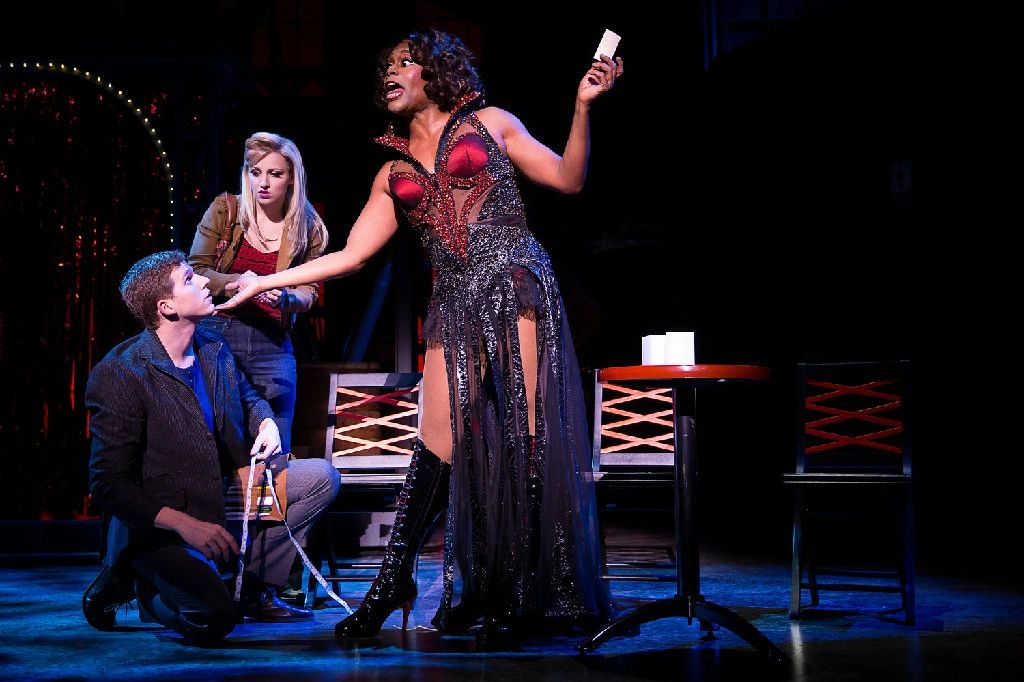 Stark Sands, Annaleigh Ashford, and Billy Porter
Kinky Boots is anything but. The new musical based on the 2005 British film is as comfortable as a pair of old slippers and not the dangerous kind of footwear the title suggests. Its plot and theme are becoming old hat—sorry to mix clothing metaphors—on Broadway these days. The young hero attempts to save a reliable but crumbling institution (the family shoe factory in the north of England) by introducing a radical new product (fabulous hip-high boots designed for male cross-dressers) with the aid of an outrageously self-reliant outsider (a drag performer named Lola). It’s sort of a cross between La Cage Aux Folles and Billy Elliot with a bit of Sister Act and The Full Monty thrown in for good measure.
But with pros like director-choreographer Jerry Mitchell, book-writer Harvey Fierstein, and pop icon Cyndi Lauper who is making her theatrical debut as a songwriter, on the creative team, these Boots are made for walkin’ and that’s just what they do. Fierstein’s book features the same uplifting-spirits and be-who-you-are tropes he inserted in La Cage and Newsies, but the characters are believable and deeply drawn. Even the belligerent factory homophobe changes his tune and does some growing up. Naturally, there is a crisis just before the big event, which will solve everyone’s problems (in this case, a shoe fashion show in Milan), the diva sings a power ballad of self-acceptance and love, and a big hand-clapping finale provides a happy resolution for all. Despite the predictability of the plot, Mitchell’s inventive moves and slick staging make it fun getting to the inevitable conclusion. Not surprisingly, the most exciting numbers feature a sextette of gorgeous dragsters, kicking and slinking around the stage in eye-popping frocks by designer Gregg Barnes.
Lauper’s score borrows a bit heavily from the 1980s vibe of her smash Top 40 hits (one song is too reminiscent of Vickie Sue Robinson’s “Turn the Beat Around” for comfort) and her lyrics won’t be keeping Stephen Sondheim up at night. “Kitsch” and “bitch” are the most memorable rhymes. Still, as skillfully orchestrated by Stephen Oremus, they are infectious, fun, and expressive.
Broadway veteran Billy Porter, who has starred in replacement companies of Miss Saigon and Dreamgirls, finally gets to originate a sockeroo role in Lola. Yes, we have seen divine drag artists in the three productions of La Cage as well as Priscilla, Queen of the Desert, but Porter gives this one his own stamp. He caresses each syllable, stretching out the word to sound like “shex,” and commanding the stage with dazzling charisma. We also see the shy male inside the fierce female when Porter steps out of drag into a vest, shirt, and pants as Simon, Lola’s masculine alter ego. Stark Sands has the more difficult challenge of playing Charlie, the nebbishy factory owner, opposite the glittering Porter. He manages to enliven Charlie’s struggle to find his own passion. When the two discover their common insecurities in “I’m Not My Father’s Son,” it’s a heart-stopping moment. Annaleigh Ashford integrates endlessly fresh comic bits into the obligatory love interest role, and Daniel Stewart Sherman is suitably gruff as the bullying Dan.
Kinky Boots may not be as dazzling as the footwear on the show’s drag queens, but it’s certainly well-constructed, holds up under pressure, and will give you an entertaining two-and-a-half-hour walk.
Al Hirschfeld Theatre
Reviewed by David Sheward
 Stark Sands, Annaleigh Ashford, and Billy Porter
Photo by Matthew Murphy
Kinky Boots is anything but. The new musical based on the 2005 British film is as comfortable as a pair of old slippers and not the dangerous kind of footwear the title suggests. Its plot and theme are becoming old hat—sorry to mix clothing metaphors—on Broadway these days. The young hero attempts to save a reliable but crumbling institution (the family shoe factory in the north of England) by introducing a radical new product (fabulous hip-high boots designed for male cross-dressers) with the aid of an outrageously self-reliant outsider (a drag performer named Lola). It’s sort of a cross between La Cage Aux Folles and Billy Elliot with a bit of Sister Act and The Full Monty thrown in for good measure.
But with pros like director-choreographer Jerry Mitchell, book-writer Harvey Fierstein, and pop icon Cyndi Lauper who is making her theatrical debut as a songwriter, on the creative team, these Boots are made for walkin’ and that’s just what they do. Fierstein’s book features the same uplifting-spirits and be-who-you-are tropes he inserted in La Cage and Newsies, but the characters are believable and deeply drawn. Even the belligerent factory homophobe changes his tune and does some growing up. Naturally, there is a crisis just before the big event, which will solve everyone’s problems (in this case, a shoe fashion show in Milan), the diva sings a power ballad of self-acceptance and love, and a big hand-clapping finale provides a happy resolution for all. Despite the predictability of the plot, Mitchell’s inventive moves and slick staging make it fun getting to the inevitable conclusion. Not surprisingly, the most exciting numbers feature a sextette of gorgeous dragsters, kicking and slinking around the stage in eye-popping frocks by designer Gregg Barnes.
Lauper’s score borrows a bit heavily from the 1980s vibe of her smash Top 40 hits (one song is too reminiscent of Vickie Sue Robinson’s “Turn the Beat Around” for comfort) and her lyrics won’t be keeping Stephen Sondheim up at night. “Kitsch” and “bitch” are the most memorable rhymes. Still, as skillfully orchestrated by Stephen Oremus, they are infectious, fun, and expressive.
Broadway veteran Billy Porter, who has starred in replacement companies of Miss Saigon and Dreamgirls, finally gets to originate a sockeroo role in Lola. Yes, we have seen divine drag artists in the three productions of La Cage as well as Priscilla, Queen of the Desert, but Porter gives this one his own stamp. He caresses each syllable, stretching out the word to sound like “shex,” and commanding the stage with dazzling charisma. We also see the shy male inside the fierce female when Porter steps out of drag into a vest, shirt, and pants as Simon, Lola’s masculine alter ego. Stark Sands has the more difficult challenge of playing Charlie, the nebbishy factory owner, opposite the glittering Porter. He manages to enliven Charlie’s struggle to find his own passion. When the two discover their common insecurities in “I’m Not My Father’s Son,” it’s a heart-stopping moment. Annaleigh Ashford integrates endlessly fresh comic bits into the obligatory love interest role, and Daniel Stewart Sherman is suitably gruff as the bullying Dan.
Kinky Boots may not be as dazzling as the footwear on the show’s drag queens, but it’s certainly well-constructed, holds up under pressure, and will give you an entertaining two-and-a-half-hour walk.
April 6, 2013
Opened
April 4 for an open run. Al Hirschfeld Theatre, 302 W. 45th St., NYC.
Tue 7pm, Wed 2pm & 8pm, Thu 7pm, Fri 8pm, Sat 2pm & 8pm, Sun
3pm. Running time 2 hours and 20 minutes, including intermission.
$57–137. (800) 432-7250.
www.telecharge.com
www.telecharge.com
